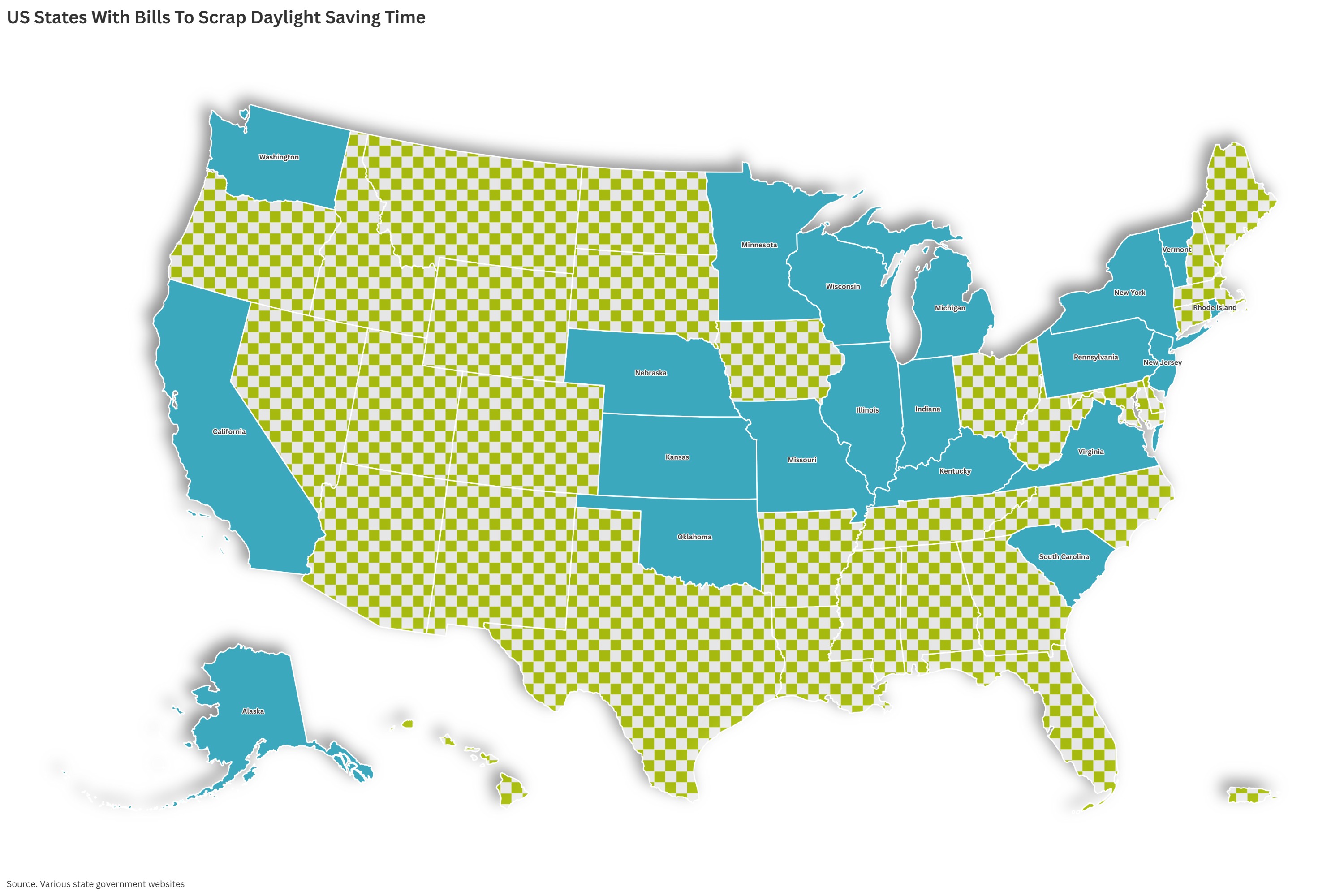
All the States With Bills To Scrap Daylight Saving Time—Mapped
Summary
Some U.S. states are considering changing the rules about daylight saving time, a system where clocks are adjusted to use more daylight. Over a dozen states want to stop changing clocks twice a year and move to a permanent standard time. The push to change these rules has been gaining attention recently, with different states introducing or debating new laws.Key Facts
- Daylight saving time (DST) involves setting clocks forward in spring and back in fall to gain more daylight.
- DST starts at 2 a.m. on the second Sunday in March and ends at 2 a.m. on the first Sunday in November.
- More than a dozen U.S. states are thinking about laws to stop changing clocks and stick with standard time.
- Hawaii, American territories, and most of Arizona don't follow DST rules.
- The Uniform Time Act of 1966 standardized this system in the U.S.
- Virginia passed a bill for year-round standard time, which depends on similar actions by Washington, D.C., and Maryland.
- Illinois and other states are considering similar changes, but they depend on neighboring states doing the same.
- Supporters of DST think it can help save energy, but there's debate about its actual impact.
Read the Full Article
This is a fact-based summary from The Actual News. Click below to read the complete story directly from the original source.