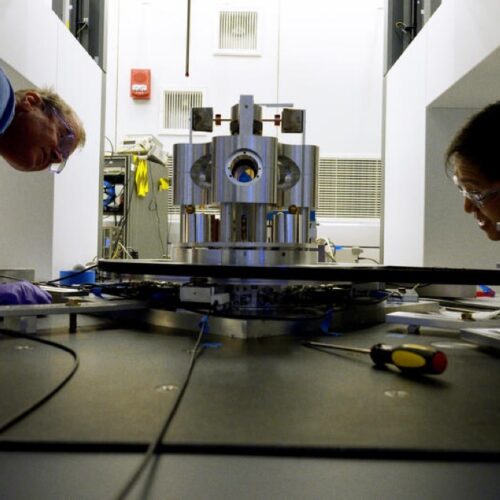
We still don't have a more precise value for "Big G"
Summary
Scientists have been trying for over 200 years to measure the gravitational constant, called "Big G," more precisely. Recent work by the National Institute of Standards and Technology (NIST) repeated an earlier experiment but still found differences in measurements, showing the challenge of accurately determining this weak force.Key Facts
- "Big G" measures how strong gravity is between two masses.
- Its value is less precisely known compared to other fundamental constants.
- Gravity is the weakest of the four fundamental forces, making measurements difficult.
- The Earth’s own gravity creates background noise that interferes with experiments.
- Henry Cavendish made the first laboratory measurement of gravity in 1798 using a torsion balance.
- NIST spent ten years replicating a 2007 French experiment to check its results.
- Their new data adds information but does not resolve the discrepancies.
- Scientists continue to develop better experiments to precisely measure Big G.
Read the Full Article
This is a fact-based summary from The Actual News. Click below to read the complete story directly from the original source.