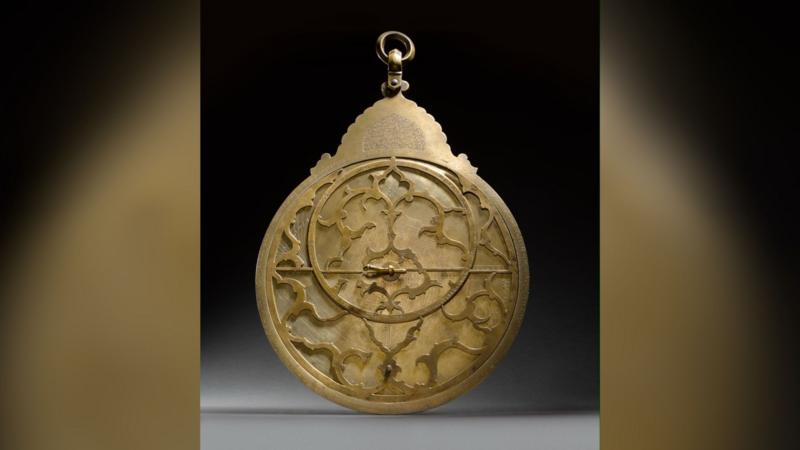
A 17th Century 'supercomputer' once owned by Indian royalty heads for auction
Summary
A large, detailed brass astrolabe from the 17th Century, once owned by Indian royalty, will be auctioned at Sotheby's in London on April 29. This scientific instrument was used to tell time, map stars, and perform calculations and was made in Lahore for a Mughal nobleman.Key Facts
- The astrolabe dates back to the early 1600s and was created in Lahore, now in Pakistan.
- It was made by two brothers, Qa'im Muhammad and Muhammad Muqim, known for their skilled craftsmanship.
- The instrument weighed 8.2 kg, measured nearly 30 cm wide, and was about 46 cm tall, much larger than typical astrolabes from that time.
- It originally belonged to a Mughal nobleman, Aqa Afzal, who managed Lahore and served under emperors Jahangir and Shah Jahan.
- The astrolabe was part of the royal collection of Jaipur, later owned by Maharaja Sawai Man Singh II, and then his wife Maharani Gayatri Devi.
- It features inscriptions of 94 cities with their coordinates and 38 star pointers with names in Persian and Sanskrit.
- Astrolabes were “hand-held astronomical computers” used to tell time, find directions like Mecca, and predict events.
- The craftsmanship combined technical accuracy with artistic design, reflecting the high skill of the Lahore School makers.
Read the Full Article
This is a fact-based summary from The Actual News. Click below to read the complete story directly from the original source.