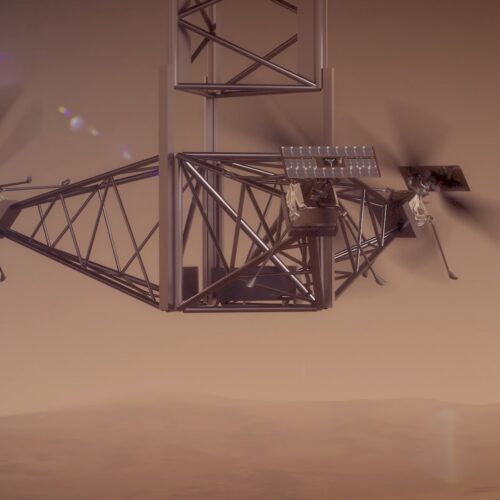
Engineers at NASA's Jet Propulsion Lab make a breakthrough in rotor technology
Summary
NASA engineers at the Jet Propulsion Laboratory have developed new rotor blades that can spin faster than the speed of sound for Mars helicopters. This breakthrough will allow the next-generation helicopters to carry heavier loads and fly longer distances in Mars’ thin atmosphere.Key Facts
- NASA’s Ingenuity Mars helicopter completed 72 flights, far exceeding its original 5-flight goal.
- Ingenuity weighed about 4 pounds and had rotors spinning at up to 2,700 rpm without reaching supersonic speeds.
- New Mars helicopters in the SkyFall mission will be larger, heavier, and use bigger rotor blades.
- Mars has a very thin atmosphere, about 1% the density of Earth’s air, requiring helicopter rotors to spin very fast to lift off.
- Engineers tested new rotors spinning above Mach 1 (faster than sound) safely in a lab simulating Mars’ atmosphere.
- The rotor tips reached up to Mach 1.08, a first for Mars rotorcraft technology.
- NASA plans to launch the SkyFall mission with three new helicopters as early as 2028, using a nuclear-powered spacecraft called Space Reactor-1 (SR-1).
- Innovations include a new way for helicopters to land by protecting themselves inside a heat shield as they enter the Mars atmosphere.
Read the Full Article
This is a fact-based summary from The Actual News. Click below to read the complete story directly from the original source.