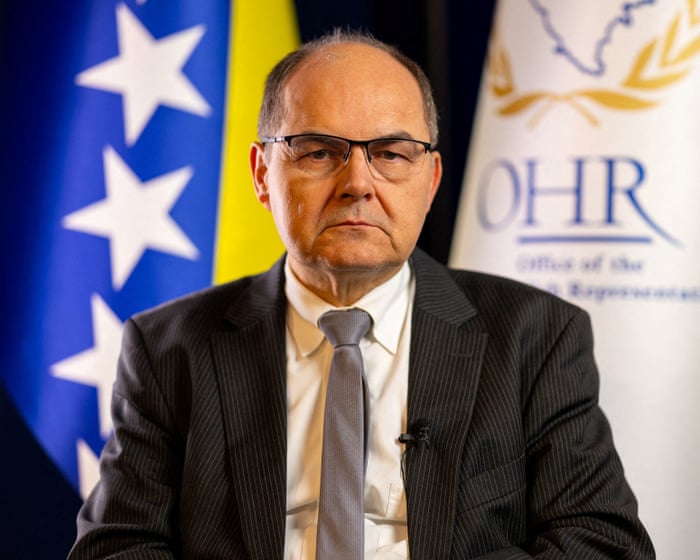
Bosnia and Herzegovina left vulnerable by policy clash with US, representative says
Summary
The UN high representative for Bosnia and Herzegovina, Christian Schmidt, has resigned after a policy disagreement with the United States, raising concerns about the stability of the country. His resignation is linked to tensions involving the largely Serb-run Republika Srpska entity and possible commercial interests connected to a U.S. firm linked to Donald Trump Jr.Key Facts
- Christian Schmidt, Germany’s Christian Democrat politician, served as the UN high representative for Bosnia and Herzegovina for five years.
- The position was created by the 1995 Dayton peace agreement to help maintain peace after a war that killed over 100,000 people.
- Schmidt clashed with Milorad Dodik, the pro-Russia Serb leader of Republika Srpska, who has secessionist goals and whose sanctions were recently lifted by the U.S.
- Dodik welcomed Schmidt’s resignation and said Schmidt had no backing from the UN security council or international law.
- Bosnia and Herzegovina is made up of two entities: the Federation of Bosnia and Herzegovina (mostly Bosniaks and Croats) and Republika Srpska (mostly Serbs).
- A U.S.-based company linked to Donald Trump Jr. won a $1.5 billion contract to build a pipeline for U.S. liquified natural gas to Bosnia, adding a commercial dimension to the political tensions.
- The EU opposes ending the UN high representative role, while the U.S. may try to change or remove it.
- German Chancellor Friedrich Merz has been unable to protect Schmidt from pressure by the U.S.
Read the Full Article
This is a fact-based summary from The Actual News. Click below to read the complete story directly from the original source.