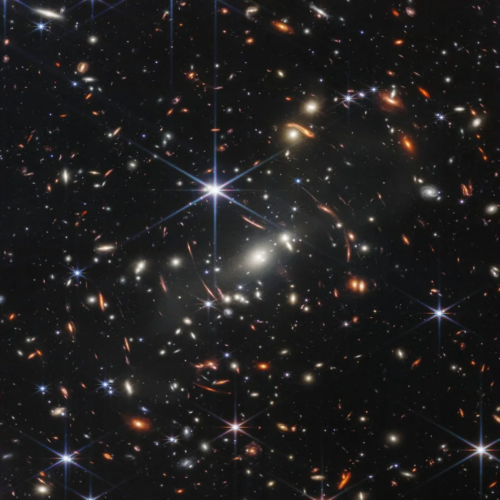
Gravitational lens shows a galaxy just 800 million years post-Big Bang
Summary
Astronomers used the James Webb Space Telescope and a natural effect called gravitational lensing to observe a very faint galaxy named LAP1-B, which existed about 800 million years after the Big Bang. This galaxy is the most chemically primitive ever seen, with almost no heavy elements, revealing clues about the universe's earliest stars.Key Facts
- LAP1-B is about 13 billion light-years away from Earth.
- Gravitational lensing by a galaxy cluster called MACS J046 magnified LAP1-B’s light by 100 times.
- Even with this magnification, LAP1-B's stars are very faint, with a total mass equal to about 3,300 Suns.
- The glow seen is mainly from gas excited by radiation from massive stars in LAP1-B.
- The gas has very low amounts of oxygen, only 0.4% of the Sun's oxygen level.
- Scientists detected strong ultraviolet radiation that suggests very hot, early stars not seen nearby today.
- These early stars, called Population III stars, were made only of hydrogen and helium created in the Big Bang.
- This discovery helps astronomers understand the first generation of stars and the formation of early galaxies.
Read the Full Article
This is a fact-based summary from The Actual News. Click below to read the complete story directly from the original source.