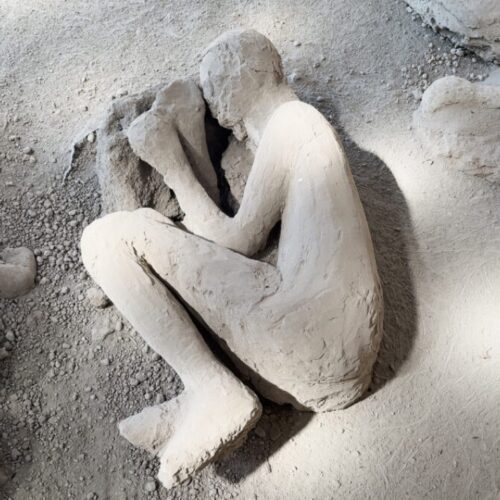
Pompeii victim ID'd as a likely doctor
Summary
Archaeologists have identified one of the victims of the 79 CE eruption of Mount Vesuvius in Pompeii as likely being a Roman doctor. This identification was made by using CT scans and 3D digital technology to examine a plaster cast of a victim, revealing a small metal case containing tools and coins that a Roman doctor might have carried.Key Facts
- Mount Vesuvius erupted in 79 CE, destroying Pompeii and Herculaneum with extreme heat and ash.
- Most victims died from choking on gas and ash, but some died instantly from the heat.
- Giuseppe Fiorelli developed a technique in the 19th century to make plaster casts of victims’ body shapes.
- About 1,000 bodies have been found, with 104 plaster casts preserved.
- Recent CT scans revealed adjustments made to casts over time, including missing bones.
- DNA tests in 2024 showed four males found in one house were unrelated, challenging previous ideas.
- One plaster cast in the Garden of the Fugitives had a small metal case with a toothed lock and doctor’s tools.
- The presence of medical instruments led researchers to conclude the victim was likely a Roman doctor fleeing the eruption.
Read the Full Article
This is a fact-based summary from The Actual News. Click below to read the complete story directly from the original source.