"Little red dot" in early Universe is a naked supermassive black hole
Summary
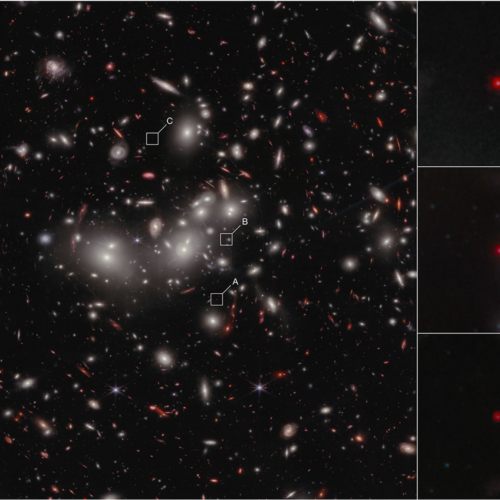
Astronomers using the James Webb Space Telescope have studied a “little red dot” called Abell 2744−QSO1, which is a supermassive black hole from the early Universe about 700 million years after the Big Bang. This black hole appears to have very few stars or a galaxy around it and is one of the earliest known supermassive black holes.Key Facts
- The James Webb Space Telescope was designed to observe light from early stars in the Universe.
- “Little red dots” are early versions of supermassive black holes found by the telescope.
- Abell 2744−QSO1 is a black hole seen as it was 700 million years after the Big Bang.
- It appears three times near a galaxy cluster due to gravitational lensing, which magnifies distant objects.
- The black hole’s mass is roughly 50 million times that of the Sun.
- The area around it has mostly hydrogen gas and very few stars.
- Models show the black hole is a massive point source with material rotating around it, not a star cluster.
- This discovery helps scientists understand how early black holes grew and their relation to galaxies.
Read the Full Article
This is a fact-based summary from The Actual News. Click below to read the complete story directly from the original source.