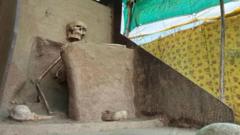
Ancient Indian skeleton gets a museum home six years after excavation
Summary
A 1,000-year-old skeleton buried in a sitting position in India was moved to a museum after being left unprotected for six years. The skeleton, discovered in Gujarat state, will be displayed to the public once formalities are completed and experts decide its placement.Key Facts
- The skeleton is about 1,000 years old and was found sitting cross-legged.
- It was initially left uncovered in a tarpaulin shelter near the excavation site in Gujarat since 2019 due to bureaucratic delays.
- Recently, the skeleton was moved to the Archaeological Experiential Museum in Vadnagar.
- It will be displayed publicly after necessary administrative processes are completed.
- Experts from the Archaeological Survey of India will examine the skeleton to determine how it should be displayed.
- The skeleton likely dates back to the Solanki period, a historical dynasty in Gujarat from 940 to 1300 CE.
- Its preservation was possible due to undisturbed soil conditions.
- The remains may provide insights into "samadhi burials," an ancient Hindu burial practice.
Read the Full Article
This is a fact-based summary from The Actual News. Click below to read the complete story directly from the original source.