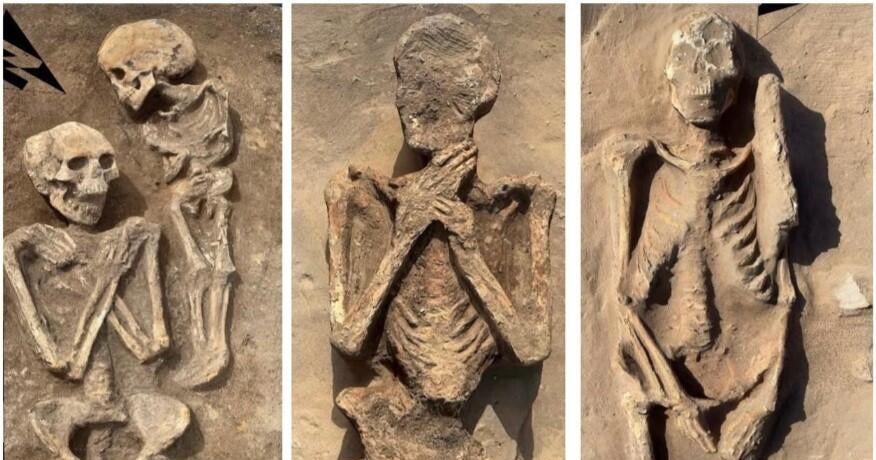
Ancient Egyptian burial site reveals centuries of changing traditions
Summary
Egyptian archaeologists found ancient burial remains and artifacts at Tell Kom Aziza in Egypt’s Nile Delta. The site shows how burial traditions changed over about 600 years, starting around 332 B.C. and continuing until about 395 A.D., and how a settlement became a cemetery over time.Key Facts
- The site is a Greco-Roman cemetery in northern Egypt's Beheira province near the Mediterranean coast.
- Burials date from approximately 332 B.C. to 395 A.D. and show many different funerary practices.
- Burial types include simple pits, mudbrick-lined graves, and painted plaster coffins.
- Bodies were buried in various positions, such as arms crossed over the chest or extended alongside the body.
- Two complete wild boar skeletons were found, animals linked to the ancient Egyptian god Seth.
- Pottery pieces from both the Old Kingdom (about 2686-2181 B.C.) and the later Greco-Roman period were uncovered.
- Items like amphorae, bread molds, and burial jars indicate the site was used repeatedly over many centuries.
- Archaeologists continue to study the site to learn more about its history and the changing burial customs.
Read the Full Article
This is a fact-based summary from The Actual News. Click below to read the complete story directly from the original source.