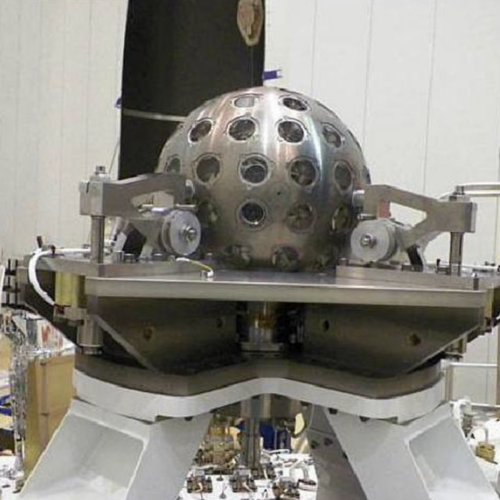
An orbiting disco ball gave Einstein’s theory its most precise test yet
Summary
Scientists have made the most accurate measurement yet of how Earth's rotation twists space and time, a phenomenon predicted by Einstein's theory of relativity called frame dragging. They used a heavy, small satellite called LARES-2, which looks like a disco ball, to track this effect by reflecting laser beams from the ground.Key Facts
- Frame dragging is a gravitational effect predicted by Einstein, where a rotating mass drags space and time around it.
- Measuring Earth's frame dragging is hard because Earth is much lighter and spins slower than black holes.
- The LARES-2 satellite is made of a dense metal alloy and is shaped like a solid sphere about 40 cm wide.
- LARES-2 has 303 special reflectors that send laser beams back exactly to their source.
- Scientists track LARES-2 with lasers from Earth to measure its orbit position within about 1 millimeter.
- The satellite was launched in July 2022 and orbits Earth at about 12,265 kilometers altitude.
- Using LARES-2 and another satellite in opposite orbits helps cancel out other forces caused by Earth's uneven shape.
- The new measurements reduce uncertainty of frame dragging to just 0.2 percent, improving on previous results.
Read the Full Article
This is a fact-based summary from The Actual News. Click below to read the complete story directly from the original source.