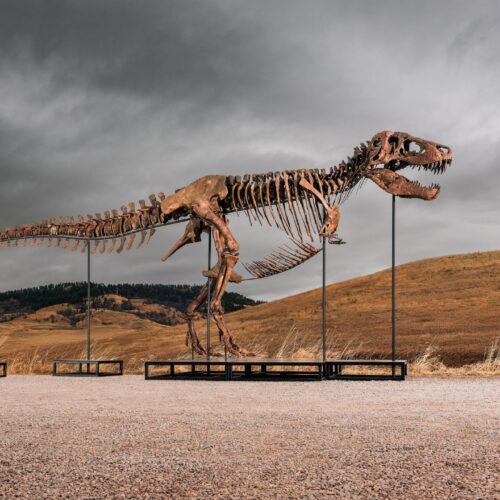
Sotheby's big T. rex auction raises concerns hype and wealth are upending science
Summary
Sotheby’s auctioned a rare T. rex fossil called Gus, expected to sell for up to $30 million. There is growing concern among scientists that wealthy private buyers purchasing dinosaur fossils at auctions may limit scientific study and public access.Key Facts
- Gus is a 67-million-year-old T. rex skeleton, about 61% complete with 183 fossil bones.
- The fossil was found in South Dakota and is mounted with a steel frame and replicas of missing bones.
- Sotheby’s expects the skeleton to sell for as much as $30 million.
- Private collectors have increasingly bought dinosaur fossils, which paleontologists worry will make fossils unavailable for research.
- In 1997, Sotheby’s sold Sue, the most complete T. rex, which went to a museum and sold for $8.4 million.
- Laws in the U.S. give landowners rights to fossils found on their property, encouraging private sales.
- Studies show more T. rex fossils are in private collections than in public institutions.
- Other fossils sold recently include a Stegosaurus for $44.6 million and a juvenile Ceratosaurus for $30.5 million, both to private buyers.
- Auction houses say sales protect fossils from damage and support professional excavation, but some scientists disagree.
Read the Full Article
This is a fact-based summary from The Actual News. Click below to read the complete story directly from the original source.