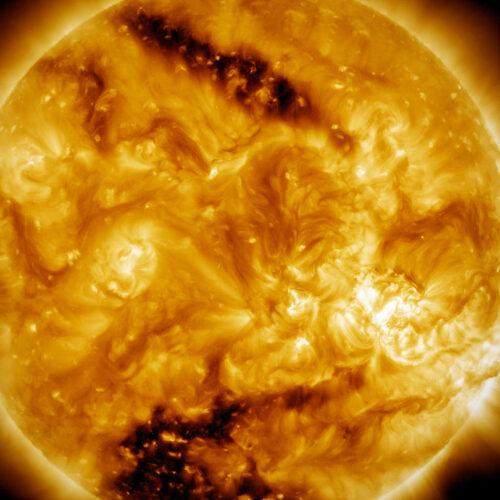
The world's biggest solar telescope caught vortexes on the Sun's surface
Summary
Scientists used the world’s largest solar telescope in Hawaii to capture clear images of swirling vortexes on the Sun’s surface. These vortex patterns, caused by a physical effect called the Kelvin-Helmholtz instability, were seen clearly for the first time and may change how we understand energy movement in the Sun’s atmosphere.Key Facts
- The Kelvin-Helmholtz instability occurs when two fluids (or plasmas) slide past each other at different speeds, forming swirling vortexes.
- Scientists suspected these vortexes existed on the Sun’s surface for decades but lacked the tools to see them.
- The Daniel K. Inouye Solar Telescope (DKIST), with a 4-meter mirror, is the largest solar telescope in the world and started operations in November 2021.
- On April 14, 2025, researchers recorded images of the Sun at a wavelength of 416 nanometers, near the blue edge of visible light.
- The telescope’s cameras captured 740 frames per second with very short exposures and combined multiple frames to get very sharp images.
- The observations achieved a spatial resolution of about 19 kilometers on the Sun’s surface.
- The data showed many vortex-shaped structures and magnetic field interactions, visible for the first time at this level of detail.
- These new observations may change scientists’ ideas about how heat, mass, and magnetic energy move in the Sun’s atmosphere.
Read the Full Article
This is a fact-based summary from The Actual News. Click below to read the complete story directly from the original source.