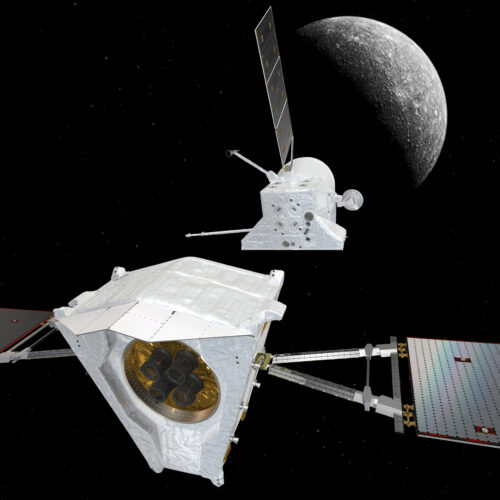
After 8 years, Europe's BepiColombo mission is on final approach to Mercury
Summary
The BepiColombo mission, led by the European Space Agency with help from Japan and the U.S., is nearing Mercury after eight years of travel. The spacecraft recently released its propulsion module and is preparing to enter orbit around Mercury later this year.Key Facts
- BepiColombo launched in 2018 to explore Mercury, the closest planet to the Sun.
- The mission costs nearly $2 billion and is led by Europe with Japanese and American contributions.
- The spacecraft used nine flybys of Earth, Venus, and Mercury to adjust its speed and direction.
- BepiColombo has the most powerful electric propulsion system ever used in deep space.
- It recently dropped the Mercury Transfer Module, which provided power and propulsion during the trip.
- BepiColombo consists of three parts: the Mercury Transfer Module, the European Mercury Planetary Orbiter, and the Japanese Mercury Magnetospheric Orbiter (Mio).
- The two orbiters will separate in December after arriving at Mercury and carry instruments to study the planet.
- The spacecraft faces extreme heat and solar radiation near Mercury, making its final steps risky and complex.
Read the Full Article
This is a fact-based summary from The Actual News. Click below to read the complete story directly from the original source.