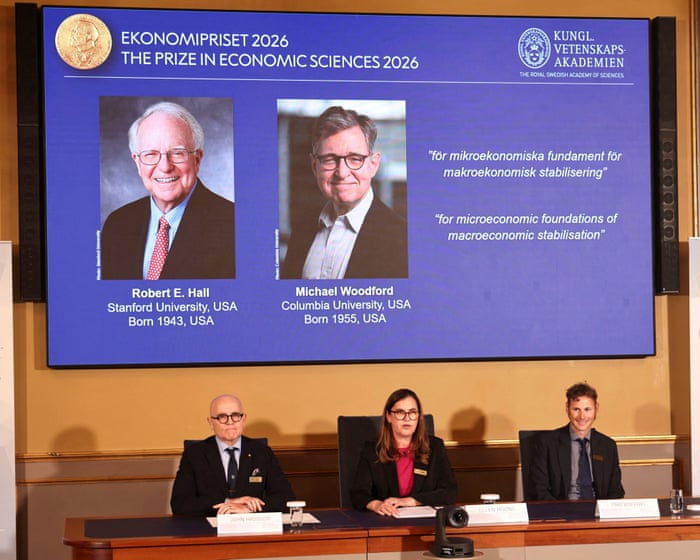
Nobel Prize for economics awarded to Hall and Woodford for work on ‘smoothing’ crises
Also reported by Al Jazeera
Summary
Two American economists, Robert Hall and Michael Woodford, won the 2026 Nobel Prize in Economics for creating new economic models that help governments and central banks manage economic ups and downs. Their work allows policymakers to better avoid long recessions and high inflation by understanding how households and businesses act in the economy.Key Facts
- Robert Hall is from Stanford University, and Michael Woodford is from Columbia University.
- They developed “microeconomic foundations of macroeconomic stabilization” models, improving policy tools.
- Their models are called New Keynesian models, updating and extending earlier ideas from economist John Maynard Keynes.
- These models became widely used after the 2008 financial crisis to guide economic policy and avoid another Great Depression.
- Their work supports the use of forward guidance, where central banks communicate future interest rate plans to influence economic behavior.
- Critics say forward guidance can sometimes cause confusion if predictions don’t match future actions.
- The Nobel Prize awarded to them is worth about $1.2 million combined.
- Hall is known for distinguishing economists into “fresh water” (free market-focused) and “salt water” (more government intervention) groups based on their school locations.
Read the Full Article
This is a fact-based summary from The Actual News. Click below to read the complete story directly from the original source.