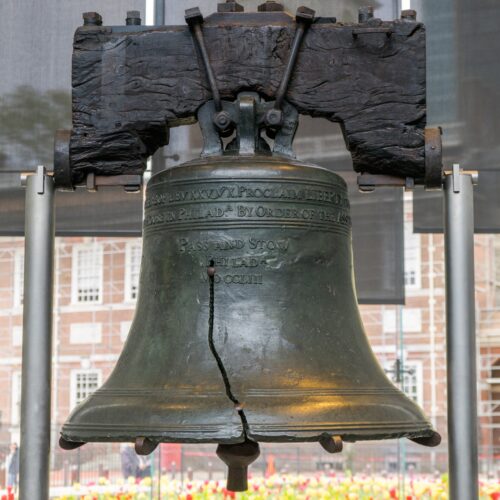
What did the Liberty Bell sound like? Science is on the case.
Summary
Scientists at Penn State have studied what the Liberty Bell might have sounded like before it cracked by analyzing one of its full-size replicas. They used a method called modal analysis to understand the bell’s vibration and sound, helping to recreate the specific notes and ringing characteristics.Key Facts
- The Liberty Bell has not been rung for 180 years because it developed a large crack.
- The crack grew in 1846 after an attempted repair and ringing the bell, making it unable to ring again.
- The bell first cracked in 1752 during testing and was recast twice to improve its sound.
- The metal alloy used for the Liberty Bell is very brittle, making it prone to cracking and chipping.
- Bell sound depends on its shape and the materials, which affect vibrations and pitch.
- Scientists used modal analysis, a technique to study vibration patterns and notes of bells, to model the sound.
- Western church bells are tuned to several specific frequencies, creating a minor triad sound, often perceived as somber.
- The Penn State team presented their research at an acoustics meeting and published a detailed article in Physics Today.
Read the Full Article
This is a fact-based summary from The Actual News. Click below to read the complete story directly from the original source.