European survey reveals 900m galaxies – and possibly secrets of ‘dark universe’
Summary
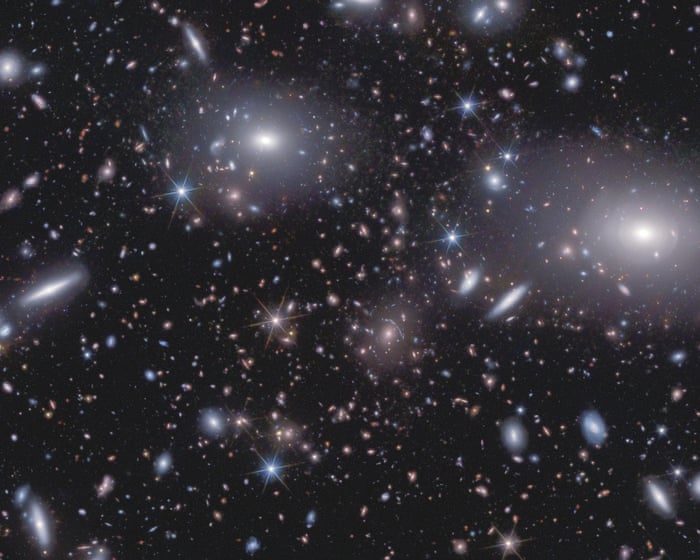
The European Space Agency’s Euclid mission has released its first major dataset, showing more than 900 million galaxies and over 60 million possible quasars. It also identifies about 15,000 probable cases of strong gravitational lensing, which researchers can study to learn how dark matter is distributed and test theories about its nature.Key Facts
- Euclid launched in July 2023 to map about a third of the sky and more than 10 billion years of cosmic history.
- The first major release covers about 14% of the sky area Euclid plans to map.
- The dataset includes more than 900 million galaxies and over 60 million potential quasars.
- Euclid identified about 15,000 probable cases of strong gravitational lensing; researchers had previously known of about 1,000.
- Strong gravitational lensing occurs when the gravity of a foreground galaxy bends and magnifies light from a more distant galaxy.
- Researchers say lensing patterns can reveal how dark matter is distributed and help distinguish theories about its properties.
- The mission is expected to find about 170,000 strong gravitational lensing cases by its end.
- A further data release is expected next summer and is due to include results on galaxy distribution and weak gravitational lensing.
Read the Full Article
This is a fact-based summary from The Actual News. Click below to read the complete story directly from the original source.