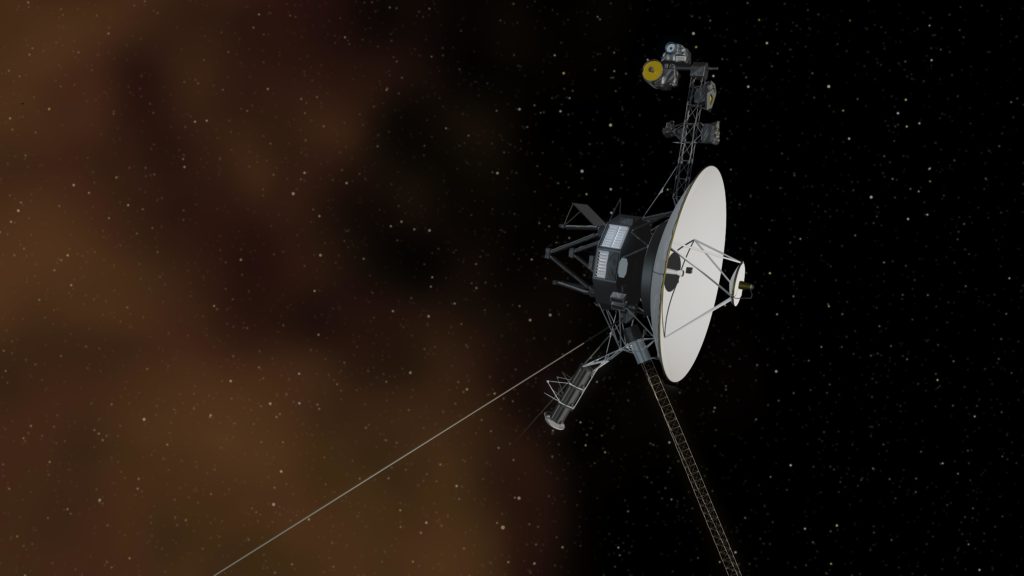
Voyager 1 is now a light-day from Earth. Here's what to know about NASA's longest-running mission
Also reported by CBS News
Summary
NASA’s Voyager 1 became the first human-made object to travel one light-day from Earth, a distance of about 16 billion miles. Launched in 1977, it continues to send scientific data from interstellar space, though radio signals now take a day to travel between the spacecraft and Earth.Key Facts
- Voyager 1 and Voyager 2 launched in 1977 to study the solar system’s giant planets and their moons.
- A planetary alignment let the spacecraft use the planets’ gravity to travel while conserving fuel.
- The probes returned images and discoveries about the outer planets, including evidence that Jupiter’s Great Red Spot is a giant storm.
- Voyager 1 took the Pale Blue Dot image of Earth in 1990 before its cameras were turned off.
- Voyager 1 crossed the heliopause in 2012, entering interstellar space.
- Voyager 2 crossed the heliopause in 2018.
- Voyager 1 travels at more than 37,000 miles per hour and communicates with Earth through NASA’s Deep Space Network.
- At one light-day away, radio signals take about a day to travel from Earth to Voyager 1 and about a day to return.
Read the Full Article
This is a fact-based summary from The Actual News. Click below to read the complete story directly from the original source.