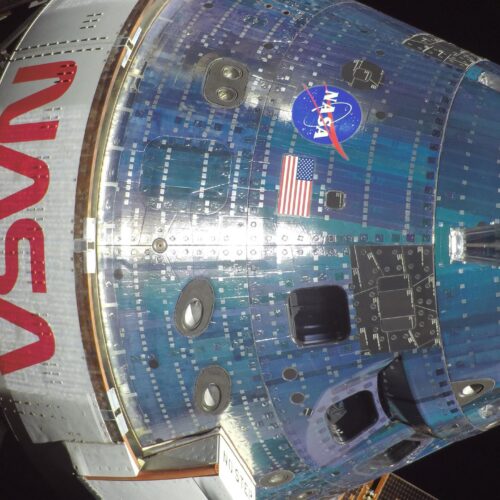
NASA's new Moon plans have a problem: Orion wasn't designed to fly this way
Summary
NASA’s revised Artemis plans require Orion to fly and operate in ways its original design did not anticipate. Engineers are modifying the spacecraft and assessing risks from unusual acceleration, heat, and orbital debris before the changed missions proceed.Key Facts
- SpaceX’s Starship plan calls for the lander to dock with Orion in Earth orbit before the spacecraft travel toward the Moon together.
- Orion must fly with its service module positioned at the top of the stack for the Starship mission, reversing its expected orientation.
- The European Space Agency and Airbus are modifying Orion service-module propellant tanks so fuel behaves safely in the changed orientation.
- NASA and Lockheed Martin are assessing whether Orion’s structure can withstand acceleration of about 0.8 to 1 g in the opposite direction from its original design assumptions.
- NASA plans a low-Earth-orbit mission to test Orion’s interactions with the lunar landers before astronauts land on the Moon.
- Orion’s design for deep space raises heating concerns during a roughly two-week stay in low-Earth orbit; engineers plan to remove some exterior thermal tape and manage electrical loads.
- NASA and Lockheed Martin are assessing the greater orbital-debris risk in low-Earth orbit, with that assessment expected by January.
Read the Full Article
This is a fact-based summary from The Actual News. Click below to read the complete story directly from the original source.