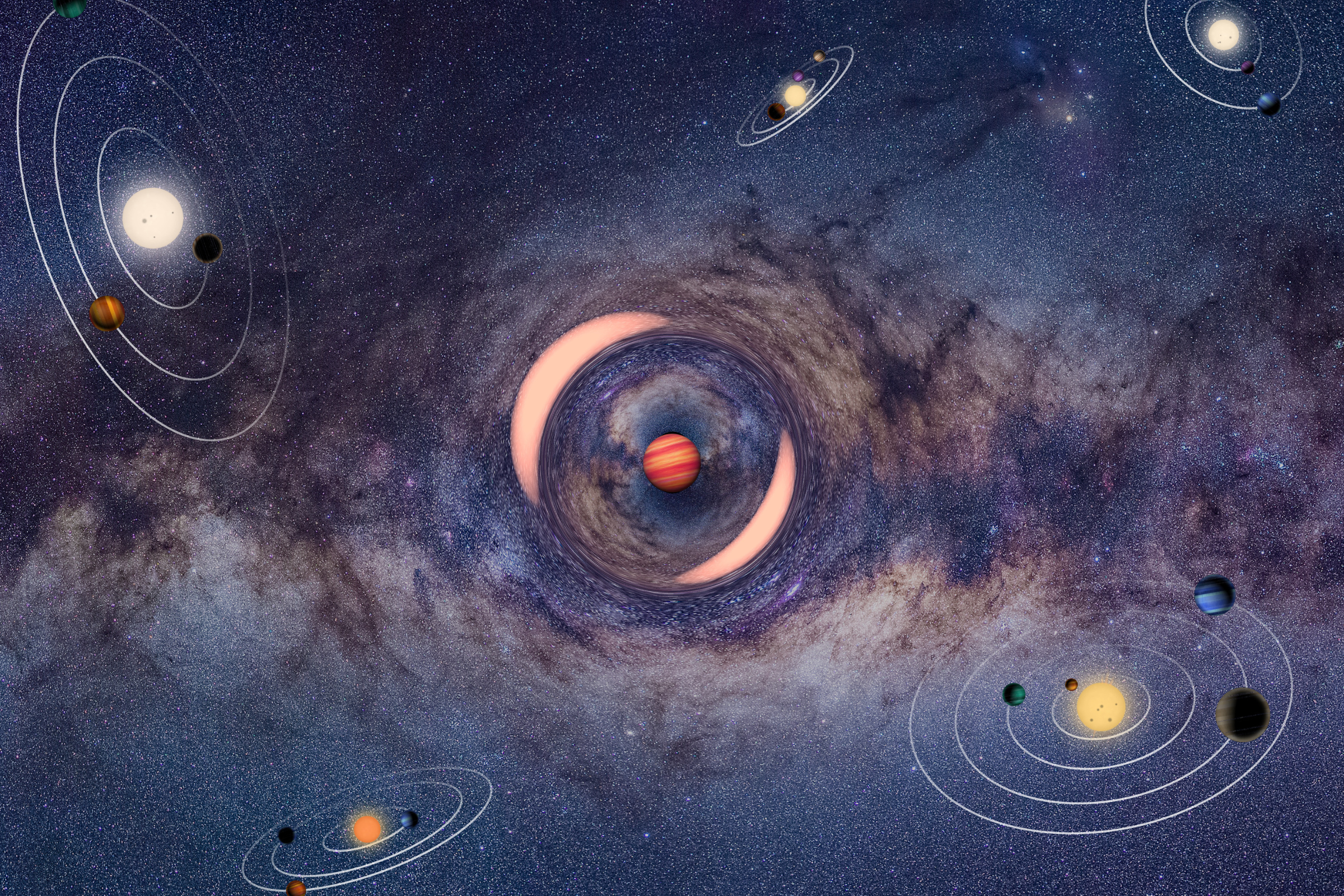
Astronomers Discover Rare 'Free-Floating' Rogue Planet
Summary
Astronomers have found a rogue planet, similar in mass to Saturn, using a method called microlensing, which detects its gravitational effects on light. By observing this planet from Earth and space, researchers could measure its mass and distance from Earth. This discovery gives more information on how planets that do not orbit stars might form and move through space.Key Facts
- A rogue planet, about the same mass as Saturn, was detected using microlensing.
- Microlensing observes gravitational effects on the light from distant stars.
- The rogue planet is roughly 3,000 parsecs from the Milky Way's center.
- This planet is about 22% the mass of Jupiter.
- Measurements were made using ground surveys and the Gaia space telescope.
- Rogue planets may form in planetary systems and be ejected through gravitational disturbances.
- The NASA Nancy Grace Roman Space Telescope, launching in 2027, may help find more such planets.
Read the Full Article
This is a fact-based summary from The Actual News. Click below to read the complete story directly from the original source.