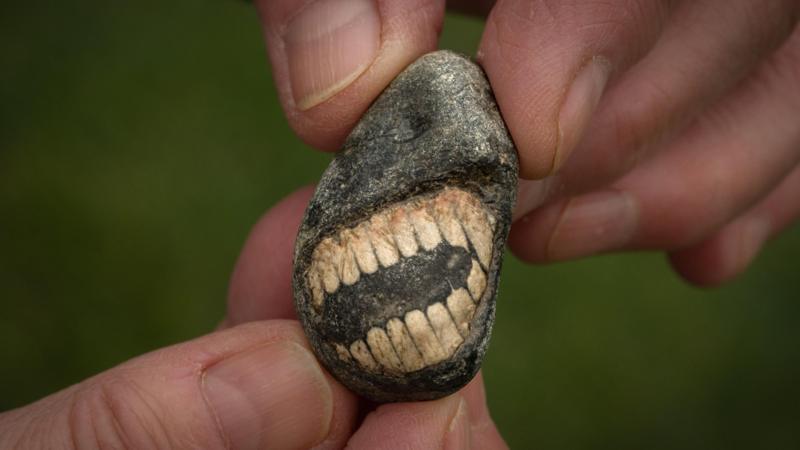
Mystery origins of 'smiling' fossil revealed
Summary
Christine Clark found an unusual fossil during a walk on Holy Island in Northumberland. Experts confirmed it was a part of an ancient marine creature called a crinoid, known for its distinctive stem and “sea lily” appearance. Crinoid fossils are common in the area, but such large and complete specimens are rare.Key Facts
- The fossil was found by Christine Clark on Holy Island, Northumberland.
- Christine initially thought the fossil looked like fake teeth.
- Experts identified it as a larger part of a crinoid, an ancient marine animal.
- Crinoids first appeared over 500 million years ago and resemble "sea lilies."
- This fossil is thought to be from a rock formation about 350 million years old.
- Complete crinoid fossils are rare; smaller parts called ossicles are more common.
- Crinoid fossils are among the most frequently found in the Northumberland area.
Read the Full Article
This is a fact-based summary from The Actual News. Click below to read the complete story directly from the original source.