The article reviews the history of official World Cup video games, highlighting many early games that had poor graphics, controls, or overall quality. Since 1998, Electronic Arts (EA) has produced more popular and enjoyable World Cup games, incorporating real teams, players, and some unique tournament features.
Key Facts
Early World Cup video games, like "World Cup Carnival" (1986) and "World Cup Italia ’90" (1990), were criticized for bad controls and poor design.
The first official FIFA World Cup game was released in 1986 by US Gold but was a commercial and critical failure.
Sega’s 1990 World Cup game had limited view of the field and bad music.
The 1994 US World Cup game had better versions on some consoles but poor versions on home computers.
From 1998 onward, EA Sports created World Cup games using its FIFA engine with real teams and stadiums, which were more successful.
Features like tournament anthems and sound effects, such as the vuvuzela horn in 2010, added unique World Cup atmosphere to games.
Video games struggle to capture iconic moments from the tournament because many become famous only after the events take place.
Some EA FIFA World Cup games include modes that let players relive important past World Cup moments.
Read the Original
Want the full story? Tap a source to open the original
article.
Tech stocks fell again as investors worry that spending on artificial intelligence (AI) might not bring big returns in the future. This has caused people to sell tech shares, affecting the stock market worldwide.
Key Facts
Tech stocks dropped in value recently.
Investors are unsure if AI investments will be profitable over time.
The selling of tech stocks is part of a wider market reaction.
The situation reflects concerns about long-term gains from AI.
Yahoo Finance reported and explained this market trend.
CBS News covered the story with additional details.
Read the Original
Want the full story? Tap a source to open the original
article.
Meta paused a program that tracked employee computer use to gather data for training artificial intelligence (AI) after privacy concerns and employee protests. The company is investigating potential data access issues and has stopped the program while reviewing the situation.
Key Facts
Meta created a tool called the Model Capability Initiative (MCI) to track employees’ keystrokes, mouse clicks, and screen content for AI training.
Over 1,600 Meta employees signed a petition opposing the data collection, citing privacy and consent worries.
Reports said MCI data was accessible internally to many employees and included private conversations and performance data.
Meta confirmed it has paused the program and is investigating possible data exposure but found no evidence of improper access so far.
CEO Mark Zuckerberg explained that AI models improve by learning from skilled Meta employees’ work.
Meta is heavily investing in AI, with up to $145 billion in spending this year, including on data centers.
Separately, Meta is developing a new app codenamed Arena, similar to prediction market platforms, which allow betting on various events.
The new prediction market app is still in early development and has not been publicly released.
Read the Original
Want the full story? Tap a source to open the original
article.
Grand Theft Auto 6 (GTA 6), a new game by Rockstar Games, will cost $79.99 for the standard edition and $99.99 for the Ultimate Edition. The game will release on November 19 for PlayStation 5 and Xbox Series X and S, and physical copies will come with a digital download code instead of a disc.
Key Facts
GTA 6 standard edition price is $79.99; Ultimate Edition costs $99.99.
The game launches on November 19, 2024, on PlayStation 5 and Xbox Series X and S.
Physical versions will include a download code inside a box, no game disc included.
Pre-orders open June 25 at midnight local time, with digital pre-loading starting November 12.
The Ultimate Edition includes extra vehicles, weapons, and character outfits.
This is the first GTA game with a playable female main character, named Lucia, alongside a male partner.
The game’s release was delayed due to a hacking incident and other issues.
Rockstar has faced staff tensions related to unionization efforts.
Read the Original
Want the full story? Tap a source to open the original
article.
The Euclid space telescope has taken the largest and most detailed photo of the center of the Milky Way galaxy, showing 60 million stars. This photo will help scientists study known planets outside our Solar System and find new details about them using a method called microlensing.
Key Facts
The photo shows the bright, crowded center of the Milky Way, called the bulge, which contains billions of stars.
Euclid is a space telescope launched in 2023 to study one-third of the sky and understand dark matter and dark energy.
The telescope captured the image from a point about 930,000 miles from Earth using a visible light camera over 26 hours in March 2025.
The black-and-white image was colorized using data from the Canada-France-Hawaii Telescope in Hawaii.
Microlensing occurs when the gravity of a closer star bends and brightens the light of a background star, allowing scientists to detect planets orbiting the closer star.
Euclid's image includes 51 known planetary systems and will help study many more planets found in the future.
Euclid is stationed about a million miles from Earth beyond the moon and will observe galaxies and galaxy clusters up to 10 billion years old during its six-year mission.
The telescope has previously captured detailed photos of distant galaxy clusters, helping scientists learn more about the universe.
Read the Original
Want the full story? Tap a source to open the original
article.
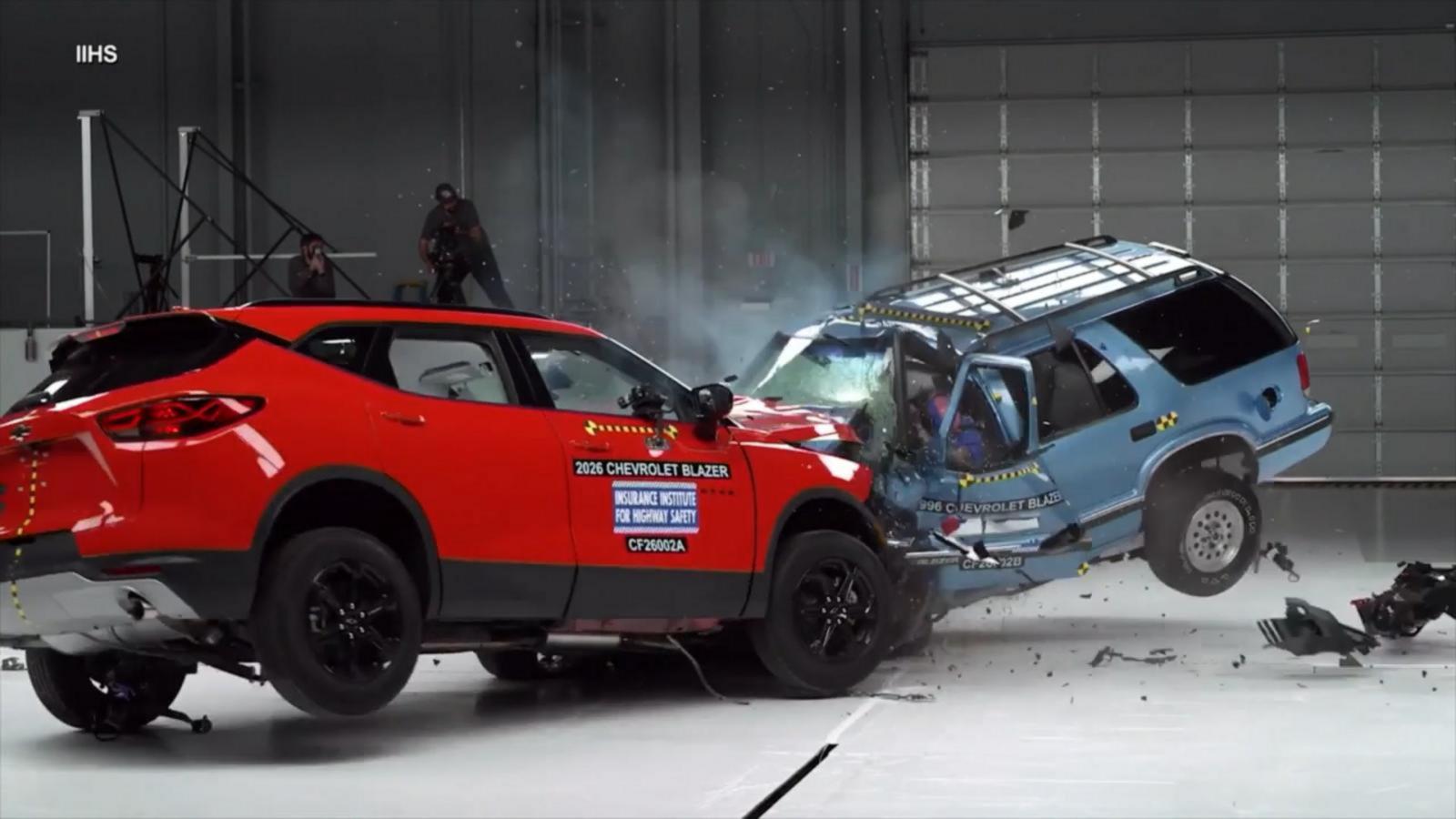
The Insurance Institute for Highway Safety released a video comparing crash tests between a 2026 Chevy Blazer and the same model from 1996. The test shows how car safety has improved over 30 years.
Key Facts
A crash test video was released by the Insurance Institute for Highway Safety.
It compares a 2026 Chevy Blazer with a 1996 Chevy Blazer.
The test demonstrates improvements in vehicle safety features.
The newer model offers better protection in crashes.
This comparison highlights advances in car design and safety technology over three decades.
Read the Original
Want the full story? Tap a source to open the original
article.
A German court decided that Google is responsible for the summaries created by its AI in search results. This ruling marks a change in how companies are legally seen when their AI changes or rewrites information from other sources.
Key Facts
The court rejected Google’s argument that users should check AI summaries themselves or generally know AI may be unreliable.
Traditionally, phone companies are "carriers" that pass along information without responsibility, while publishers choose content and are liable for it.
Internet companies have tried to act as both carriers and publishers, with Section 230 of U.S. law protecting them from liability for user speech.
AI-generated summaries differ from usual search results because they rewrite content and make editorial choices, similar to a publisher.
Other companies using AI chatbots, like Air Canada, have been held liable for their bots’ statements in court.
Legal experts argue that companies should be responsible for the actions and content generated by their AI systems.
This ruling may influence how laws apply to AI tools in various industries where accuracy is important.
Read the Original
Want the full story? Tap a source to open the original
article.
President Donald Trump is thinking about a plan for the U.S. government to own parts of top artificial intelligence (AI) companies. This idea aims to give the American public a share in these companies and their benefits.
Key Facts
President Trump is exploring ways for the U.S. government to take ownership stakes in leading AI firms.
The plan involves giving parts of these companies to the American people.
The goal is for the public to share in the profits and growth of AI technology.
This approach is unusual because it aligns the president with some critics who want more government involvement in tech.
The president mentioned these ideas publicly earlier this month.
The proposal could affect how AI companies are managed and how their gains are distributed.
It focuses on balancing private innovation with public benefit in AI development.
Read the Original
Want the full story? Tap a source to open the original
article.
Chamath Palihapitiya, an investor in AI, said that worries about AI causing massive job loss are not based on how technology has worked before. He explained that technology changes jobs but does not make people unneeded, and humans will still be needed to run businesses and provide basic needs.
Key Facts
Chamath Palihapitiya is the CEO of Social Capital and a co-host of the All-In podcast.
He disagrees with the idea that AI and robots will eliminate all jobs, including manual ones like plumbing.
Palihapitiya believes humans will still need to manage businesses and daily life needs, like housing and food.
He says new technology usually leads to people doing more types of tasks, not fewer.
MIT researchers also say AI will raise overall job opportunities rather than destroy them.
OpenAI’s CEO Sam Altman admitted earlier predictions about AI wiping out many jobs were wrong.
The article highlights concerns about future job stability for younger generations but Palihapitiya thinks this fear is exaggerated.
He suggests AI will change jobs and create new ways to spend time, rather than end work entirely.
Read the Original
Want the full story? Tap a source to open the original
article.
Amazon Prime Day 2026 runs from June 23 to 26, offering discounts on many tech and home products. Major deals include Samsung Galaxy phones, tablets, smartwatches, and fitness trackers, with some of the lowest prices ever seen.
Key Facts
Prime Day 2026 lasts four days, from June 23 to June 26.
Deals cover a wide range of tech items like TVs, robot lawnmowers, XR glasses, and cameras.
Samsung Galaxy S26 Ultra is discounted by $350 to $949.99.
Apple Watch Series 11 and Samsung Galaxy Watch 8 both have significant price cuts.
Memory and storage prices have gone up this year, so Prime Day may be a good time to buy laptops and SSDs.
Fitness trackers like Fitbit Charge 6 are also on sale with notable discounts.
New deals will appear throughout the event, and popular items may sell out quickly.
Tablets such as the Samsung Galaxy Tab S11 and Apple iPad 11-inch have notable price drops.
Read the Original
Want the full story? Tap a source to open the original
article.
Cory Doctorow explains that AI is a tool that helps machines but also forces people to assist machines, often in difficult jobs. He says AI is not truly intelligent or conscious, but mistakes lead people to think it is. Despite that, AI investment is growing rapidly, creating a large financial bubble that could cause big problems.
Key Facts
A “reverse centaur” is a person forced to assist machines, like warehouse workers pushed by AI-controlled targets.
AI threatens many jobs, including truck driving, legal work, and music.
Elon Musk and other AI leaders warn AI could be very dangerous to humanity.
Doctorow argues AI is not conscious or truly intelligent; it predicts words without real understanding.
People often mistake AI errors, called “hallucinations,” for intentional acts.
Huge amounts of money have been invested in AI, creating a bubble that was $700 billion last year and has grown to $1.4 trillion.
The US tech sector dominates the stock market, which sometimes insulates it from global events.
Doctorow warns that the AI investment bubble may continue growing, which could lead to a financial crash.
Read the Original
Want the full story? Tap a source to open the original
article.
Some AI researchers are shifting focus from just language-based AI like chatbots to building "world models" that let AI understand and interact with the physical world. These world models help AI learn about space, time, and physical objects, allowing robots and other systems to predict the effects of their actions in real environments.
Key Facts
Louis Castricato stopped studying large language models (LLMs) to create a company called Overworld that aims to build AI that understands and navigates physical spaces.
Investors are still putting lots of money into chatbot AI companies like Anthropic and OpenAI.
"World models" teach AI how objects behave and how environments look from different angles, going beyond just language.
Fei-Fei Li, a leading AI scientist, says world models are a key concept for future AI development.
Yann LeCun, a pioneer in AI, left Meta to start a lab focused on AI that can predict the results of its actions.
Current AI language models work well for text and images but can’t handle physical tasks, like picking up a coffee mug.
Researchers say understanding physical movement and interaction is more complex than predicting words or images.
The goal is to create AI that can interact with the real world, not just process information from books or online data.
Read the Original
Want the full story? Tap a source to open the original
article.
China’s supercomputer, LineShine, has become the fastest in the world, surpassing the top American system, El Capitan. LineShine is located in Shenzhen and can perform over 2 quintillion calculations per second, marking a major achievement in computing power.
Key Facts
LineShine is the world’s fastest supercomputer according to the latest TOP500 ranking.
It achieved a peak performance of 2.198 exaflops (quintillion calculations per second).
This is the first time since 2017 that a Chinese supercomputer ranks first on the list.
The previous leader, El Capitan, is based in California and now ranks second.
LineShine uses only central processing units (CPUs), unlike many others that use graphics processing units (GPUs).
The TOP500 list ranks supercomputers by how fast they solve complex math problems.
The list is updated twice a year and includes systems from countries like the US, Germany, Japan, and the UK.
China and the US are competing fiercely in technology fields including AI and supercomputing.
Read the Original
Want the full story? Tap a source to open the original
article.
NASA is preparing for a moon mission in 2028 with new spacesuits that offer better safety and movement. These suits are made by Axiom Space in Houston, which is working together with the fashion brand Prada.
Key Facts
NASA plans to send astronauts to the moon in 2028.
New spacesuits will have improved safety features.
The suits will allow astronauts to move more easily.
Axiom Space in Houston is developing the spacesuits.
Prada, a fashion company, is partnering with Axiom Space for the design.
The mission is named Artemis.
Read the Original
Want the full story? Tap a source to open the original
article.
China’s LineShine supercomputer is now ranked the world’s fastest, surpassing the top US machine, El Capitan. LineShine uses traditional computer chips instead of graphics processors and can perform over 2 quintillion calculations per second.
Key Facts
LineShine is located in Shenzhen, China, and leads the Top500 list of supercomputers for the first time since 2017.
It achieved 2.198 exaflops, meaning it can do more than 2 quintillion calculations per second.
LineShine runs on regular CPUs, while many other supercomputers use GPUs designed for AI tasks.
It uses about 42.2 megawatts of electricity to operate.
The previous top US supercomputer, El Capitan in California, now ranks second.
The top five supercomputers are all publicly verified exascale machines, with two others in the US and one in Germany.
Other countries with supercomputers in the top 10 include Italy, Switzerland, and Japan.
The EU has a €20 billion plan to build facilities with very large supercomputers for AI research, aiming to catch up with the US and China.
Read the Original
Want the full story? Tap a source to open the original
article.
At Stanford University's recent graduation, discussing artificial intelligence (AI) caused mixed reactions among students, with some protesting during the commencement speech. Graduates showed a range of feelings about AI, from optimism about its potential to concerns about ethical issues and job prospects.
Key Facts
Some graduates at Stanford walked out and held signs protesting AI during Google's CEO Sundar Pichai's speech.
Stanford is closely linked to major tech companies and considered a leading place for AI innovation.
Graduates have mixed views about AI: some are hopeful about its benefits, while others worry about its fast impact and ethics.
AI is changing the job market, with some early-career fields like software development facing significant employment challenges.
Some students fear AI could reduce human creativity, especially in areas like art.
The Federal Reserve Bank of New York found recent college graduates are having difficulty finding work, especially in jobs vulnerable to AI.
Stanford does not currently share specific job placement statistics for its graduates.
Most interviewed graduates have either secured jobs or plan to continue their studies.
Read the Original
Want the full story? Tap a source to open the original
article.
YouTube, owned by Google, has settled a lawsuit filed by a 15-year-old in Florida who claimed the platform was designed to be addictive. The same teenager is also suing other social media companies like Meta, TikTok, and Snap in ongoing legal cases about social media addiction among young people.
Key Facts
A 15-year-old Florida teen sued YouTube, saying its design made the platform addictive.
YouTube settled this case, but the teen continues to sue Meta, TikTok, and Snap.
Another similar case involving a 20-year-old woman led to a $6 million verdict against YouTube and Meta earlier this year.
That previous case is important because it affects many related lawsuits about social media addiction.
Features like autoplay and infinite scroll are mentioned as ways to keep users watching longer.
YouTube says it has worked to create safer experiences for young users over the past decade.
The lawsuits focus on how social media companies might put profits before the mental health of young people.
Read the Original
Want the full story? Tap a source to open the original
article.
The White House has issued a new executive order that speeds up the timeline for government agencies and related organizations to switch to quantum-resistant encryption systems. This change is meant to protect sensitive information from future quantum computer attacks by requiring updates by 2030-2031, several years earlier than initially planned.
Key Facts
The order is called Securing the Nation against Advanced Cryptographic Attacks.
Agencies handling high-value or high-impact data must adopt quantum-safe key systems by December 31, 2030, and quantum-safe digital signatures by December 31, 2031.
This new deadline is about five years earlier than the previous government schedule.
Recent research shows building quantum computers capable of breaking current encryption is becoming easier and cheaper than expected.
Companies like Google and Cloudflare have also moved up their deadlines to 2029 for stronger encryption.
The order sets up a government-wide coordination process led by the Office of Management and Budget and the National Cyber Director.
Federal agencies must appoint a person to track and report progress on the quantum encryption transition.
It encourages international cooperation to adopt standard quantum-safe algorithms and introduces new rules for contractors to meet these encryption deadlines.
Read the Original
Want the full story? Tap a source to open the original
article.
Instagram and Facebook experienced a sudden global outage on Tuesday evening. Users were unable to load feeds, view profiles, or refresh posts, with some app features failing and error messages appearing.
Key Facts
The outage started around 5 p.m. Eastern Time.
Users worldwide, including in the U.S. and U.K., reported problems.
Some parts of the apps continued working, but core functions like loading feeds and profiles failed.
Instagram users saw blank profiles and photos that would not load.
Facebook pages stalled or showed error screens.
The outage caused inconsistent app performance rather than a complete shutdown.
The problem involved server-side errors, meaning issues occurred on the platforms’ main computers.
The situation is ongoing and being updated as more information becomes available.
Read the Original
Want the full story? Tap a source to open the original
article.