SpaceX is focusing on artificial intelligence (AI) as its main future business, aiming at a very large market opportunity. The company owns the AI division SpaceXAI, which runs the Grok chatbot, but Grok has so far had limited success compared to rivals like OpenAI and Anthropic.
Key Facts
SpaceX sees AI as its biggest growth area, estimating a potential market worth $26.5 trillion, close to the size of the US economy.
SpaceX acquired the AI startup xAI earlier in 2026; Grok chatbot is developed by SpaceXAI, the division created from that acquisition.
Grok chatbot has low user adoption, with only 0.174% of surveyed US users paying for it in early 2026; OpenAI’s ChatGPT had over 6%.
Corporate use of competing AI tools Claude (Anthropic) and Gemini (Google) has grown much faster than Grok’s.
The US government rarely uses Grok, with only three public mentions out of 400 AI uses in federal agencies in 2025.
Grok had a controversy in early 2026 for allowing users to create inappropriate images, leading to lawsuits and regulatory bans in the EU.
SpaceX introduced business and government-targeted versions of Grok hoping to gain more customers.
Elon Musk has described xAI as a small player in the AI industry during legal proceedings related to his lawsuit against OpenAI.
Read the Original
Want the full story? Tap a source to open the original
article.
Ring, a company that makes doorbells and security cameras, has a new Fire Watch feature to help people during wildfires. This feature gives alerts and helps residents and emergency teams stay informed and safe.
Key Facts
Ring makes doorbells and home security cameras.
The Fire Watch feature is designed to help during wildfires.
It sends alerts to users about fire risks near their homes.
The feature helps both residents and emergency responders.
It is currently being used as people evacuate during the Sandy Fire in Southern California.
Jamie Siminoff, Ring's founder, spoke about how Fire Watch works.
The feature aims to improve safety and information flow during wildfire emergencies.
Read the Original
Want the full story? Tap a source to open the original
article.
A Stanford student named Theo Baker wrote an opinion piece about how artificial intelligence (AI) affected the class graduating in 2026. He talked about the changes AI brought to their studies and daily life at the university.
Key Facts
Theo Baker is a student at Stanford University.
He wrote an opinion article for The New York Times.
The article focuses on how AI influenced the 2026 graduating class.
AI changed how students studied and learned at Stanford.
The discussion about AI's impact was featured on CBS News.
The conversation aims to show real student experiences with AI technology.
Read the Original
Want the full story? Tap a source to open the original
article.
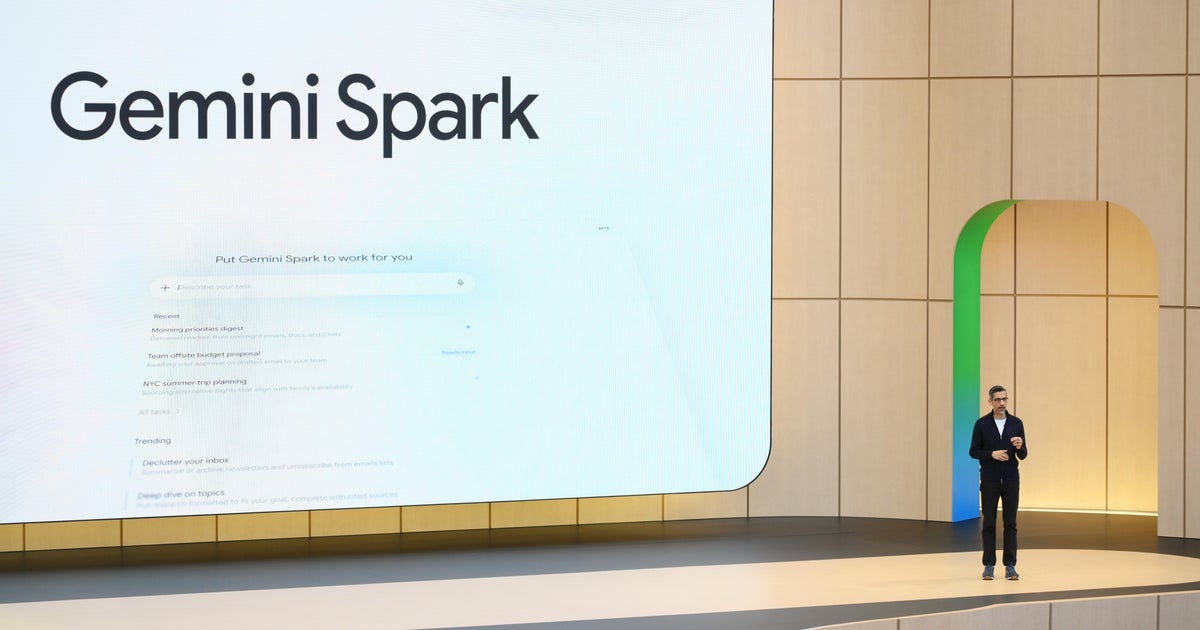
Google introduced Gemini Spark, a new AI tool that acts like a personal assistant to help users complete tasks such as writing emails, making reservations, and managing calendars. This AI connects with Google apps like Gmail and Calendar, giving it important information to work better, and can also interact with outside services like Instacart.
Key Facts
Gemini Spark is Google’s new AI assistant that can perform tasks for users.
It connects to Google apps like Gmail, Docs, and Calendar to access relevant user information.
The AI can highlight important details from emails and meetings automatically.
Gemini Spark can also work with external apps like Instacart (for groceries) and OpenTable (for reservations).
Google is currently testing Gemini Spark and will roll it out to Google AI Ultra subscribers who pay $100 per month.
The AI needs user permission before doing sensitive actions like spending money or sending emails.
Experts suggest starting with simple tasks before trusting AI with more important jobs.
Gemini Spark represents a shift from chat-based AI to AI that can actively perform work on your behalf.
Read the Original
Want the full story? Tap a source to open the original
article.
AT&T is suing the state of California because the state won’t allow the company to stop providing old-style landline phone service to all potential customers. AT&T wants permission to replace its outdated copper phone network, used by a small number of people, with modern fiber and wireless technology.
Key Facts
AT&T filed a lawsuit against California for blocking its plan to end landline phone service to about 199,000 customers.
California requires AT&T to maintain its old copper phone network, even though only 3% of households use it.
AT&T argues that maintaining the copper network costs about $1 billion a year and is inefficient.
The California Public Utilities Commission (CPUC) denied AT&T’s request to stop being the Carrier of Last Resort (required to serve everyone).
CPUC says AT&T can still upgrade to fiber or other technologies and retire copper lines if they want.
AT&T plans to prioritize fiber internet in densely populated areas but wants to replace copper with wireless options in less populated areas.
AT&T claims copper networks are vulnerable to theft and use a lot of electricity.
AT&T asked the Federal Communications Commission (FCC) to override California’s rules and allow the company to shut down the old network.
Read the Original
Want the full story? Tap a source to open the original
article.
Meta has settled a lawsuit with a Kentucky school district that accused the company of causing mental health problems by making its social media platforms addictive. The school district wanted money to cover costs from dealing with this issue and changes to how the platforms work. Other companies like TikTok, Snap, and YouTube also settled similar cases.
Key Facts
Breathitt School District sued Meta and other social media companies for causing mental health issues like anxiety and self-harm in students.
The district wanted $60 million to help pay for the effects of social media addiction and asked for the platforms to be changed to be less addictive.
Meta's settlement lets the company avoid going to trial, but other cases against Meta are still planned.
The lawsuit was chosen to represent over 1,200 school districts with similar claims.
Earlier, a woman won $6 million in a case saying Meta and YouTube made platforms that harmed her mental health.
Meta says it is working on safety features like Instagram Teen Accounts to protect young users.
Critics say these safety tools do not fully prevent harmful content like posts about suicide.
Meta has faced accusations of trying to influence public opinion by paying influencers to promote its safety features.
Read the Original
Want the full story? Tap a source to open the original
article.
Spotify and Universal Music Group have made a deal to let Spotify subscribers create AI-generated song covers and remixes. This feature will be a paid add-on for Premium users and aims to give artists extra income while keeping copyrights protected.
Key Facts
Spotify is allowing users to create AI-driven remixes and covers of songs from participating Universal Music artists.
The new AI remix feature will be a paid add-on available on Spotify’s app for Premium users.
The deal is the first time Spotify officially licenses AI-generated music creation on its platform.
Universal Music Group represents major artists like Taylor Swift, Ariana Grande, and Billie Eilish.
The financial details and specific involved artists have not been made public.
Spotify’s new AI tools focus on respecting artist consent, giving credit, and ensuring compensation.
Spotify recently introduced a Verified badge to distinguish human artists from AI-created content.
Spotify aims to grow its business by adding AI features and new subscription options beyond traditional music streaming.
Read the Original
Want the full story? Tap a source to open the original
article.
Fans are using artificial intelligence (AI) to create many football songs supporting their teams before the World Cup. These AI-made songs are becoming very popular on social media, raising questions about who owns the music and how artists should be paid.
Key Facts
Fans make AI-generated football anthems that get millions of plays on YouTube, TikTok, and Instagram.
The trend began with a French team song called "Imbattables" made using AI-assisted music production.
Songs for countries like Brazil, Portugal, Argentina, and Germany followed, copying similar formats and beats.
AI helps create music by layering sounds, but questions about copyright and who owns the songs remain.
Experts say AI music can lack complexity and sometimes have errors, like wrong accents or pronunciations.
Some listeners do not mind the simple style of AI songs and prefer them over official World Cup anthems.
The World Cup is held in the U.S., Canada, and Mexico in June and July, and official songs from artists like Shakira have also been released.
Read the Original
Want the full story? Tap a source to open the original
article.
Meta agreed to settle a federal lawsuit about social media addiction before a major trial was set to begin in June. This settlement follows similar agreements from three other tech companies earlier this month.
Key Facts
Meta settled a federal lawsuit regarding social media addiction.
The lawsuit was brought by the Breahitt County, Kentucky, Board of Education.
The settlement was reached just weeks before the scheduled June trial.
Three other technology companies also settled similar cases earlier in the same month.
The lawsuit involved claims related to Facebook, which is owned by Meta.
The case centers on concerns about addiction linked to social media platforms.
Read the Original
Want the full story? Tap a source to open the original
article.
The Metropolitan Police wants to spend £50 million on Palantir’s AI technology to help analyze large amounts of digital evidence amid budget cuts and staff losses. This has sparked debate about using AI in public services, with concerns over privacy, trust, and reliance on controversial US tech firms.
Key Facts
The Metropolitan Police faces a £125 million funding shortfall and plans to cut 1,150 jobs.
Palantir’s AI systems would sift through intelligence reports, emails, phone records, and other crime data.
AI is seen as a possible substitute for some human police work and a growing part of national security.
Other UK police forces like Bedfordshire and Leicestershire also use Palantir technology.
The Home Office supports faster and broader AI adoption in policing.
London Mayor Sadiq Khan blocked the Palantir contract citing procurement and ethical concerns.
Palantir is controversial due to ties with US government agencies and statements by its leaders.
Police unions worry about privacy and surveillance issues with Palantir’s AI monitoring their own staff.
British firms are not currently able to offer the full range of AI tools that Palantir provides.
Read the Original
Want the full story? Tap a source to open the original
article.
President Donald Trump postponed signing an executive order on artificial intelligence (AI) due to concerns it might harm the U.S. lead in AI technology. He canceled the event hours before it was planned, saying the order’s details did not meet his approval.
Key Facts
President Trump decided not to sign a new AI-related executive order as planned on May 21, 2026.
He expressed worry that the order could reduce America’s advantage over other countries, especially China, in AI technology.
Trump said he did not like the specific language in the text of the order.
The order was intended to address government oversight of powerful AI systems.
There is rising concern about AI’s ability to find security weaknesses in software, affecting industries like banking.
U.S. officials have mentioned the cyber abilities of an AI model called Mythos from the company Anthropic, which is not widely available.
The signing was scheduled to take place at the White House Oval Office.
Trump made these remarks during a different event in the Oval Office.
Read the Original
Want the full story? Tap a source to open the original
article.
A new drug called retatrutide, developed by Eli Lilly, helped people lose up to 28% of their body weight in a clinical trial. The drug combines three hormones and is taken once a week by injection. It showed better results than other weight-loss drugs currently available.
Key Facts
Retatrutide led to an average weight loss of 70.3 pounds (28.3%) over 80 weeks in the highest dose group.
The trial included 2,339 adults with obesity or overweight and at least one related health condition, but no diabetes.
45.3% of participants on the highest dose lost at least 30% of their body weight.
Retatrutide combines GLP-1, GIP, and glucagon hormones to help metabolism, appetite control, and energy balance.
Other drugs like Eli Lilly’s Zepbound and Novo Nordisk’s Wegovy typically result in 14%-20% weight loss, less than retatrutide.
Common side effects include nausea (up to 42%), diarrhea, constipation, and vomiting, with higher doses causing more side effects.
About 65.3% of participants on the highest dose reduced their BMI below 30, which is the level used to define obesity.
The drug is injected weekly, with the dose gradually increasing over time.
Read the Original
Want the full story? Tap a source to open the original
article.
President Donald Trump delayed signing an executive order about voluntary testing for artificial intelligence (AI) models. He said he did not agree with some parts of the order, leading to the cancellation of the signing ceremony planned for Thursday afternoon.
Key Facts
President Trump postponed signing an executive order related to AI.
The order involved a voluntary testing process for AI models.
The signing ceremony was canceled just hours before it was scheduled.
The White House informed invited technology leaders about the cancellation.
President Trump expressed concerns about certain parts of the order.
The delay came despite the order being long-awaited.
Read the Original
Want the full story? Tap a source to open the original
article.
OpenAI has made progress on a math problem that has been studied for about 80 years. Their AI system found new arrangements of points that go beyond a previous guess by mathematician Paul Erdős about distances between points on paper.
Key Facts
The problem is called the planar unit distance problem, first asked by Paul Erdős in 1946.
Erdős suggested that the number of point pairs at the same distance grows only a little faster than the number of points.
OpenAI’s AI showed there are better arrangements that break Erdős’s suggested limit.
This result was confirmed by human mathematicians, including Thomas Bloom and Tim Gowers.
The AI used is a general reasoning model that breaks down problems, not a math-specialized system.
Humans still improved and helped interpret the AI’s proof.
Experts say the AI is offering new ways to think about mathematical problems.
This work represents a notable step in using AI for advanced math research.
Read the Original
Want the full story? Tap a source to open the original
article.
The Netflix documentary "The Crash" tells the story of a fatal car crash in Ohio in 2022 and explores the role of social media in understanding people’s lives. It highlights differences between Millennials and Gen Z in how they use and show themselves on social media.
Key Facts
"The Crash" aired on Netflix on May 15 and covers a crash that killed two young men and left one survivor, Mackenzie Shirilla.
Shirilla was driving when the car hit a building at about 100 mph and was later found guilty of murder and sentenced to 15 years to life.
The documentary uses courtroom footage and recordings from Shirilla’s cell phone and social media to tell the story.
Shirilla’s online posts showed partying, drug use, and other behaviors shortly after the crash, raising questions about how people present themselves online.
Millennials often worry about their digital footprint, the lasting impact of their online posts on future jobs and reputation.
Gen Z, who grew up with smartphones and social media, share more of their everyday lives online as part of their identity.
Gen Z spends more time on social media (about 3.2 hours daily) than older generations and uses several platforms actively.
Researchers believe Gen Z’s social media use reflects different social rules and ways of expressing themselves compared to Millennials.
Read the Original
Want the full story? Tap a source to open the original
article.
The article discusses the growing importance of AI "inference," which means carrying out tasks using AI models, rather than just creating or training them. It highlights a startup named Antimatter that offers small, energy-efficient data centers inside containers to support this AI inference. It also mentions local opposition to new large data centers in Cape Town due to concerns about electricity, noise, pollution, and water use.
Key Facts
AI inference refers to the process where AI systems perform tasks after the models are trained.
Antimatter is a French startup providing mini data centers that use less energy and space.
These mini data centers are container-sized and come with specialized software.
Antimatter's solution costs less money and takes less time to deploy than traditional data centers.
Cape Town is seeing protests against new big data centers because of worries about power, noise, pollution, and water scarcity.
The article connects this trend to broader challenges in managing energy and resources for AI technology.
The piece also briefly references legal and business news involving AI companies and space-based data centers.
Read the Original
Want the full story? Tap a source to open the original
article.
The article discusses uncertainty about whether tech layoffs are ending or will continue. It notes that AI technology is rapidly improving and still has a lot of potential for growth.
Key Facts
It is unclear if tech layoffs are over or will increase.
AI systems are developing very quickly.
The capabilities of AI are still expanding.
AI has a long time to develop before reaching its full potential.
The article focuses on the impact of AI development on tech jobs and layoffs.
Read the Original
Want the full story? Tap a source to open the original
article.
Meta, the company behind Facebook, is laying off thousands of employees while focusing more on artificial intelligence (AI). This shift shows Meta’s plan to invest heavily in AI technologies.
Key Facts
Meta is cutting a large number of jobs.
The layoffs are part of Meta’s strategy to focus on AI.
AI stands for artificial intelligence, which means computers can perform tasks that usually need human thinking.
This move reflects a trend in big tech companies investing in AI.
Meta is known for Facebook, Instagram, and WhatsApp.
The company aims to develop new AI tools and services.
The layoffs signal a change in Meta’s priorities and resources.
The news was reported by CBS News and Business Insider.
Read the Original
Want the full story? Tap a source to open the original
article.
Audi’s new Q9 SUV will bring advanced adaptive beam headlights to the US for the first time later this year. These headlights use many tiny LEDs to brighten the road while dimming light that could blind other drivers. This technology has been allowed in Europe and Japan for years but only recently passed US safety tests.
Key Facts
Audi’s Q9 SUV will have adaptive beam headlights when released in the US.
These headlights use many tiny LED lights that can turn on or off to adjust the beam shape.
The technology improves visibility for the driver while reducing glare for others.
The US had old headlight rules dating back to the 1960s, allowing only basic low and high beams.
Audi and other car makers lobbied the US safety agency (NHTSA) for years to allow this kind of lighting.
NHTSA approved the technology in 2022 after extensive testing to prove it is safe.
Adaptive beam headlights have been common in Europe and Japan for many years.
The technology helps drivers see better without dazzling other road users or blinding road signs.
Read the Original
Want the full story? Tap a source to open the original
article.
On Wednesday, major developments in artificial intelligence (AI) showed rapid progress in AI research, growing business success, and expanding computing power. President Donald Trump will meet top tech leaders to sign an executive order aiming to improve government oversight and cybersecurity related to AI.
Key Facts
OpenAI’s AI system solved a difficult math problem unsolved for 80 years, showing AI’s potential for scientific discovery.
Anthropic, an AI company, expects over $10 billion in revenue next quarter and their first profit two years earlier than planned.
Anthropic will spend about $1.25 billion per month until 2029 to use SpaceX’s supercomputers for AI work.
Nvidia earned $81.6 billion this quarter, mostly from data centers powering AI, calling this the biggest tech infrastructure growth ever.
SpaceX filed to sell shares publicly, highlighting its big role in AI computing beyond space travel.
President Trump invited CEOs of major tech companies to Washington to sign an AI executive order for sharing AI models with the government before release.
The order aims to build a government-industry partnership for safer AI development amid growing cybersecurity concerns.
Many people are worried AI is advancing too fast and might not benefit everyone equally, shown by surveys and company layoffs despite high AI spending.
Read the Original
Want the full story? Tap a source to open the original
article.