Elon Musk’s X platform agreed with the UK regulator Ofcom to block access in the UK to accounts linked to banned terrorist groups. X will also review most reported illegal terrorist and hate content within 48 hours and get expert advice on handling such reports.
Key Facts
X promised to block UK access to accounts connected to terrorist groups banned by the UK government.
The platform will review at least 85% of illegal terrorist and hate content reported through its tools within 48 hours.
Ofcom, the UK communications regulator, made this agreement to improve how social media handles terrorist and hate content.
Ofcom will monitor X closely to ensure it follows through on these promises.
The agreement comes amid concerns over online hate and terrorist content, especially after hate crimes against the UK’s Jewish community.
Ofcom is also investigating X for showing manipulated images created with Musk’s Grok AI tool.
Some experts praised the agreement as a positive step but said X still has problems addressing racism.
X has faced criticism for its content moderation since Elon Musk bought the platform in 2022.
Read the Original
Want the full story? Tap a source to open the original
article.
Tech companies are using artificial intelligence (AI) to reduce the number of middle managers. This change is making managers take on more work while relying on AI tools to help with tasks like coding and employee evaluations.
Key Facts
Tech companies like Coinbase, Amazon, Block, and Meta have cut many jobs, focusing on reducing management layers.
AI allows companies to do more with fewer workers and to flatten their management structures.
Middle managers now have more responsibilities, often needing to both supervise and produce work.
AI tools are used to speed up tasks such as drafting documents, taking notes, evaluating employees, and generating code.
This shift may make jobs harder for employees because managers have less support.
Middle manager job openings in the U.S. dropped by 42% from 2022 to the end of 2025.
Managers are trying new ways to work, like using AI bots to communicate with their teams asynchronously.
Experts say companies are still figuring out the best way to manage with fewer middle managers and more AI.
Read the Original
Want the full story? Tap a source to open the original
article.
The Velotric Discover 3 is a commuter bike that aims to balance comfort, reliability, and affordability, costing under $2,000. It features a new mid-frame motor with a torque sensor for better pedal assistance, and Shimano’s updated Cues drivetrain, offering improved gear shifting and integration.
Key Facts
The Discover 3 is the third model in Velotric’s commuter bike line and is more expensive than the original Discover 1.
It replaces a hub motor with a mid-frame motor that uses a torque sensor to assist pedaling based on pedal force.
The torque sensor provides a more natural feel compared to cadence sensors, which only detect if pedals are spinning.
Using a cadence sensor mode can drain the battery faster, as it allows the motor to do more work without pedaling effort.
The bike includes Shimano’s new Cues groupset, designed to be interoperable across different bike types.
The Cues drivetrain improves gear shifting quality and offers a useful range of eight gears.
The bike has thumb trigger shifters instead of cheap plastic ones used in earlier low-end models.
Velotric has expanded its presence in the U.S. and moved towards higher-end features with the Discover 3.
Read the Original
Want the full story? Tap a source to open the original
article.
Anthropic is developing Claude Code, a software tool that helps create other software using artificial intelligence. Due to rapidly increasing user demand and more complex uses, Anthropic faced computer processing shortages. The company is adding new features and increasing usage limits to better support users and expects AI improvements will guide future product plans.
Key Facts
Claude Code is an AI-powered tool from Anthropic that aids software development.
User demand grew 80 times faster than Anthropic anticipated, causing computing resource shortages.
Anthropic increased usage limits for paid users after partnering with SpaceX for more computing power.
The product expanded from command line tools to integrated desktop and web app versions.
Anthropic is testing ways to manage demand, such as stricter usage limits during busy times and adjusting subscription plans.
The company released many new features for managing multiple AI agents and workflows.
Anthropic’s product team works in quick development cycles, experimenting to find new uses and improve the tool.
Competitors like OpenAI and GitHub are also releasing AI coding tools with different features to improve efficiency.
Read the Original
Want the full story? Tap a source to open the original
article.
British game developer Playground Games created Forza Horizon 6, a racing game set in Japan. To make the game realistic, they spent years researching with photos, videos, and experts to accurately show Japan’s landscape and car culture.
Key Facts
Forza Horizon is a series of open-world driving games first released in 2012.
Playground Games sends design teams to real locations to gather photos and videos before building the game maps.
Japan was chosen as the setting for Forza Horizon 6 after years of preparation and research.
The team hired cultural consultant Kyoko Yamashita to advise on authentic Japanese details.
They worked with local car culture experts, including a Kyoto bodyshop and a car photographer featured in the game.
The game includes famous Japanese drift cars like the Nissan Skyline and Toyota Supra.
They recreated Japan’s touge mountain road racing culture with carefully chosen routes and cars.
To capture details, the team used 360-degree cameras for their reference photography.
Read the Original
Want the full story? Tap a source to open the original
article.
About half of the new online articles are now written mostly by artificial intelligence (AI), but this number has stopped growing and stayed steady for over a year. This means AI has not completely taken over online writing, although AI-written content keeps getting better.
Key Facts
AI-generated articles rose quickly after ChatGPT launched in November 2022.
Within one year, AI wrote about 36% of new online articles; within two years, close to 48%.
Since early 2025, the share of AI-written articles stays near 50%.
The data comes from analyzing over 55,000 English webpages published from 2020 to 2026.
Three AI-detection tools were used to classify if articles were mostly AI-written.
Many articles are a mix of human and AI efforts, making exact counts tricky.
Experts warn that if AI content feeds future AI training without fresh human knowledge, quality could suffer.
AI-written content is improving and sometimes matches or beats human writing in quality.
Read the Original
Want the full story? Tap a source to open the original
article.
Two tech leaders, Elon Musk and Sam Altman, are in a court trial over claims Musk made that Altman cheated him in a charity-related issue connected to OpenAI, the company behind ChatGPT. The trial revealed many details about their business dealings, Altman’s character, and the involvement of other tech figures, as the judge and jury consider the evidence.
Key Facts
Elon Musk claims that Sam Altman lied about keeping OpenAI as a non-profit and stole a charity, which Altman denies.
Several tech figures, including OpenAI co-founder Ilya Sutskever and Microsoft CEO Satya Nadella, testified that they saw no proof of Musk’s claim about the non-profit status.
Microsoft, a major investor in OpenAI, is also involved in the case as a co-defendant accused of helping Altman’s alleged scheme.
Altman’s trustworthiness was questioned during the trial, with his past and business practices examined closely.
The court heard about Altman’s large investments in startups, including Helion Energy, a nuclear energy company where he held a high-level position.
A judge is overseeing the trial, guiding the jury that will decide the outcome based on the evidence presented.
The case has revealed more complex disputes beyond just Musk and Altman’s personal conflict, involving other tech industry leaders and business relationships.
Read the Original
Want the full story? Tap a source to open the original
article.
Researchers have found many anti-immigration social media accounts targeting the UK that are actually run from countries like Sri Lanka and Vietnam. These accounts use AI-generated videos and posts to show misleading stories about the UK’s future, often suggesting the country is in decline due to immigration.
Key Facts
The "Great British People" Facebook page claims to be from Yorkshire but is run from Sri Lanka.
The accounts use AI to create fake videos showing the UK in decline and dominated by Muslims.
These social media pages have millions of views and share content suggesting mass immigration harms the UK.
The creators are located in various countries, including Sri Lanka, the US, Europe, Vietnam, the Maldives, Iran, and the UAE.
Some accounts show sympathy to the Russian and Iranian governments, though direct state involvement is unclear.
Experts say AI-made fake content can make people distrust real information.
London’s Mayor says some accounts are motivated by money, others possibly by hostile states.
The fake videos often show British cities in 2050 with misleading scenes of Islamic culture taking over.
Read the Original
Want the full story? Tap a source to open the original
article.
Orchid breeding is a competitive and profitable field that uses genetic tools to create new flower varieties faster. Companies conduct genetic tests on young plants to find desired traits, speeding up the traditional breeding process that can take years.
Key Facts
The global orchid market is worth hundreds of millions of dollars.
Developing a new orchid variety can take about ten years of work.
Many commercial orchids have complex genetics due to long-term selective breeding.
Companies use genetic markers to identify traits like color, shape, disease resistance, and flower lifespan early on.
Eben Upton, founder of Raspberry Pi, warned that people might wrongly believe artificial intelligence (AI) can replace many tech jobs. This could discourage people from learning tech skills and hurt the economy by causing a shortage of engineers.
Key Facts
Eben Upton is the founder of Raspberry Pi, a British computer maker.
He said people often overestimate what AI tools like ChatGPT can do.
Some companies have blamed AI for large layoffs, but experts think AI is sometimes an excuse for job cuts.
Overestimating AI might stop people from choosing tech careers, making skill shortages worse.
Upton advised waiting several years before making decisions about education related to AI’s impact.
Raspberry Pi is popular for teaching programming and is the UK’s top-selling computer maker.
Raspberry Pi became a public company in 2024 on the London Stock Exchange.
High energy costs in the UK are a challenge for engineering firms like Raspberry Pi.
Read the Original
Want the full story? Tap a source to open the original
article.
Elon Musk sued OpenAI and its leaders, claiming they broke a promise to keep the company a charity and instead made profits for insiders. Lawyers from both sides made their final arguments as jurors prepare to decide if OpenAI acted improperly. The case also involves Microsoft, a major investor in OpenAI.
Key Facts
Elon Musk, founder of a competing AI called Grok, filed the lawsuit against OpenAI, CEO Sam Altman, and president Greg Brockman.
Musk alleges OpenAI moved away from being a charity and wrongly made money for investors and insiders.
Musk is not in court for the final arguments because he is on a diplomatic trip to China with President Donald Trump.
Musk’s lawyer accused Sam Altman of lying under oath, citing testimony from five witnesses who worked closely with Altman.
OpenAI’s lawyers said Musk waited too long to sue and that he wanted to control the company for profit.
Microsoft invested $1 billion in 2019 and $10 billion in 2023, and Musk’s lawyer claims Microsoft knew about OpenAI’s actions.
A judge said if the jury finds Musk filed the lawsuit too late, the case will likely be dismissed.
The trial’s outcome could affect OpenAI’s upcoming plan to sell shares publicly in one of the largest stock sales ever.
Read the Original
Want the full story? Tap a source to open the original
article.
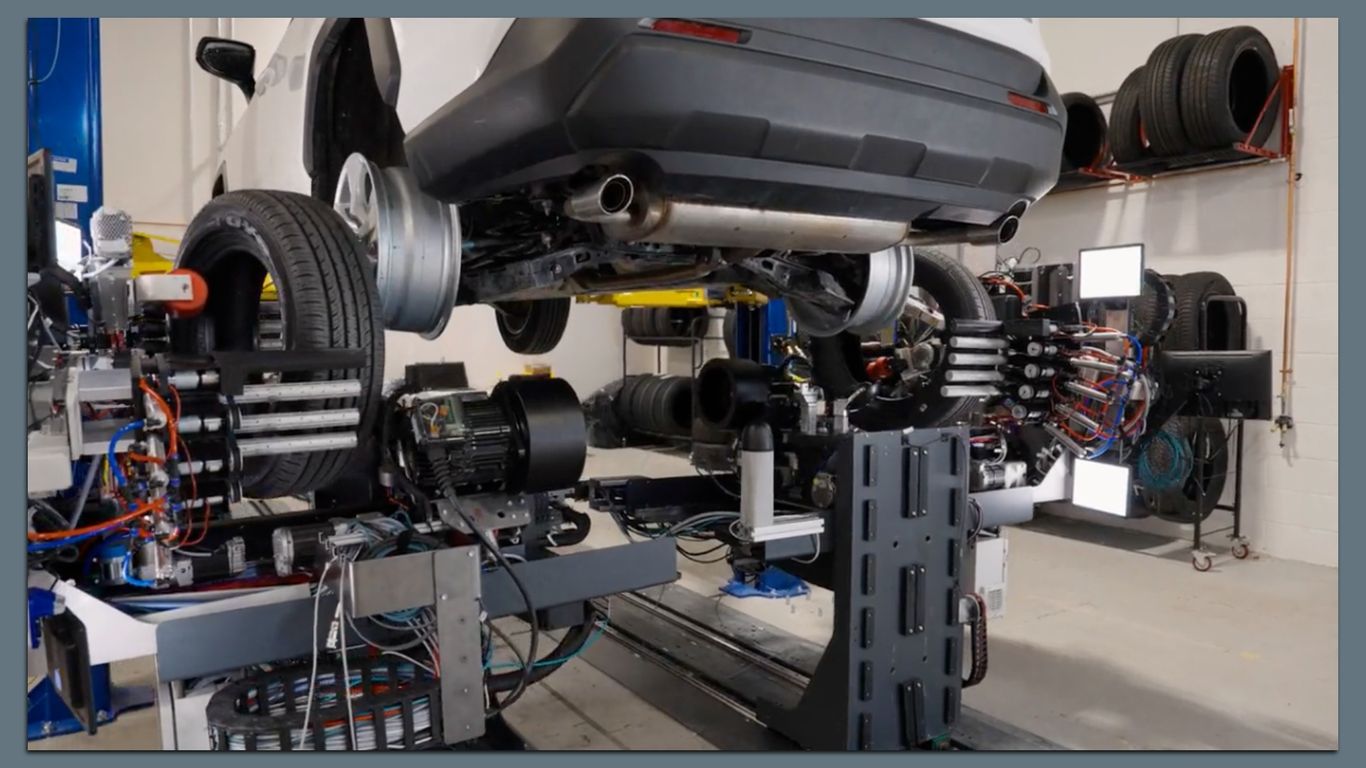
A new AI-powered robot called SmartBay can change and balance tires in about 30 minutes, much faster than the usual 75 minutes with humans. This system helps tire shops work faster and save money by letting one technician run multiple service bays at the same time.
Key Facts
SmartBay is a robotic system that inspects vehicles, changes tires, and balances wheels with little human help.
It uses AI to adjust its work based on the specific vehicle and collects data during the process.
The system fits into a standard 12-foot service bay.
One technician can manage up to three bays with the robot’s help.
Tire changes take about 30 minutes with the robot, compared to 75 minutes manually.
This means a technician can handle up to 24 tires per hour instead of just 4.
The company leases SmartBay to shops for $4,900 per month, which is cheaper than hiring an experienced technician.
The creator, Andy Chalofsky, has a history of building successful tire businesses and aims to modernize tire installation.
Read the Original
Want the full story? Tap a source to open the original
article.
Lawyers gave their final statements in a lawsuit involving OpenAI. The case is between Elon Musk and OpenAI's CEO, Sam Altman. The trial discussions were reported by CBS News.
Key Facts
The lawsuit involves OpenAI, an artificial intelligence company.
Elon Musk is one of the parties involved in the case.
Sam Altman, OpenAI’s CEO, is the other party in the lawsuit.
Lawyers presented their closing arguments on Thursday.
CBS News covered the closing arguments and provided updates through their app and website.
Jessica Levinson, a legal expert for CBS News, gave more information about the trial.
Read the Original
Want the full story? Tap a source to open the original
article.
The UK government saved millions of pounds by replacing Palantir’s IT system, which helped find homes for Ukrainian refugees, with a new system built by its own experts. Palantir initially provided their system for free but later charged millions, leading the government to develop a more flexible and cost-effective in-house solution.
Key Facts
Palantir created the original IT system for the Homes for Ukraine scheme for free for six months.
The scheme matched people offering homes with Ukrainian refugees fleeing the conflict.
Subsequent contracts with Palantir cost the government £4.5 million and £5.5 million.
The government’s new system is built in-house and is saving millions in running costs each year.
The in-house system offers more control over data and software code.
Palantir’s technology, called Foundry, was replaced by the government’s own platform.
Some critics worry about over-reliance on large U.S. tech firms like Palantir.
The replacement system is seen as a step toward "sovereign technology," meaning technology developed and controlled within the UK.
Read the Original
Want the full story? Tap a source to open the original
article.
Twin brothers Muneeb and Sohaib Akhter were caught deleting 96 U.S. government databases after being fired from their federal IT contractor job. They accidentally recorded their own crime because they forgot to stop a Microsoft Teams meeting recording started during their termination.
Key Facts
Muneeb and Sohaib Akhter are 34-year-old twin brothers employed by Opexus, a federal IT contractor.
After being fired in 2024, they deleted 96 U.S. government databases within an hour.
The brothers had a history of cyber fraud and had previously been in prison for it.
They left a detailed recorded transcript of their actions because a Microsoft Teams meeting stayed recording after their firing.
The recording captured their conversation as they planned and executed the deletion and discussed possible payoffs.
The government had no need for secret surveillance; the evidence was gathered from the brothers' own mistake.
The recordings came from a meeting that started with HR firing them, but continued without HR present.
The brothers were living together in Arlington, Virginia, and communicated verbally during the deletion spree.
Read the Original
Want the full story? Tap a source to open the original
article.
Trump Mobile announced that it will start shipping its T1 mobile phone this week, after nearly a year of delays. The phone costs $499, is assembled in the U.S., and uses mostly American-made parts, but the company’s preorder terms do not guarantee that customers who put down a deposit will receive the phone.
Key Facts
Trump Mobile's T1 phone is gold-toned and costs $499.
Shipping of the phone will begin this week to customers who pre-ordered.
The phone’s release was delayed due to the U.S. government shutdown and other factors.
Trump Mobile says the T1 phone is assembled in the U.S. with parts made domestically.
Preorder customers paid a $100 deposit, but the company’s terms say the deposit does not guarantee a phone will be produced or sold.
Experts say the preorder terms give Trump Mobile the right to decide whether to sell the phone and that the deposit acts like a no-interest loan to the company.
The terms also state the phone may not work in all regions or with all mobile networks.
Trump Mobile did not respond to additional requests for comment on the situation.
Read the Original
Want the full story? Tap a source to open the original
article.
AMD announced that its improved FSR 4 upscaling technology, which was originally only for the newest Radeon RX 9000 GPUs, will soon work on older Radeon GPUs starting in July. Support will begin with Radeon RX 7000 series and integrated GPUs, then expand to older RDNA2-based GPUs like the RX 6000 series and the Steam Deck in early 2027.
Key Facts
AMD’s FSR 4 is a graphics upscaling technology that improves image quality with hardware help.
Initially, FSR 4 worked only on the latest RDNA4-based Radeon RX 9000 GPUs.
Starting July, FSR 4 will support RDNA3/3.5 GPUs, including Radeon RX 7000 series and some integrated GPUs.
In early 2027, support will extend to RDNA2 GPUs like the Radeon RX 6000 series and devices like the Steam Deck.
Older GPUs use a different type of hardware (INT8 instead of FP8) causing potential performance or image quality differences.
Early tests show older GPUs might see a 10-20% performance drop running FSR 4 compared to older FSR versions.
AMD plans a driver update to enable FSR 4.1 on supported older GPUs.
FSR competes with Nvidia’s DLSS, which is usually more widely supported and hardware-accelerated.
Read the Original
Want the full story? Tap a source to open the original
article.
A new zero-day exploit called YellowKey allows someone with physical access to a Windows 11 computer to bypass BitLocker encryption and access all data on the drive quickly. The exploit uses a special folder on a USB drive to trick the system’s recovery process, letting an attacker open a command prompt with full access to the protected disk without needing the encryption key.
Key Facts
YellowKey is a zero-day exploit affecting default BitLocker encryption on Windows 11.
It requires physical access to the computer and a USB drive prepared with a custom FsTx folder.
By booting the device in a certain way and holding the Ctrl key, the exploit triggers a command prompt that bypasses BitLocker recovery protections.
BitLocker normally encrypts entire drives using a hardware component called a TPM (Trusted Platform Module) to keep data safe without the key.
The exploit manipulates Windows’ Transactional NTFS system, a feature for handling file operations safely in transactions.
This manipulation allows modification of files across different drive volumes, which is unusual and may be a separate security issue.
Security researchers have confirmed the exploit works as described, though Microsoft has not given a public response.
The exploit threatens many organizations that rely on BitLocker for disk encryption, including government contractors.
Read the Original
Want the full story? Tap a source to open the original
article.
Cisco and LinkedIn, two major technology companies, are planning to lay off thousands of employees. These job cuts are part of a broader trend of layoffs in the tech industry.
Key Facts
Cisco and LinkedIn are major companies in the technology sector.
Both companies announced plans to reduce their workforce by thousands.
These layoffs are among several in the tech industry recently.
The job cuts aim to reduce costs or restructure operations.
Details about the exact number of jobs cut or affected areas were not provided.
Read the Original
Want the full story? Tap a source to open the original
article.
Adam Meyers, the leader of Crowdstrike’s team that fights cyber attacks, talked with CBS News about the risk of cyber threats from China and North Korea. He explained how Americans can understand and prepare for these online dangers.
Key Facts
Adam Meyers leads Crowdstrike’s counter adversary operations, which focus on stopping cyber attacks.
He discussed cyber risks coming from China and North Korea.
Crowdstrike is a company that protects organizations from hackers.
The interview was featured on CBS News.
Meyers explained how people should think about and watch for cyber threats.
China and North Korea are known for carrying out cyber attacks.
The conversation aimed to raise awareness about these ongoing cyber risks.
Read the Original
Want the full story? Tap a source to open the original
article.