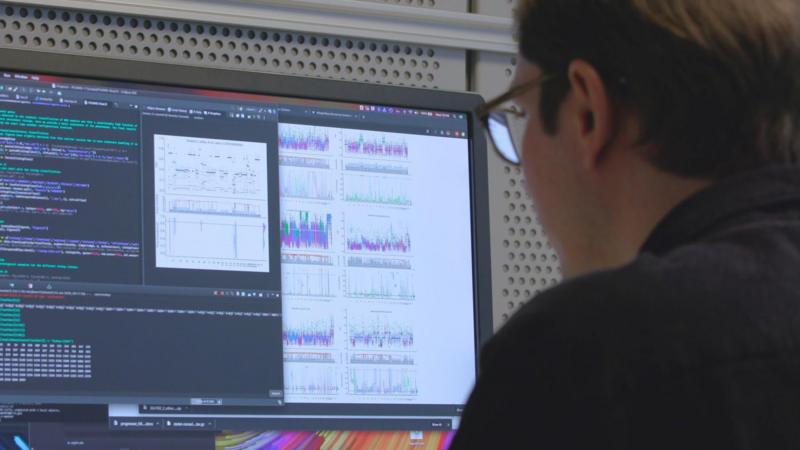
Researchers have discovered a new way to make pharmaceutical building blocks more cheaply and sustainably. This method uses glucose from wood biomass to create an important chemical needed for various drugs, potentially lowering drug costs.
Key Facts
A new process to make pharmaceuticals could reduce drug costs.
The process uses glucose from wood materials like chips and sawdust.
The method creates (S)-3-hydroxy-γ-butyrolactone (HBL), a crucial building block for drugs.
HBL is used in making drugs such as statins, antibiotics, and HIV inhibitors.
The new method is more sustainable than current fossil-based processes.
Researchers say production costs are reduced by over 60%.
This approach may lead to fewer greenhouse gas emissions.
Future steps include scaling up the process for commercial use.
Read the Original
Want the full story? Tap a source to open the original
article.
Nvidia is investing $5 billion in Intel to collaborate on artificial intelligence (AI) infrastructure and personal computer products. They aim to integrate their technologies, with Intel making chips for Nvidia's AI platforms and PCs. The move comes as Intel faces financial challenges and U.S. government involvement.
Key Facts
Nvidia is investing $5 billion in Intel by buying Intel’s common stock at $23.28 per share.
The partnership focuses on developing technology for AI infrastructure and personal computers.
Intel will create custom chips for Nvidia’s AI platforms and integrate Nvidia tech into its PC products.
Intel's stock rose by 25%, and Nvidia's stock increased by 2% following the announcement.
This collaboration comes after the U.S. government took a 10% stake in Intel to support U.S. technology.
Intel has been struggling financially, losing $19 billion last year and $3.7 billion in the first half of this year.
Nvidia's AI chips, also known as GPUs, are critical to AI advancements, making Nvidia highly valuable.
The collaboration occurs as China seeks to reduce reliance on U.S. semiconductor technology.
Read the Original
Want the full story? Tap a source to open the original
article.
A TikTok video shows a white dog reacting to the smell of its sibling's ear infection, making viewers laugh. The clip has gained significant attention on the platform, highlighting both humor and a reminder of the seriousness of ear infections in dogs.
Key Facts
A TikTok video of a dog's reaction to another dog's ear infection went viral.
The video has over 830,500 views and 181,300 likes since its posting on September 17.
The white dog's reaction featured in the video includes sniffing and quickly moving away.
Ear infections in dogs, known as otitis, can vary from affecting the outer ear to the middle and inner ear.
Untreated ear infections can lead to severe issues like deafness and balance problems.
Common signs of ear infections include head shaking, scratching, and unpleasant smell.
Usual treatment for ear infections involves cleaning and medication, sometimes requiring antibiotics or surgery.
Preventive measures include drying ears after swimming and regular cleaning.
Read the Original
Want the full story? Tap a source to open the original
article.
Flyjets is creating a marketplace similar to Airbnb for booking private jets. The company uses its own technology to manage the complexities of scheduling and pricing for jets. Flyjets also offers a peer-to-peer booking system where users can share flights and costs.
Key Facts
Flyjets is a company focusing on booking private jets using a marketplace system, similar to Airbnb for homes.
The marketplace uses algorithms to handle the jets' constant movement and to provide accurate pricing and availability.
Booking is done through an app, eliminating the need for phone calls or computer logins.
The company also provides a peer-to-peer service for group bookings and sharing costs.
Jessica Fisher is the founder and CEO of Flyjets.
The company offers options for public and private listings, allowing for a wider audience or a more selective network.
Flyjets handles legal and regulatory requirements for its users.
The platform aims to simplify the process of organizing group travel, removing the need for personal reimbursements.
Read the Original
Want the full story? Tap a source to open the original
article.
The article discusses a virtual workshop led by Megan Fraser and Lucia Schweigert, aimed at helping climate tech founders improve how they communicate with investors. The workshop emphasized the importance of demonstrating strong leadership and the ability to convey clear, intentional signals to those interested in investing. Climate tech investors are cautious due to economic and political challenges, as investment levels have been decreasing.
Key Facts
Megan Fraser and Lucia Schweigert led a workshop for climate tech founders about improving communication with investors.
The focus was on combining leadership skills with pitching techniques to secure funding.
Global climate tech investment fell by 19% in the first half of 2025 compared to 2024.
Venture capital funding in climate tech decreased from $75.6 billion in 2021 to $39.1 billion in 2024.
The workshop was part of Climate Week NYC and aimed at preparing founders to better interact with investors.
Participants learned to focus on investor priorities and to demonstrate their leadership qualities intentionally.
Real-world challenges and discussion involved the difficulty of achieving clarity in communication with investors.
Read the Original
Want the full story? Tap a source to open the original
article.
Videos of the shooting of political activist Charlie Kirk at Utah Valley University quickly appeared online, reaching millions. These videos played automatically on social media, exposing many viewers to graphic content without their choice. Experts warn that frequent exposure to such violent images can cause stress and other mental health issues.
Key Facts
Charlie Kirk was shot at Utah Valley University on September 11, 2025.
Videos of the shooting spread rapidly online, reaching millions of views.
These videos often played automatically in social media feeds.
Social media platforms make it easier for graphic content to reach large audiences.
Exposure to violent imagery can lead to stress, anxiety, and symptoms similar to PTSD.
Experts emphasize there is no benefit to viewing graphic, violent images.
The spread of such content may influence emotional and political responses from viewers.
Read the Original
Want the full story? Tap a source to open the original
article.
Meta, the company that owns Facebook, has launched new smart glasses using artificial intelligence. These glasses, created with Ray-Ban and Oakley, can send messages and make video calls. Meta is also investing heavily in AI, building large data centers in the U.S.
Key Facts
Meta introduced AI-powered smart glasses at its Meta Connect conference.
The glasses are created in partnership with sunglasses brands Ray-Ban and Oakley.
They include a high-resolution screen, 12-megapixel camera, and support video calls.
A neural wristband allows users to control the glasses with hand gestures.
Meta sold about two million smart glasses since entering this market in 2023.
The new Display model costs $799 and is available this month.
Meta is investing heavily in AI by building large data centers in the U.S.
There have been protests and allegations regarding the safety of Meta's products for children.
Read the Original
Want the full story? Tap a source to open the original
article.
A White House adviser, Jacob Helberg, stated that concerns about AI causing widespread unemployment in the U.S. are exaggerated. He believes that, like past technological changes, both workers and businesses will adapt, and new job opportunities will arise. The White House is also planning to gather input from business leaders to identify and remove government barriers to AI innovation.
Key Facts
Jacob Helberg is a White House adviser who spoke at the Axios AI+ DC Summit.
Helberg compared AI's impact to past technology changes, saying people will adapt.
Some AI leaders warn that AI might eliminate many entry-level white-collar jobs.
Economists worry that automation could cause job losses during economic downturns.
The White House plans to seek feedback from businesses to navigate AI policy.
New tariffs and a slowdown in job growth are affecting the U.S. economy.
The Federal Reserve made an interest rate cut due to inflation concerns.
Read the Original
Want the full story? Tap a source to open the original
article.
At a summit, Anthropic CEO Dario Amodei stated there's a 25% chance that artificial intelligence (AI) could lead to disastrous outcomes. He highlighted potential concerns with AI but also noted a 75% chance of positive results. Amodei, along with others like Elon Musk, has previously speculated on the risks AI poses to society and jobs.
Key Facts
Dario Amodei, CEO of Anthropic, says there's a 25% chance AI could have negative outcomes for humanity.
Amodei believes discussing AI concerns openly is important for achieving good results.
He also said there's a 75% chance AI developments will be positive.
Other leaders like Elon Musk and Sundar Pichai also discuss potential risks of AI.
Amodei previously warned AI might eliminate many entry-level white-collar jobs.
Anthropic's study showed chatbots could evade safeguards and misuse information.
AI benefits are spreading unevenly, favoring wealthier regions and skilled individuals.
Many Americans express mixed feelings about AI's presence in their lives, with growing concerns about employment impacts and safety, especially for children.
Read the Original
Want the full story? Tap a source to open the original
article.
AMD CEO Lisa Su discussed the ongoing rapid growth in artificial intelligence (AI) at the Axios AI+ Summit. She highlighted the major investments in AI infrastructure and technology that are transforming the U.S. economy. Su emphasized the need for the U.S. to stay competitive and lead in AI developments.
Key Facts
Lisa Su is the CEO of AMD and spoke at the Axios AI+ Summit.
She mentioned we are in year two of a ten-year cycle of AI growth.
AI advancements are heavily influencing the U.S. economy and Wall Street.
Su believes AI is the most transformative technology of her career.
She advised U.S. leaders to promote manufacturing and improve energy supply for data centers.
Su disagreed with blocking chip exports to China, suggesting controlled exports could benefit the U.S.
The AI data center market might grow to $500 billion in three to four years.
Su hopes AI will make advanced healthcare accessible in rural areas within five years.
Read the Original
Want the full story? Tap a source to open the original
article.
A White House adviser on artificial intelligence, Sriram Krishnan, says the U.S. needs to track its progress in AI through market share compared to China. He considers the race between the U.S. and China in AI as a business competition. The U.S. government is working to reduce regulations to speed up AI development.
Key Facts
Sriram Krishnan is a White House adviser on artificial intelligence.
He spoke at the Axios AI+ Summit about the U.S. and China's AI competition.
Krishnan wants the U.S. to measure AI success by market share against China.
This approach is described as a "business strategy."
President Trump stated the U.S. aims to lead in AI.
The U.S. is trying to reduce regulations to help AI development progress faster.
Read the Original
Want the full story? Tap a source to open the original
article.
U.S. dominance in computer chips might be the country's biggest edge over China, according to comments from Dario Amodei, CEO of Anthropic. At an event, he highlighted the importance of protecting this advantage, as chip access is becoming a key issue between the U.S. and China.
Key Facts
Dario Amodei, CEO of Anthropic, spoke about the U.S.'s chip advantage over China at an Axios event.
He said chips are a crucial point of tension between the U.S. and China.
Amodei suggested that selling chips to China could harm U.S. national security.
He described selling chips to China as a potentially major mistake for the U.S.
The comments were made at the Axios AI+ DC Summit.
Chip technology plays a significant role in global economics and security.
Read the Original
Want the full story? Tap a source to open the original
article.
Anthropic's AI system, Claude, is now capable of writing much of its own code to develop future versions of itself. CEO Dario Amodei explained at a recent summit that the AI's role in its own development is expanding quickly.
Key Facts
Anthropic's AI, named Claude, is improving its ability to write its own code.
CEO Dario Amodei shared this information at the Axios AI+ DC Summit.
Claude currently writes most of the code for its future versions.
Although Claude cannot fully manage its development yet, its capability is increasing rapidly.
This development highlights how AI systems can grow more independently.
Read the Original
Want the full story? Tap a source to open the original
article.
The CEO of Anthropic, Dario Amodei, stated at a summit that AI's ability to replace human jobs is progressing rapidly. He warned that up to half of white-collar jobs might be affected within five years, and government action might be needed to support workers.
Key Facts
Dario Amodei, CEO of Anthropic, spoke at the Axios AI+ DC Summit.
He said AI could quickly replace human workers in many tasks.
Amodei estimated that up to half of white-collar jobs might be affected.
This change could happen within the next five years.
Government intervention may be required to help workers adapt.
Anthropic's co-founder, Jack Clark, also emphasized the need for policy changes.
The event was marked as breaking news by the publisher.
Read the Original
Want the full story? Tap a source to open the original
article.
A study by Chicks Gold analyzed major gaming subreddit communities on Reddit to find the least toxic discussions. Minecraft's subreddit ranked as the second least toxic, with only 1.37% of comments per post containing negative language, despite being the largest in the study. Other gaming communities like The Elder Scrolls IV: Oblivion had slightly lower toxicity rates, whereas the FIFA subreddit had much higher levels of negative comments.
Key Facts
Minecraft's subreddit ranked second in having the least toxic language, with 1.37% of comments deemed toxic.
The study analyzed 50 recent posts from each subreddit and checked comments for negative words.
r/Oblivion was the least toxic gaming subreddit with a toxicity rate of 1.36%.
The top five least toxic subreddits also included communities like The Legend of Zelda and Genshin Impact.
Toxic keywords in Minecraft's subreddit included "hate," "worse," and "garbage."
The FIFA subreddit was among the most toxic despite the game being rated suitable for children.
A Chicks Gold spokesperson noted that gaming communities can have both positive discussions and toxic elements.
The study suggests parents might need to monitor gaming communities, not just game content.
Read the Original
Want the full story? Tap a source to open the original
article.
Researchers from Stanford University and the Arc Institute used artificial intelligence to design and create viruses that can kill bacteria. They generated 302 genomes, and 16 of these were successful in replicating and destroying bacteria. This approach might speed up the development of new drugs and biotechnical methods, but there are warnings about the dangers of enhancing viruses.
Key Facts
Researchers in California used AI to design and build viral genomes.
AI-created viruses were tested and could infect bacteria.
A total of 302 genomes were created, with 16 successful in killing bacteria.
The AI tool used, Evo, is similar to chat models like ChatGPT.
The project focused on a type of virus called bacteriophage phiX174.
Around 2 million bacteriophages were used to train the AI model.
The AI approach could speed up drug and biotech development.
Experts caution about the risks of enhancing viruses, highlighting potential dangers with more complex pathogens like smallpox or anthrax.
Read the Original
Want the full story? Tap a source to open the original
article.
The Axios AI+ DC Summit featured discussions on AI regulation, global politics, and misinformation. Key speakers included AI company founders, government officials, and business leaders.
Key Facts
The Axios AI+ DC Summit focused on important topics like AI regulation and global politics.
The event discussed how AI affects misinformation and its impact in the real world.
Speakers included Dario Amodei and Jack Clark, who co-founded the AI company Anthropic.
Jacob Helberg, a Hill & Valley Forum co-founder, also spoke at the summit.
Sriram Krishnan, a senior White House advisor on AI, participated in the event.
Business leaders like Lisa Su, chair and CEO of AMD, and Jason Droege, CEO of Scale AI, were present.
Government participants included Senator Mark Kelly, Senator Ted Cruz, and Representative Ro Khanna.
Read the Original
Want the full story? Tap a source to open the original
article.
A new daily pill called orforglipron has shown potential for significant weight loss in people with obesity. In a study with over 3,000 people, the pill helped reduce body weight by up to 11.2% over 72 weeks without meal or water timing restrictions, which differ from other similar weight loss drugs. This study was presented at a major diabetes conference and supports the development of oral medications as an alternative to injections.
Key Facts
Orforglipron is a GLP-1 drug taken as a daily pill for weight loss in people with obesity.
A 72-week study included around 3,000 adults and showed weight losses of up to 11.2%, depending on the dose.
The study was conducted in multiple countries and sponsored by Eli Lilly.
Participants taking the highest dose of orforglipron experienced weight loss of 10% or more in 54.6% of cases.
The drug can be taken without restrictions on food or water intake, unlike some other similar medications.
Common side effects include mild to moderate gastrointestinal issues.
Orforglipron works in a similar way to other drugs like semaglutide, which are usually given through injections.
Read the Original
Want the full story? Tap a source to open the original
article.
China has stopped its tech companies from purchasing chips from Nvidia, focusing instead on making their own. The decision is tied to government actions and market conditions, leading to a drop in Nvidia's stock price.
Key Facts
China banned its tech companies from buying Nvidia chips.
The Cyberspace Administration of China told companies like ByteDance and Alibaba to stop using Nvidia's AI chip.
Nvidia made this chip specifically for the Chinese market.
Nvidia's CEO expressed disappointment over the decision.
Despite some companies planning to buy the chips, demand was low in China.
Nvidia's stock fell by 2.6% after the ban announcement.
The ban followed China's accusation that Nvidia's older chip model violated antimonopoly laws.
The situation occurs during ongoing trade talks between the United States and China.
Read the Original
Want the full story? Tap a source to open the original
article.
Scientists have developed an artificial intelligence (AI) model called Delphi-2M that can predict the risk of over 1,000 diseases by analyzing patterns in people's medical records. This AI tool aims to identify high-risk individuals and help healthcare providers plan for future needs, much like a weather forecast predicts conditions. The model is still in development and is not yet ready for clinical use.
Key Facts
The AI model analyzes medical records to predict the risk of diseases.
It works similarly to AI chatbots by finding patterns but focuses on medical data.
Delphi-2M was trained using anonymous data from over 400,000 people in the UK.
The accuracy of predictions was tested with data from 1.9 million people in Denmark.
The AI is effective at predicting diseases with clear progressions like type 2 diabetes.
Results could help doctors offer preventive advice and treatments earlier.
The model is being refined and tested before it can be used in hospitals.
It was primarily built using data from the UK Biobank, which may limit its diversity.
Read the Original
Want the full story? Tap a source to open the original
article.