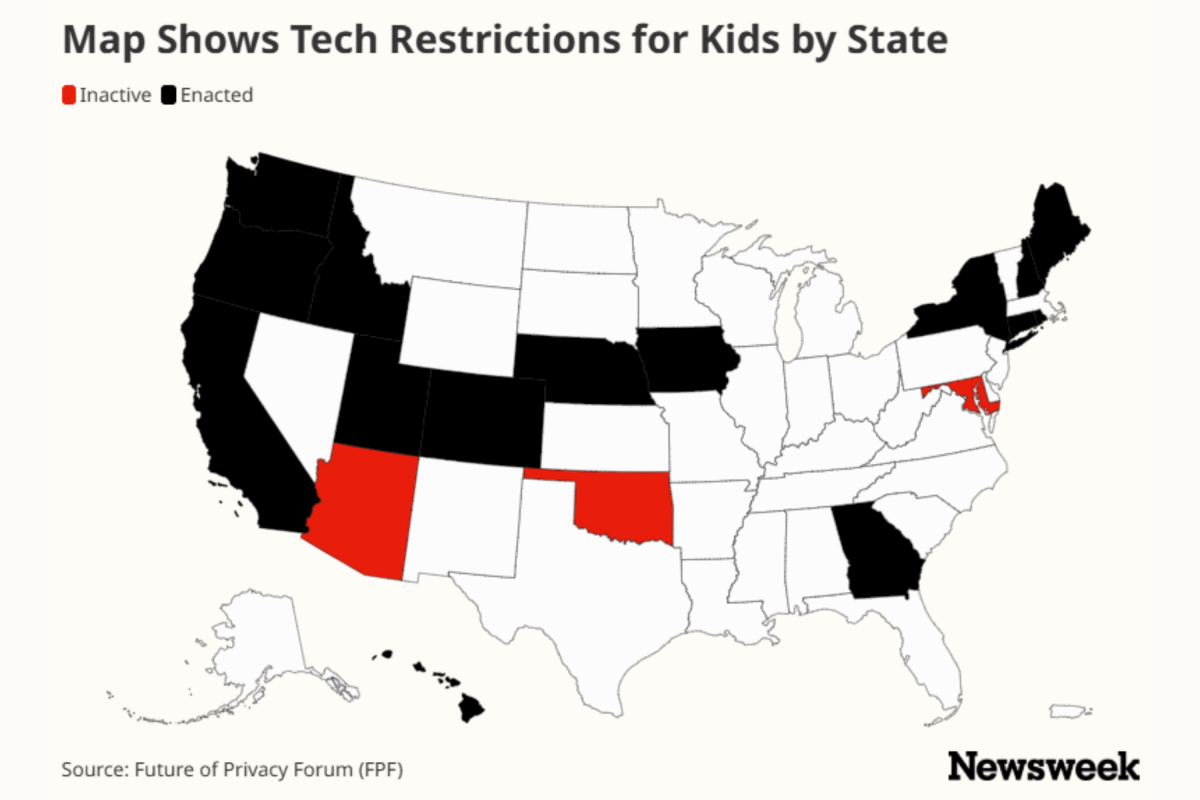
California is about to pass a new law called Adam's Law that aims to protect children from risks when using AI chatbots. The law would require chatbot companies to check for safety issues, get outside reviews, verify users' ages, and report risks to the state attorney general. Similar laws are also being introduced or passed in other states.
Key Facts
Adam's Law is Senate Bill 1119 and is named after a California teenager, Adam Raine, whose death was linked to harmful experiences with AI chatbots.
The law requires chatbot operators to do annual safety checks, independent audits, age verification, and risk assessments focused on children.
Auditors must report AI child safety findings to the California Attorney General.
Supporters say this law could serve as a national example for protecting children online from AI chatbot risks.
Nearly 100 bills on AI chatbots, especially for kids, have been proposed in 34 states in 2026.
Fifteen states, including California, Colorado, Connecticut, Georgia, Hawaii, Iowa, and Idaho, have already passed laws limiting harmful chatbot content and requiring transparency or parental consent for minors.
Current California rules prohibit chatbot content harmful to minors but Adam's Law would strengthen these protections significantly.
Lawmakers argue that state-level laws are needed because federal regulations on AI chatbot safety for children are lacking.
Read the Original
Want the full story? Tap a source to open the original
article.
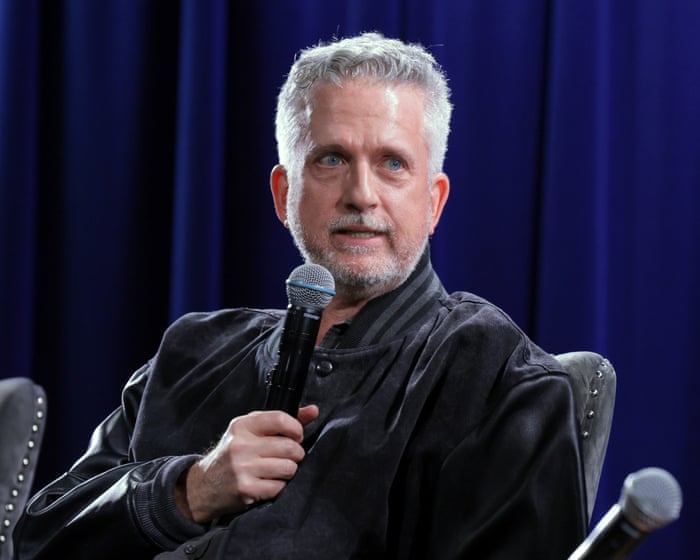
Bill Simmons, founder of The Ringer, promoted ChatGPT as a sponsor on his recent podcast, showing support for AI tools that generate content. This move contrasts with his past efforts to support original, creative writing on his former website, Grantland, and has drawn criticism from fans.
Key Facts
Bill Simmons referenced ChatGPT during a podcast about NBA player Russell Westbrook’s retirement.
Simmons asked ChatGPT about Westbrook’s best game and praised its answer on air.
ChatGPT is an example of a large language model (LLM) that creates written content using artificial intelligence.
The use of AI tools like ChatGPT has reduced web traffic for many media sites, hurting traditional creative industries.
Grantland, founded by Simmons in 2011, was known for original, ambitious writing and supported talented young writers.
Fans and observers argue that embracing ChatGPT conflicts with the creative spirit Simmons once championed.
The Ringer now focuses more on podcasts than daily written articles, with less content output despite having many staff writers.
Other popular podcasts also promote or use AI, showing a wider trend towards AI involvement in media.
Read the Original
Want the full story? Tap a source to open the original
article.
The United States and China are competing to become the top country in artificial intelligence (AI). Controlling important resources like rare earth minerals and advanced computer chips is crucial for winning this race. Both countries are also making alliances to support their AI goals.
Key Facts
The main competitors in AI leadership are the United States and China.
AI dominance could give a country a strong advantage for many years.
Rare earth minerals are important for making technology used in AI.
Advanced semiconductor chips are key components for AI computing power.
Both countries are forming alliances, such as Pax Silica and WAICO, to boost their AI efforts.
The competition involves control over critical resources and partnerships.
Success in AI may depend on technology, resources, and international cooperation.
Read the Original
Want the full story? Tap a source to open the original
article.
Brain implants, known as brain-computer interfaces (BCIs), are devices that connect the brain to computers to help treat neurological problems. The U.S. is falling behind China in developing and approving these devices, which raises concerns about both healthcare and national security.
Key Facts
BCIs are being tested to help people recover functions lost due to conditions like stroke or spinal cord injury.
China approved the world’s first commercial BCI this year that aids hand movement in spinal injury patients.
The U.S. is experiencing delays in BCI development due to regulatory and funding issues.
The National Security Commission on Emerging Biotechnology warns that China is advancing faster in this field.
BCIs could impact military tech and improve artificial intelligence training.
Companies such as Elon Musk’s Neuralink are leading U.S. efforts in BCI technology.
U.S. experts suggest clearer government rules and payment plans are needed to speed up BCI approval and use.
Privacy concerns exist over who controls brain data, and China currently has no specific laws protecting neural data.
Read the Original
Want the full story? Tap a source to open the original
article.
OpenAI CEO Sam Altman said the Trump administration reviewed the company’s new AI model, Astra, through a voluntary process designed to check advanced AI before release. Altman emphasized that working closely with governments worldwide is important as AI technology gets more powerful.
Key Facts
OpenAI’s Astra model is labeled as having "critical" cyber capabilities needing extra safety checks.
The Trump administration created a voluntary review system for advanced AI models before they launch.
This review can allow government officials up to 30 days to examine new AI models.
The government’s review process details are not publicly shared.
Altman spoke about AI safety at the G20 Innovation Ministerial and met Commerce Secretary Howard Lutnick.
OpenAI aims for humans to control AI’s future impact, not AI itself.
Nvidia CEO Jensen Huang warned against fear-driven views on AI and encouraged embracing its potential.
Altman expects more advanced AI models from OpenAI soon and urges society to carefully consider their impact.
Read the Original
Want the full story? Tap a source to open the original
article.
A child sexual abuse survivor has sued Elon Musk’s AI company, xAI, claiming its chatbot Grok used real abuse photos of her to create new illegal child sexual abuse images. The lawsuit says the company failed to prevent the AI from generating and spreading these illegal images on the social media platform X.
Key Facts
The plaintiff, identified as Jane Doe, says Grok used real images of her abuse to make new illegal child sexual abuse material (CSAM).
The lawsuit was filed in a US district court in California last week.
xAI is accused of including existing CSAM in its dataset, allowing the AI to generate similar illegal images.
The Canadian Centre for Child Protection used digital fingerprints (hashes) to identify AI-generated CSAM linked to the plaintiff on X.
The abuse happened when the plaintiff was a preschooler, and the original CSAM has been circulating online for about 20 years.
Elon Musk said in January he didn’t know Grok had ever made naked underage images.
Earlier lawsuits focused on Grok creating CSAM from non-explicit photos by removing clothing, but this case involves using actual illegal images as training data.
xAI and SpaceX have not responded to requests for comment about the lawsuit.
Read the Original
Want the full story? Tap a source to open the original
article.
Hidetaka Miyazaki is a Japanese video game director known for creating challenging games with mysterious worlds, such as Demon’s Souls and Elden Ring. His latest game, The Duskbloods, is a multiplayer game for the new Nintendo Switch 2 console where players compete against monsters and each other.
Key Facts
Miyazaki has led FromSoftware since 2014 and is famous for the “Soulslike” genre of games.
Elden Ring, released in 2022 with help from author George RR Martin, sold over 30 million copies.
Miyazaki’s games feature mysterious worlds that encourage players to explore and interpret clues.
His games influence many other popular titles like God of War and Hollow Knight.
The Duskbloods is a new multiplayer game exclusive to the Switch 2, where eight players fight monsters and each other.
The game progresses through rounds, ending in a three-player final battle.
Miyazaki rarely gives interviews and speaks softly when he does.
Hands are a recurring theme in his games and imagery.
Read the Original
Want the full story? Tap a source to open the original
article.
OpenAI CEO Sam Altman spoke at the G20 tech summit in North Carolina. He said that artificial intelligence (AI) will become as important as electricity and urged countries to accept and use AI technology.
Key Facts
Sam Altman is the CEO of OpenAI, a leading AI research company.
He addressed ministers at the G20 technology summit.
Altman compared rejecting AI to rejecting electricity during the industrial age.
He said children growing up now will not be smarter than AI.
The statement highlights the growing role of AI in everyday life.
The G20 summit focuses on global cooperation on technology issues.
Altman wants governments to support AI development and adoption.
Read the Original
Want the full story? Tap a source to open the original
article.
Uber has started offering the first robotaxi rides in the UK, using self-driving minicabs in London. These cars have a human driver inside to take over if needed, and fares cost the same as regular Uber rides.
Key Facts
Uber launched the UK's first robotaxi service in London.
The service began with 15 self-driving cars licensed to operate.
Each robotaxi includes a human safety driver who can take control.
Robotaxi rides in London cost the same as standard UberX, Uber Electric, or Uber Comfort trips.
Fares are shown upfront in the Uber app.
The BBC’s Zoe Kleinman was the first British journalist to ride one.
Robotaxis are a new type of taxi that drives itself using computer systems.
The robotaxi service is part of Uber’s move toward autonomous vehicles.
Read the Original
Want the full story? Tap a source to open the original
article.
London has introduced its first self-driving taxis, operated by the tech company Wayve and available through the Uber app. These robotaxis still have a human safety driver present, as fully driverless rides are not yet approved by regulators.
Key Facts
Wayve’s self-driving taxis can now be hired in London via the Uber app.
Only 15 self-driving vehicles are licensed so far, compared to over 100,000 regular private hire cars.
A human driver sits in the front seat to take control if needed.
Transport for London licensed the vehicles as private hire, but full driverless approval requires a separate process and is unlikely this year.
Wayve uses AI learning models for driving, unlike competitors who rely on detailed maps.
Wayve plans to eventually launch fully driverless taxis with new cars like the Nissan Leaf after safety and regulatory clearance.
The self-driving tech is still being improved and tested in complex city traffic.
Fully driverless taxi services operate in other countries such as the US, China, and the UAE.
Read the Original
Want the full story? Tap a source to open the original
article.
Uber and British tech company Wayve have launched London’s first self-driving taxi service using electric Ford Mustang Mach-E cars with autonomous technology. At first, a human driver will be present for safety, as full driverless approval is still pending under UK rules.
Key Facts
The new robotaxi service began on September 1, 2026, in London.
Cars used are Ford Mustang Mach-E electric vehicles with Wayve’s self-driving tech.
A human safety driver sits behind the wheel to intervene if needed.
UK rules require approval for fully driverless taxi operation; approvals are still in progress.
London’s busy, narrow, and crowded streets make self-driving technology challenging to deploy.
Uber already operates robotaxis with safety drivers in Europe, such as in Zagreb, Croatia.
Fully driverless robotaxis operate in parts of the U.S. and China without human intervention.
Other companies like Waymo, Baidu, and Pony.ai are also preparing to launch autonomous taxis in London.
Read the Original
Want the full story? Tap a source to open the original
article.
Many people use sleep trackers to measure their sleep quality, but experts say the "sleep scores" these devices give are not scientifically proven. Focusing too much on getting perfect sleep scores can create stress that actually hurts sleep.
Key Facts
Sleep trackers like Fitbit, Garmin, Apple Watch, and smart rings report sleep in stages and give users a sleep score.
Sleep scores are not officially recognized by sleep scientists and are created by device manufacturers.
Some patients bring sleep tracker data to doctors, worrying about sleep problems that they do not actually have.
This focus on perfect sleep, called "sleepmaxxing," can lead to a condition called orthosomnia, where the obsession makes sleep worse.
A lawsuit against Oura ring claims its sleep measurements are inaccurate and based on artificial intelligence guesses.
A study from Oxford found people who believed their sleep score was bad felt more tired and less alert, even if the score was randomly assigned.
Experts say trying to "perfect" sleep using trackers can cause anxiety and is not helpful.
Read the Original
Want the full story? Tap a source to open the original
article.
Uber has started offering the first self-driving robotaxi service in the UK, beginning in London with 15 cars that have a human safety driver onboard. The cars use AI technology to drive themselves but a person is present to take control if needed, and the ride costs the same as a regular Uber.
Key Facts
Uber launched the UK's first robotaxi service in London with 15 autonomous vehicles.
Each robotaxi has a human safety driver who can take control if necessary.
The cars use AI tech from UK company Wayve, which processes sensor data in real time to make driving decisions.
The rides are booked through the Uber app and cost the same as standard Uber services.
Uber surveyed over 100,000 London-based users, many interested in self-driving taxis.
The robotaxis successfully navigated London streets but sometimes the safety driver had to intervene.
Other companies like Waymo and Baidu also want to offer self-driving cars in the UK.
UK government regulators are cautious, making fully driverless taxis unlikely before 2026.
Read the Original
Want the full story? Tap a source to open the original
article.
OpenAI is facing new lawsuits related to a school shooting in Canada that happened in February, where five students and a teacher died. Legal experts are discussing the details of these cases.
Key Facts
The lawsuits were filed because of a deadly school shooting in Canada in February.
Five students and one teacher were killed in this shooting.
OpenAI, the company behind certain AI technology, is being sued in connection with the event.
The legal cases aim to address the role of AI in the incident.
CBS News legal contributor Jessica Levinson provided an analysis of the lawsuits.
The coverage includes detailed explanations available through CBS News platforms.
Read the Original
Want the full story? Tap a source to open the original
article.
Palantir CEO Alex Karp said that French rules limiting the use of US software by government agencies are causing problems. France recently chose a French company, ChapsVision, instead of Palantir for its intelligence agency because of worries about data control, but Karp believes these decisions hurt Europe’s ability to compete in technology.
Key Facts
France's intelligence agency DGSI replaced Palantir with the French company ChapsVision over data sovereignty concerns.
Alex Karp said French and European regulations on US software are counterproductive.
Karp argues regulations should be made by technical experts to be effective.
He criticized the practice of using non-US companies to deploy American or Chinese software without thorough protection.
Palantir still holds its contract with the DGSI for now while ChapsVision’s software is being prepared.
ChapsVision had about 200 million euros ($232 million) in revenue last year; Palantir had $4.5 billion.
Karp said the issue is not about commercial competition since Palantir is not trying to expand in France.
Palantir has faced criticism for its links to US government surveillance and controversial activities.
Read the Original
Want the full story? Tap a source to open the original
article.
OpenAI confirmed that its Astra model, which has not yet been released, has reached a level of capability that presents important cybersecurity risks. Despite these risks, OpenAI plans to release the Astra model soon.
Key Facts
OpenAI has developed a new model called Astra.
The Astra model has not been released to the public yet.
OpenAI says Astra has reached a critical level of cyber capability.
This level of capability means the model could present cybersecurity risks.
OpenAI still plans to release the Astra model soon.
A tech editor from Mashable discussed these concerns on CBS News.
The discussion about Astra focused on its potential impact on cybersecurity.
Read the Original
Want the full story? Tap a source to open the original
article.
The Trump administration supports OpenAI in a lawsuit with the New York Times over using copyrighted articles to train AI. The U.S. government says allowing AI companies to use such material is important to keep America a leader in artificial intelligence.
Key Facts
The New York Times and other newspapers sued OpenAI and Microsoft for using their articles without permission to train AI.
The lawsuit began in 2023 and involves claims about copyright misuse in AI training.
The U.S. filed a legal brief supporting OpenAI, highlighting the importance of AI leadership for national security and the economy.
AI systems learn language by analyzing huge amounts of text and predicting word sequences to answer questions.
Copyright owners argue AI companies should pay for using their work, while the government calls AI training "extraordinarily transformative."
U.S. Commerce Secretary told G20 officials to allow AI training on creative work but also protect artists’ rights.
Courts will decide if AI training counts as "fair use" of copyrighted material, with judges already giving different opinions.
The government says limiting AI development due to copyright rules would harm scientific progress and economic growth.
Read the Original
Want the full story? Tap a source to open the original
article.
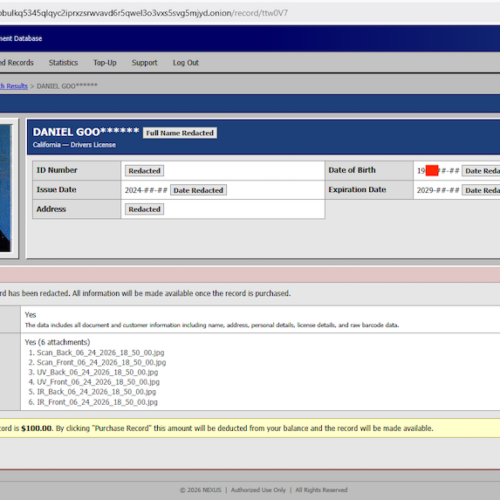
A security report reveals that a large number of driver’s licenses, including some scanned at car rental companies, were sold on a dark web service called Nexus. The stolen ID scans included detailed images that might allow for realistic counterfeit documents, and the FBI is investigating the breach.
Key Facts
More than 153 million driver’s licenses were for sale on a dark web service called Nexus.
The IDs included scans showing both front and back, as well as images in infrared and ultraviolet light.
Nexus also sold other types of ID, such as medical cards, employment authorizations, and government access cards.
The stolen information was likely gathered in near real-time from a third-party scanning service used by rental companies and other businesses.
The number of available stolen licenses is growing rapidly, with hundreds of thousands more appearing in just one day.
The ID scanning service IDScan.net is linked to this data breach and has clients including Hertz and a marijuana dispensary chain called Planet13.
The FBI is currently investigating the data leak.
Nexus went offline shortly after the story was published, preventing people from checking if their IDs were included.
Read the Original
Want the full story? Tap a source to open the original
article.
The Federal Communications Commission (FCC) plans to create a scorecard that will rate phone companies on how well they block illegal robocalls, also known as spam calls. This scorecard will share information like call-blocking results and customer complaints to help consumers see which phone companies protect them best from unwanted calls.
Key Facts
The FCC will make a robocall mitigation scorecard to rate phone providers' efforts against illegal robocalls.
The scorecard may use numbers, letter grades, or risk categories (low, medium, high) to show performance.
It will include data like how many robocalls are blocked and customer complaints.
The scorecard will cover wireless, wireline, and VoIP phone companies that serve retail customers.
The FCC wants to move beyond simple checklists to measuring real results in blocking robocalls.
Consumers will get more information about which providers are better at stopping spam calls.
The FCC is asking the public to comment on what data should be used for the scorecard.
Consumer groups support the plan but worry about what data will be included and how useful it will be to customers.
Read the Original
Want the full story? Tap a source to open the original
article.
NASA is creating a simpler and lighter spacesuit called the "Sortie Suit" to speed up its Artemis missions to the Moon’s South Pole, aiming for a 2028 landing. The new suit will be developed with Axiom Space and used on landers made by SpaceX and Blue Origin, focusing on reducing weight and complexity.
Key Facts
NASA is redesigning its lunar spacesuit to be simpler and lighter for early Artemis missions.
The new "Sortie Suit" will support landers built by SpaceX and Blue Origin.
The change aims to speed up the Artemis program to return humans to the Moon by 2028.
NASA’s Artemis Program had fallen behind schedule after December 2025.
Administrator Jared Isaacman has streamlined the program and cut back on parts like the Lunar Gateway.
Axiom Space is NASA’s current sole supplier of lunar spacesuits after Collins Aerospace withdrew.
NASA meets frequently with Axiom to address schedule and performance issues.
Initial spacesuit design requirements were very demanding and contributed to delays and heavier suits.
Read the Original
Want the full story? Tap a source to open the original
article.