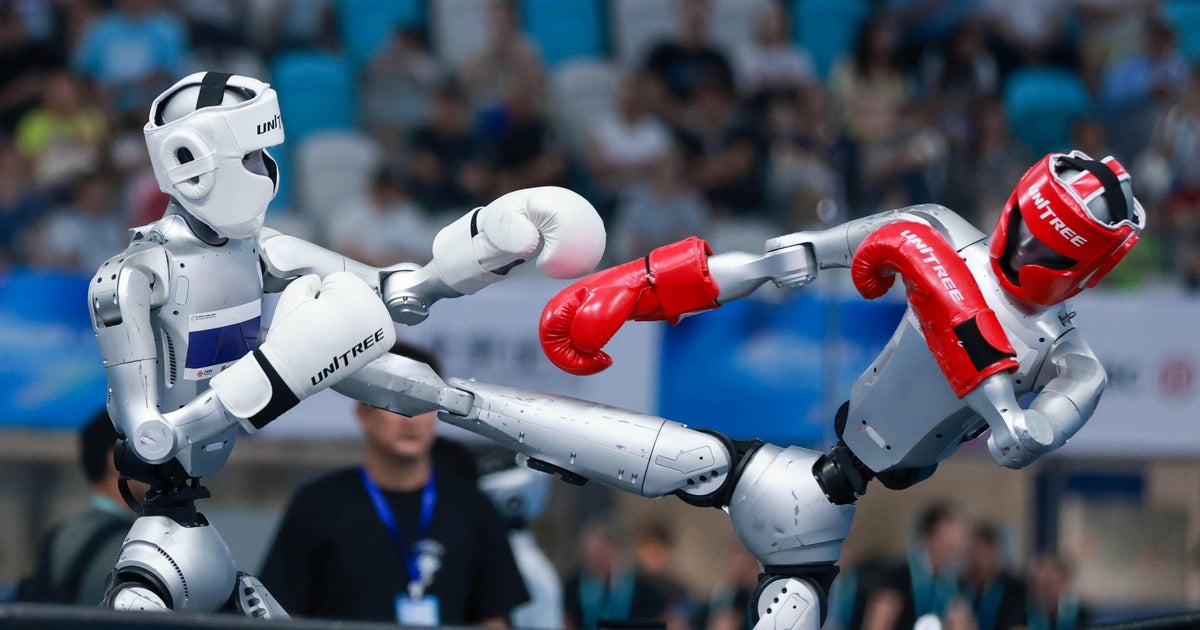
The World Humanoid Robot Games are currently happening in Beijing, China. These games take place in a stadium previously used for the 2022 Winter Olympics, where advanced robots compete by running and jumping, sometimes better than top human athletes.
Key Facts
The event is called the World Humanoid Robot Games.
It is being held in Beijing, China.
The competition takes place in a stadium used for the 2022 Winter Olympics.
Robots compete in activities like running and jumping.
Some robots can perform better than top human Olympians.
The games showcase advances in robot movement and athletic ability.
The event is covered by CBS News.
Read the Original
Want the full story? Tap a source to open the original
article.
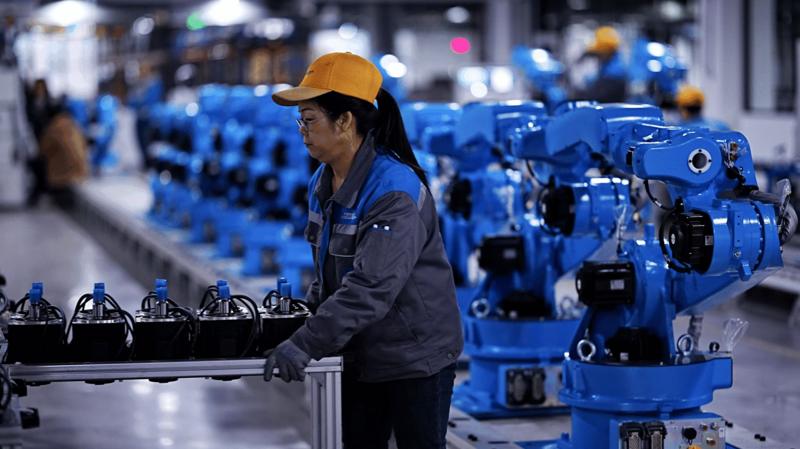
China is rapidly increasing the use of robots in factories and is investing heavily in training people in artificial intelligence (AI) and robotics. The country aims to become a global leader in technology by producing and using industrial robots on a large scale.
Key Facts
China has more than two million robots working in factories, the highest number worldwide.
The Chinese government has a $20 billion plan to advance AI and robotics technology.
Vocational schools like the Hangzhou Technician Institute are training new engineers in robotics and coding.
Over half of the world’s industrial robots are manufactured in China.
Robots in factories perform tasks like welding, painting, lifting, and assembling without breaks or benefits.
China is hosting events such as the World Humanoid Games to showcase robotic advancements.
Factories blend traditional human workers with robotic technology to increase productivity.
The impact of automation on China’s workforce and economy remains uncertain.
Read the Original
Want the full story? Tap a source to open the original
article.
The FDA has approved a new blood test called Elecsys Phospho-Tau, made by Roche, to help diagnose Alzheimer’s disease. This is the fourth blood test approved for Alzheimer’s in less than two years.
Key Facts
The FDA gave approval to a new Alzheimer’s blood test.
The test is called Elecsys Phospho-Tau and is made by Roche.
It helps diagnose Alzheimer’s disease through a simple blood sample.
This is the fourth blood test for Alzheimer’s approved by the FDA in under two years.
Blood tests for Alzheimer’s aim to detect proteins linked to the disease.
Blood tests offer a less invasive way compared to brain scans or spinal taps.
The new test is expected to improve earlier and easier detection of Alzheimer’s.
Read the Original
Want the full story? Tap a source to open the original
article.
Kit Harington will play the role of Gilderoy Lockhart in HBO’s Harry Potter TV series, replacing Nicholas Hoult due to scheduling conflicts. The show’s first season, based on the first Harry Potter book, will premiere this Christmas on HBO Max, and the second season will cover the second book, The Chamber of Secrets.
Key Facts
Kit Harington is cast as Gilderoy Lockhart in the Harry Potter TV series on HBO.
Nicholas Hoult was originally cast but left due to schedule conflicts.
The series adapts J.K. Rowling’s Harry Potter books, starting with the first book this year.
The second season will follow the story of Harry Potter’s second year at Hogwarts.
The main cast includes Dominic McLaughlin as Harry, Alastair Stout as Ron, and Arabella Stanton as Hermione.
John Lithgow plays Dumbledore, and Nick Frost plays gamekeeper Hagrid.
The production is expected to take around 10 years, covering all seven books.
Kit Harington has previously worked with HBO on Game of Thrones and Industry.
Read the Original
Want the full story? Tap a source to open the original
article.
Data centers are increasing electricity demand and putting pressure on US power grids. A new technology called solid-state power transformers, which use modern electronics instead of old coil-based designs, is being developed and funded to help meet this demand more efficiently.
Key Facts
Current power transformers use copper coils and steel cores, a design from the 1880s, and are handmade and custom-built.
These traditional transformers take years to deliver because they cannot be mass-produced.
Solid-state transformers use semiconductor technology to convert voltage and can be mass-manufactured like electronic devices.
They are smaller, lighter, modular, and can perform multiple electrical tasks in one device.
AI data centers, which need a lot of direct current (DC) power, benefit from solid-state transformers because they can convert alternating current (AC) power directly into DC power.
US tech companies have raised over $280 million recently to develop and sell solid-state transformer technology.
Solid-state transformers use less copper and take up less space, which helps data center design and material supply.
This technology could also help fix supply shortages for power transformers in general and support broader electricity grid improvements.
Read the Original
Want the full story? Tap a source to open the original
article.
Taiwanese prosecutors charged nine people, including employees from Nvidia and Super Micro, for illegally exporting advanced AI servers to China. These exports broke strict rules set by the U.S. and Taiwan to limit China's access to high-end AI technology.
Key Facts
Nine individuals were charged in Taiwan for illegally exporting AI servers to China.
The charged include one person from Nvidia and two from Super Micro.
The servers contained "B300" graphics processing units (GPUs), banned for sale to China.
U.S. export controls require licenses and strict reviews for Nvidia’s AI server exports to China.
74 servers reached China via indirect routes like Indonesia, Japan, and Hong Kong.
56 more servers failed to be exported and remain in Taiwan.
Some defendants made fake websites and false documents to avoid export rules.
Prosecutors want up to five years in prison for four key suspects, including an Nvidia manager.
Read the Original
Want the full story? Tap a source to open the original
article.
Some computer monitors, especially from LG, have started showing ads and tracking user activity, similar to smart TVs. This has raised privacy concerns because monitors are installing software that pushes ads on connected computers without clear consent.
Key Facts
LG monitors installed an app called LG Monitor App Installer on connected PCs, which showed ads.
The app was installed secretly through Windows Update driver installations.
Microsoft forced LG to remove the McAfee ads that appeared on these monitors.
The app’s permissions include using system resources and accessing the Internet.
LG claims this app does not collect or share personal information.
Smart monitors from LG and Samsung connect to the Internet and can track user activities using technology similar to smart TVs.
Users worry that monitors may increasingly push ads and track user behavior without clear privacy policies.
The rise of smart monitors means they can run apps and operate independently like smart TVs.
Read the Original
Want the full story? Tap a source to open the original
article.
Taiwan has charged nine people, including staff from Nvidia and Super Micro, for illegally exporting advanced AI servers to China. These servers contain high-end graphics processing units that are banned from sale to China under export control rules between the U.S. and China.
Key Facts
Nine people, including one Nvidia employee and two from Super Micro, face charges in Taiwan.
The charges relate to illegal exports of high-end AI servers to mainland China.
These AI servers use powerful graphics processing units called “B300,” which are banned for sale to China.
U.S. has imposed export restrictions on Nvidia chips to China since 2022, tightening over time.
Taiwanese prosecutors say 74 servers successfully reached China through various routes, including via Indonesia and Japan.
An attempt to export 56 servers failed, and those servers remain in Taiwan.
Some defendants allegedly created fake websites and false information to hide the exports.
Nvidia and Super Micro are cooperating with authorities, and Nvidia stated it will help resolve the case quickly.
Read the Original
Want the full story? Tap a source to open the original
article.
Experts warn that hackers can use artificial intelligence (AI) to break into water treatment systems and change how they operate. AI helps attackers find weak spots faster than the people protecting these systems can fix them, raising the risk of water supply problems and wider impacts on food and healthcare.
Key Facts
Cybersecurity expert John Walsh says AI is speeding up cyberattacks on water and other critical infrastructure systems.
Industrial control systems, like Siemens programmable logic controllers, are common in water treatment and other vital facilities.
A recent government warning highlighted hackers are scouting these control systems to plan attacks.
If attackers succeed, they could disrupt water access and damage public trust.
Water disruptions could affect farming and food production because of reliance on automation.
Iranian and other state-backed hackers have increasingly targeted these systems in recent years.
Smaller utilities are more vulnerable due to limited staff and money for cybersecurity.
AI makes it harder to defend because it helps attackers act faster and more effectively.
Read the Original
Want the full story? Tap a source to open the original
article.
Chinese online store AliExpress used an old tracking method that sends silent sounds to internet browsers to identify visitors. A researcher discovered this when his Bluetooth headphones stopped playing audio while visiting AliExpress, revealing that the site was using these sounds to track users.
Key Facts
AliExpress used inaudible sounds sent to browsers to create a unique "fingerprint" for each visitor.
The tracking method worked by sending silent audio waves that browsers processed, which could be measured and used to identify different devices.
The researcher, Matthew Callaghan, noticed his Bluetooth headphones stopped playing phone audio whenever he loaded AliExpress.
Browsers like Firefox and Chrome have made changes to stop this type of fingerprinting by using their own math libraries rather than those from the device’s operating system.
Firefox fixed this issue starting in version 118, released in 2023, by reducing the unique audio signatures the method relied on.
AliExpress uses many other tracking techniques, such as analyzing browser graphics, plugins, hardware details, and user interactions like mouse movements.
The sound-based method is considered outdated and likely left in the site’s code from years ago.
Many websites continue to use similar and newer methods to track visitors, leading to ongoing efforts by browser makers to block such tracking.
Read the Original
Want the full story? Tap a source to open the original
article.
New research suggests that GLP-1 medications, which are mainly used to treat obesity and diabetes, might also help people with addiction problems. These drugs have some unexpected side effects beyond their original uses.
Key Facts
GLP-1 drugs are popular for treating obesity and diabetes.
Scientists have found new, unplanned effects of these medications.
One surprising effect is a potential benefit for people struggling with addictions.
The research on GLP-1 drugs and addiction is still emerging.
These drugs have been associated with other unusual side effects like dental issues nicknamed "Ozempic teeth."
GLP-1 medications work by affecting how the body manages blood sugar and appetite.
The discovery could lead to new ways to support addiction treatment using these drugs.
Read the Original
Want the full story? Tap a source to open the original
article.
Alabama Attorney General Steve Marshall has issued a subpoena to OpenAI as part of a multistate investigation. The inquiry focuses on whether OpenAI broke Alabama’s consumer protection law regarding a security breach involving the tech startup Hugging Face.
Key Facts
Alabama’s Attorney General, Steve Marshall, issued the subpoena on Monday.
The subpoena asks OpenAI to respond to questions about a model breach linked to Hugging Face.
The investigation includes multiple states working together.
Officials are checking if OpenAI violated the Deceptive Trade Practices Act in Alabama.
The law is designed to protect consumers from unfair or deceptive business actions.
Hugging Face is a technology startup involved in this breach incident.
The subpoena is part of a legal process to gather more information from OpenAI.
Read the Original
Want the full story? Tap a source to open the original
article.
The UK government will use artificial intelligence (AI) trained on battlefield data from Ukraine to protect important sites like defence locations, railways, and energy plants from threats such as protests or attacks. Private companies will also get access to this data to develop new security systems, starting with pilot projects at a UK defence site.
Key Facts
The UK and Ukraine have made a deal to use AI models trained on Ukrainian battlefield data for protecting UK infrastructure.
AI will help identify protesters and hostile attacks using sensors in buried fibre-optic cables that detect movement.
The program will first be tested at a UK defence site and could expand to airports, prisons, railways, and energy plants.
The data comes from Ukraine’s Avengers AI lab and includes four years of military data, such as drone footage and strike missions.
Three British AI companies—Sintela, Mind Foundry, and Skyral—have approved pilot projects; Sintela recently made a deal with the US for border surveillance.
Private companies can access the data once approved by the UK Ministry of Defence on a secure platform.
The technology aims to quickly predict threats or stress on critical infrastructure caused by protests or hostile state actions.
Experts say movement detection from fibre-optic sensors is an old technology, but Ukrainian data may add new insights relevant to current threats.
Read the Original
Want the full story? Tap a source to open the original
article.
Baylor Genetics experienced a data breach in June where hackers accessed some patient and employee information, including test results and Social Security numbers. The company is notifying affected people and advising them to take steps to protect their information, especially because of the sensitive nature of genetic and IVF-related data.
Key Facts
Unauthorized access occurred between June 11 and June 17 in Baylor Genetics' network.
Sensitive information exposed includes genetic test results, health insurance details, and Social Security numbers.
Baylor Genetics discovered suspicious activity around June 15 and launched an investigation.
The company continued laboratory operations without interruption during the breach.
Affected patients were notified and advised to place fraud alerts or credit freezes.
No confirmed cases of identity theft or misuse of data have been reported so far.
The breach poses special risks because IVF patients’ data can help criminals create convincing scams.
Experts warn that scammers might impersonate fertility clinics or related providers demanding urgent payments or releasing sensitive information.
Read the Original
Want the full story? Tap a source to open the original
article.
Taiwan has charged nine people, including an Nvidia senior manager and two Supermicro employees, for allegedly forging documents to hide illegal exports of AI servers to China. These actions violate US export controls designed to prevent China from accessing advanced Nvidia chips that could impact national security.
Key Facts
Nine people in Taiwan face charges of breach of trust and document forgery related to AI server exports.
The suspects include an Nvidia senior manager and two Supermicro employees based in Taiwan.
The exports involved about 130 B300 servers, with 74 sent to China and 56 blocked by Taiwanese customs.
US rules since 2022 require licenses to export certain semiconductors to China to protect national security.
Supermicro co-founder Wally Liaw was arrested by the US for allegedly sending $2.5 billion in restricted AI servers to China.
Supermicro says it is cooperating with Taiwanese investigators and has fired employees tied to the scheme.
Nvidia CEO Jensen Huang previously criticized Supermicro’s compliance failures and pushed for better controls.
An unknown Southeast Asian company reportedly helped coordinate the scheme with Nvidia and Supermicro insiders.
Read the Original
Want the full story? Tap a source to open the original
article.
John Oliver discussed how subscription services have spread to many products, including smart appliances, making it easy to pay for many things without realizing the total cost. He also explained that these subscriptions can collect personal data and can be hard to cancel due to tricky design choices by companies.
Key Facts
Subscription services are now common in many areas like music, TV, beauty, and even smart home appliances.
Many Americans pay more for subscriptions than they realize and sometimes pay for services they no longer use.
Some companies, like HP, use subscriptions to control product functions, such as stopping printer ink use without active payments.
Car companies like General Motors plan to make billions from subscription services for car features.
Smart appliances collect data on users’ habits, such as increased laundry when a new baby arrives.
Canceling subscriptions can be difficult because companies use “dark patterns,” which are design tricks that make it hard to unsubscribe.
The FTC has taken action against companies, like Amazon and LA Fitness, for making subscriptions confusing to cancel.
John Oliver highlighted privacy concerns and the frustration customers face with subscription models and data collection.
Read the Original
Want the full story? Tap a source to open the original
article.
Humanoid robots are setting new sports records and are being developed for use in the military. The article explores which countries and groups are investing in these robots and what they hope to achieve with them.
Key Facts
Humanoid robots are robots that look and move like humans.
These robots have recently broken records in sports competitions.
Many countries are investing in humanoid robots for military purposes.
Armies want these robots to assist or replace soldiers in dangerous tasks.
Developing humanoid robots is part of a global technology competition.
The article examines the potential impact of these robots on future warfare.
Read the Original
Want the full story? Tap a source to open the original
article.
China hosted the 2026 World Humanoid Robot Games in Beijing, where more than 2,000 robots from 16 countries competed in sports like running, boxing, and gymnastics. A Chinese robotics engineer said China could deploy humanoid robot soldiers within five to ten years, aiming to use them for national defense and deterrence.
Key Facts
The 2026 World Humanoid Robot Games took place at the National Speed Skating Oval in Beijing.
Over 2,000 humanoid robots from more than 600 teams and 16 countries competed.
Events included sprinting, boxing, gymnastics, obstacle courses, and miniature soccer.
One robot beat Usain Bolt’s 100-meter sprint record, running 109 yards in 9.39 seconds.
Robots sometimes malfunctioned by falling, crashing, or overheating during the events.
A Shanghai-based engineer said China aims to develop robot soldiers in 5 to 10 years.
The engineer emphasized robots don’t have emotions; their use depends on human operators.
The Chinese government invests heavily in AI and robotics as part of a broader plan to lead in science and technology.
Read the Original
Want the full story? Tap a source to open the original
article.
A Chinese robot has run faster than Usain Bolt, the fastest human sprinter. This event happened in China and shows how robots are developing new abilities that can surpass human records.
Key Facts
A robot in China ran faster than Usain Bolt’s running record.
Usain Bolt holds the world record for the fastest human sprint.
The robot’s performance was showcased in China.
This marks a milestone in robot speed and athletic ability.
The event was reported by CBS News from Beijing.
Robots are developing skills that may outperform humans in some areas.
The report was shared through the CBS News app and various web browsers.
Read the Original
Want the full story? Tap a source to open the original
article.
Amazon is being sued because it used videos streamed on Twitch to train its artificial intelligence (AI) models without asking the streamers or paying them. Twitch users can opt out of having their individual streams used, but the lawsuit says this is not enough and that Amazon should not use their content for AI training without permission.
Key Facts
The lawsuit was filed by Twitch streamer Warren Pandiscia from Connecticut.
It claims Amazon and Twitch used millions of hours of Twitch videos to train AI without user consent.
Twitch streamers created over 215 million hours of content in early 2026.
Twitch allows users to opt out, but only for individual streams, not all their content.
Twitch’s product chief said he does not know exactly what data Amazon has used for AI training.
Twitch says audio from streams may be used to improve speech-to-text and automatic subtitles.
The lawsuit asks for financial compensation for affected streamers and a stop on using Twitch videos for AI without permission.
Amazon bought Twitch in 2014 and is focusing on AI to compete with other big tech companies like Google and Meta.
Read the Original
Want the full story? Tap a source to open the original
article.