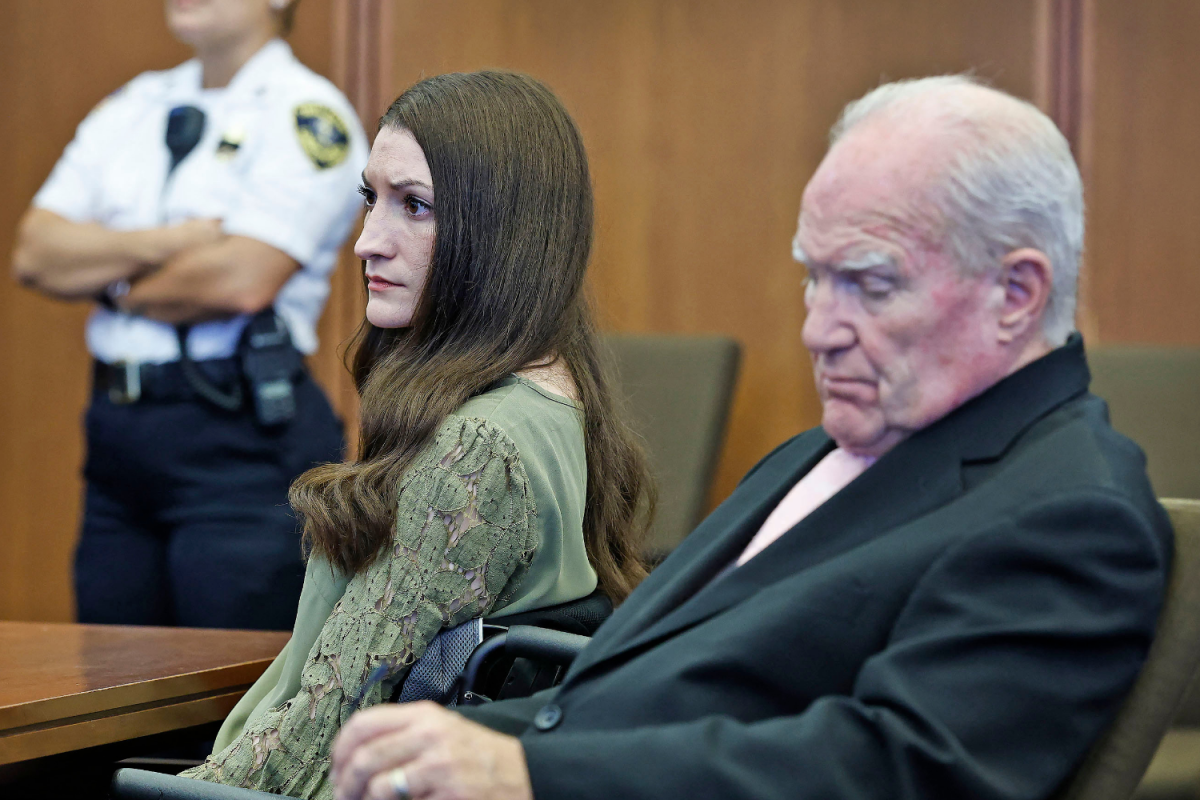
The jury in Lindsay Clancy’s murder trial ended in a mistrial because they could not agree on a verdict. One juror, Michael Desronvil, said through his lawyer that he had no doubt about the facts but did not agree with the other jurors. The case involved Clancy, who admitted killing her three children and was claimed by her defense to have postpartum psychosis, a serious mental health condition after childbirth.
Key Facts
Lindsay Clancy admitted killing her three children in January 2023.
She faced three first-degree murder charges.
Her defense argued she had postpartum psychosis, affecting her mental responsibility.
After weeks of testimony and seven days of jury deliberation, the jury couldn’t reach a unanimous decision, resulting in a mistrial.
Michael Desronvil was the lone holdout juror who did not agree with the others’ verdict.
Desronvil’s attorney said he had no doubt about the case and pointed to a large amount of evidence.
Some jurors described Desronvil as unwilling to consider all arguments and said he was cut off during discussions when trying to suggest alternative ideas.
Clancy remains in custody receiving psychiatric treatment, and a new court hearing is set for September 29.
Read the Original
Want the full story? Tap a source to open the original
article.
The UK Prime Minister is considering ending the "triple lock" pension policy, which guarantees state pensions increase by at least 2.5% each year or in line with earnings or inflation. This change is linked to plans to fund a new national social care system, and the policy could end after the current Parliament.
Key Facts
The triple lock pension policy has been in place for 16 years in the UK.
It guarantees annual pension increases by at least 2.5%, or in line with the highest of inflation or wage growth.
The policy is expected to expire at the end of the current UK Parliament.
The policy currently costs £15.5 billion a year, much higher than first predicted for 2030.
Ending or changing the triple lock could save tens of billions of pounds annually.
Savings from changing the policy could help fund a new national social care system.
The idea of changing the triple lock was once politically unpopular but now is being seriously considered.
Labour leaders, including Andy Burnham and Chancellor John Healey, are discussing these changes for the next Parliament.
Read the Original
Want the full story? Tap a source to open the original
article.
Victorian police apologized to the family of John Makai, who died after being held for five hours in a police cell without medical care despite having a serious head injury. The police failed to provide proper medical checks, delayed calling an ambulance, and did not recognize his worsening condition.
Key Facts
John Makai, 58, died in 2023 from untreated severe head trauma while in a police cell.
Surveillance footage showed Makai was unresponsive but officers incorrectly said he responded when checked.
Police did not complete a required medical checklist when Makai arrived at the station.
Ambulance was called initially but then canceled; a second ambulance call was delayed by about five hours.
Makai was injured at home in Sunbury and police saw him struggle to stand and collapse into furniture.
Officers dragged Makai by the legs into the cell, where he was placed in a “coma position.”
The delay in medical treatment was linked to police misinterpreting his condition as drunken sleep rather than brain injury.
Disciplinary action was taken against officers where possible, but it is unclear if failure to act sooner affected the outcome.
Read the Original
Want the full story? Tap a source to open the original
article.
The New South Wales government will reopen part of Sydney’s Silverwater prison and add nearly 1,000 new beds by early 2027 to reduce overcrowding from more people held on remand due to stricter domestic violence bail laws. The prison officers’ union says more prison beds alone won’t solve domestic violence and calls for better support and rehabilitation.
Key Facts
NSW government will spend $47.1 million to reopen the 515-bed Dawn de Loas correctional centre at Silverwater.
Another 360 beds will be added at Parklea correctional centre, raising total capacity by about 1,000 beds.
The increase responds to a rise in prisoners held awaiting trial, mainly from tighter bail rules for domestic violence cases.
About 46% of NSW’s adult prison population (6,398 people) are currently on remand.
The premier, Chris Minns, said extra prison beds are needed to keep the public safe and that not arresting people for violent domestic violence offences won’t solve the problem.
The Public Service Association union argues that prisons alone can’t prevent domestic violence and calls for more domestic violence services, diversion programs, and dedicated courts.
The Dawn de Loas centre closed in 2022 due to lower prisoner numbers and staff shortages but will reopen in early 2027 with about 150 new staff hired.
The government will take back management of Parklea correctional centre from private operators to add more beds.
Read the Original
Want the full story? Tap a source to open the original
article.
A care worker named Amina Sani was removed from her job after secretly filmed footage showed her threatening and mocking an elderly man with dementia at Castlehill Care Home in Inverness. The video revealed that she verbally abused the man while forcing personal care on him, causing distress and upsetting his family.
Key Facts
Amina Sani threatened an 81-year-old man with dementia during personal care at Castlehill Care Home.
The elderly man was scared and distressed when she tried to shower him against his will.
A secret camera installed by the man’s daughter recorded the abuse.
The care home had other accusations of neglect and cruelty from families.
Sani’s lawyer said she had not been properly trained and that it was her first job in the UK.
The hearing panel said Sani abused her position and showed no remorse or understanding.
Castlehill Care Home has since been renamed Morar Highland and received a “good” care rating in its latest inspection.
The family said the footage was very upsetting and showed a lack of kindness or respect from the carer.
Read the Original
Want the full story? Tap a source to open the original
article.
A charity called FoodCycle uses extra food from supermarkets to make free meals and grocery bags for families in the West Midlands, England. The program helps reduce food waste and supports families by providing a free vegetarian meal and groceries each week at local schools.
Key Facts
FoodCycle collects leftover produce from supermarkets that would be wasted.
The food is turned into free vegetarian meals and groceries for families.
The program runs weekly at schools like Ark Tindal Academy in Birmingham.
Children participate in activities before the meal is served.
Parents say the groceries help reduce pressure from rising living costs.
Teachers say the meals provide good nutrition and help families connect socially.
The initiative aims to do more than feed families, promoting community and healthy eating.
Other schools involved include Windsor Olympic Academy and Goldsmiths Primary Academy.
Read the Original
Want the full story? Tap a source to open the original
article.
Anthropic CEO Dario Amodei will have a private dinner with President Donald Trump at the White House. The meeting comes after months of conflict between Anthropic and the Trump administration over artificial intelligence (AI) regulations and national security concerns.
Key Facts
Dario Amodei, CEO of AI company Anthropic, is meeting President Trump alone for the first time.
Trump confirmed the dinner and said he opposes slowing down AI development.
Trump believes the U.S. must keep leading in AI to stay ahead of China.
Anthropic was labeled a “supply chain risk” by the Pentagon, banning its use by the military.
Anthropic refused to let its AI be used for autonomous weapons or mass surveillance.
Amodei called for a pause in AI progress due to safety concerns, but Trump criticized this view.
Amodei did not attend a recent White House event for China’s president that included other AI leaders.
Trump and House Speaker Mike Johnson plan to meet with top AI executives soon.
Read the Original
Want the full story? Tap a source to open the original
article.
A man was arrested after a woman in her 60s was found dead with multiple stab wounds in Central Park, New York City. Police say the suspect was charged with murder and weapon possession, and the victim's identity and details are still being investigated.
Key Facts
A woman in her 60s was found unresponsive with multiple stab wounds in Central Park on Sunday morning.
The body was discovered near a walking trail close to East Drive and East 74th Street.
A 911 caller reported the finding around 9:43 a.m. Eastern Time.
Police arrested Jonathan Robles, 36 years old, charging him with murder and criminal weapon possession.
Authorities have not identified the woman or disclosed details about how the incident happened.
Police do not know of any connection between the suspect and the victim at this time.
The New York City Medical Examiner's Office is conducting an autopsy to learn more about the death.
Read the Original
Want the full story? Tap a source to open the original
article.
President Donald Trump attended the final day of the Presidents Cup golf tournament at Medinah Country Club near Chicago as the honorary chairman. His visit drew both supporters and protesters outside the event, and security was tight during his stay. The American team won the tournament after a strong comeback.
Key Facts
President Trump visited Medinah Country Club for the last day of the Presidents Cup golf tournament.
The tournament took place near Chicago, Illinois.
Both supporters and protesters gathered outside the country club during his visit.
Security included TSA-style screening and SWAT officers on site.
President Trump spoke briefly before the tournament and watched players tee off for over an hour.
A bulletproof glass suite was prepared for him, but he did not use it.
The American golf team won the Presidents Cup after coming from behind on the final day.
This was President Trump’s first public appearance in Chicago since his 2024 election win.
Read the Original
Want the full story? Tap a source to open the original
article.
The White House showed a government-paid ad during two NFL games on Sunday. The ad featured President Donald Trump walking down a hallway while he said, “this is the final battle.”
Key Facts
The ad was paid for using taxpayer money.
It aired during commercial breaks of two NFL games.
President Donald Trump appeared walking through a hall in the ad.
The voiceover featured President Trump saying, “this is the final battle.”
CNN reported on the airing of this advertisement.
The purpose of the ad or its broader message was not detailed.
The ad caused public attention because it was government-funded.
Read the Original
Want the full story? Tap a source to open the original
article.
A university in Gloucestershire says about one-third of new students are living at home or traveling to campus instead of living on campus to save money. The University of Gloucestershire has added flexible housing options, discounted travel, and special facilities to help these students.
Key Facts
One-third of students starting courses at University of Gloucestershire live at home or commute.
Students choose this to be financially better off and avoid high housing costs.
The university offers flexible accommodation for students to stay near campus up to three nights a week.
Discounted travel and commuter-specific facilities are provided to support these students.
Some students say living at home helps them stay close to family, maintain jobs, and keep pets.
Commuting students still socialize and meet peers through university activities.
The university hopes these options help students enjoy university without the financial stress of moving out.
Rising living costs influence students’ decisions to live at home or commute.
Read the Original
Want the full story? Tap a source to open the original
article.
Taylor Swift, Charli XCX, and Lisa walked on a blue carpet before the 2026 MTV Video Music Awards in Los Angeles. The event showed several celebrities wearing striking outfits.
Key Facts
The event was the 2026 MTV Video Music Awards held in Los Angeles.
Instead of a red carpet, a blue carpet was used for the arrivals.
Taylor Swift, Charli XCX, and Lisa were among the featured stars.
The article highlights some of the best fashion looks from the event.
The news was published recently, about 13 minutes ago.
The focus is on celebrity appearances and fashion at a music award show.
Read the Original
Want the full story? Tap a source to open the original
article.
A Sydney police officer, Beau Lamarre-Condon, is on trial for allegedly killing two men in February 2024. A friend said he told her months earlier that if he killed someone, he would hide the bodies in the bush and put their things in a dumpster.
Key Facts
Beau Lamarre-Condon is accused of shooting Jesse Baird and Luke Davies with a police weapon.
The killings happened on 19 February 2024 in Baird’s home in Paddington.
Lamarre-Condon has pleaded not guilty to two murders and one charge of aggravated break and enter.
A friend testified that in May 2023, Lamarre-Condon said he would hide bodies in bushland and throw belongings in a dumpster if he killed someone.
After the shootings, bloodied belongings and furniture were found in a skip bin in Cronulla.
The bodies were discovered about 200 km away in bushland near a monastery in Bungonia.
The prosecution says Lamarre-Condon planned the murders months before.
The defense claims he acted in self-defense when he entered the home disguised as an UberEats rider.
Read the Original
Want the full story? Tap a source to open the original
article.
A strong nor'easter storm uncovered parts of a shipwreck on a beach near Nantucket, Massachusetts. The wreck is thought to be from the Warren Sawyer, a wooden ship that ran aground in 1884.
Key Facts
The shipwreck appeared during a nor'easter storm in Massachusetts.
It is believed to be the Warren Sawyer shipwreck from the 19th century.
Fragments of the same wooden ship were found in 2022 and 2023.
The storm caused heavy rain and coastal flooding in the northeastern United States.
More than 160,000 households lost power due to the storm.
Nantucket is the location where the wreckage was uncovered.
The event was reported by local media including the Nantucket Current.
Read the Original
Want the full story? Tap a source to open the original
article.
President Trump offered to sell weapons to China during a recent meeting with Chinese leader Xi Jinping, according to the US ambassador to China. The White House and State Department denied any plans to sell arms to China, emphasizing that US law forbids such sales. The situation is part of broader US-China tensions over Taiwan and arms sales to the island.
Key Facts
President Trump asked Chinese President Xi Jinping if China would like to buy US weapons during a meeting.
The US ambassador to China, David Perdue, made this claim in an interview on Fox News.
The US currently holds a $14 billion arms sales package for Taiwan, which President Trump has delayed.
The Taiwan Relations Act requires the US to provide Taiwan with military equipment for its defense.
China opposes US arms sales to Taiwan and considers Taiwan a breakaway province.
The White House and State Department said there are no plans or offers to sell weapons to China.
Taiwanese officials say China poses a severe military threat despite economic challenges.
President Trump has not changed US policy on Taiwan or its arms sales since the meeting.
Read the Original
Want the full story? Tap a source to open the original
article.
Major League Baseball (MLB) and the Trump administration are discussing the idea of holding a baseball game in a national park. This plan would involve organizing an official game at a federally protected outdoor area.
Key Facts
MLB and the Trump administration are exploring a new location for a baseball game.
The game would take place in a national park.
National parks are protected natural areas managed by the government.
The idea aims to create a unique setting for a baseball event.
Officials from MLB and the White House have talked about this plan.
This would be a first-ever MLB game held in a national park.
The report on this topic came from The Washington Post.
No final decision has been announced yet.
Read the Original
Want the full story? Tap a source to open the original
article.
The Tompkins County District Attorney in New York has reopened a 2024 investigation into an alleged gang rape at Cornell University after a new civil lawsuit renewed public attention. Prosecutors are reviewing new evidence and plan to present the case to a grand jury, despite earlier decisions not to file criminal charges.
Key Facts
A student at Cornell University accused seven fraternity members of gang rape in 2024.
The Chi Phi fraternity chapter at Cornell was banned after the incident, but no criminal charges were filed initially.
The District Attorney, Matthew Van Houten, said the woman’s original police statement differed from the recent civil lawsuit and did not allege she was drugged or forced.
The DA’s office did not conduct an independent investigation at the time and relied on Cornell Police findings.
New evidence, including a group chat claimed to have been shared with police in 2024, was not previously reviewed by prosecutors.
The DA plans to present the case to a grand jury with the cooperation of the alleged victim.
The victim’s attorney criticized authorities for lacking proper follow-up and specialized handling of the case.
The reopening follows public outrage after the civil lawsuit was filed in 2026.
Read the Original
Want the full story? Tap a source to open the original
article.
Three people died and four others were hurt after a fight turned into a shooting at an after-hours strip club in Detroit early Sunday morning. Police are investigating the incident and have asked the public for help to find those responsible.
Key Facts
The shooting happened around 7:21 a.m. on a mostly residential street in Detroit.
Three men were killed at the scene.
Four others, two men and two women, were injured but their injuries are not life-threatening.
All victims are believed to be in their 20s and 30s.
Police said the violence started after an argument and a fight.
The location has been linked to police calls seven times earlier this year.
Detroit Mayor Mary Sheffield encouraged people with information to come forward.
Police have some leads but have not given details publicly yet.
Read the Original
Want the full story? Tap a source to open the original
article.
Senator John Fetterman spoke with CBS News correspondent Major Garrett at the Texas Tribune Festival about his thoughts on the upcoming midterm elections and his plans for the future in politics.
Key Facts
Senator John Fetterman is a Democrat from Pennsylvania.
The interview took place at the Texas Tribune Festival in Austin.
The discussion focused on the midterm elections happening soon.
Fetterman shared his views on his political career going forward.
Major Garrett conducted the interview for CBS News.
Video of the interview is available on the CBS News App.
Read the Original
Want the full story? Tap a source to open the original
article.
A strong storm called a nor’easter hit the northeastern United States, causing flooding and power outages in several states. The storm brought heavy rain, strong winds, and tidal surges, leading to damaged homes, downed trees, and flight cancellations.
Key Facts
The storm caused flooding in low-lying areas of New Jersey and New York, especially Queens and Long Island.
Over 100,000 homes lost power across the Northeast and mid-Atlantic regions.
A worker died in New York City when a tree fell on Saturday during the storm.
More than 10 cm (4 inches) of rain fell in parts of New Jersey since Friday.
The storm’s damage is less severe than Hurricane Sandy in 2012 but caused the worst flooding in some areas in nearly 10 years.
Flight delays and cancellations affected airports along the East Coast, including over 250 cancellations at Boston Logan Airport.
Strong winds reached speeds of up to 64 km/h (40 mph).
The storm is expected to continue causing tidal flooding through Sunday night, with some possible follow-up storms this fall due to the El Nino climate pattern.
Read the Original
Want the full story? Tap a source to open the original
article.