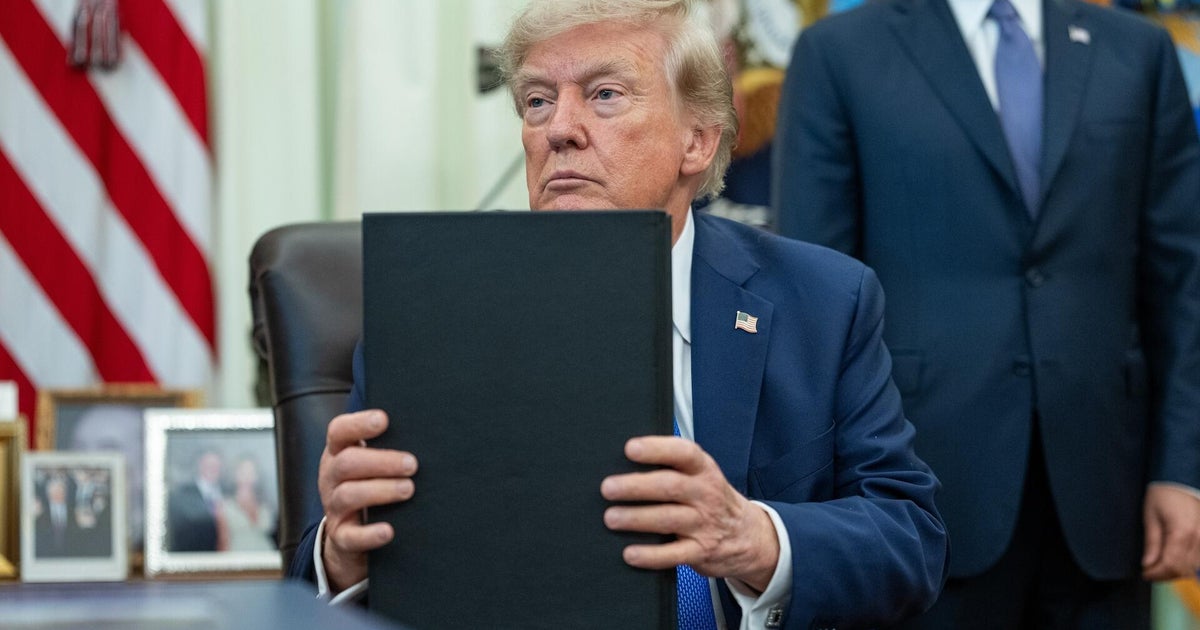
President Donald Trump signed new executive orders that aim to limit birthright citizenship in specific situations. This move follows a recent Supreme Court decision related to his earlier attempts to change these citizenship rules.
Key Facts
President Trump issued new executive orders about birthright citizenship.
The orders focus on restricting birthright citizenship in certain cases.
Birthright citizenship means a child born in the U.S. automatically becomes a citizen.
These executive orders come after a Supreme Court ruling on prior related actions by President Trump.
The Supreme Court had reviewed the legality of President Trump’s previous executive orders on birthright citizenship.
Read the Original
Want the full story? Tap a source to open the original
article.
President Donald Trump spoke positively about data centers and disagreed with some efforts in Texas to limit them. He said opposing data centers is a mistake and highlighted their importance.
Key Facts
President Trump praised data centers in a recent interview.
He mentioned seeing Texas take actions against data centers.
Trump believes it is a mistake to oppose data centers.
Data centers are facilities that store and manage digital information.
Both Republicans and Democrats have shown concerns about data centers in some areas.
The interview was published by Punchbowl News.
Trump’s comments suggest a different view from some state policies on data centers.
Read the Original
Want the full story? Tap a source to open the original
article.
A US court in Oregon ordered the Department of Defense (DoD) to restart its review process for approving wind power projects. The court ruled that the DoD cannot stop this process based on national security claims without legal approval from Congress. This decision ends a government pause on wind energy development that started in August 2025.
Key Facts
Since August 2025, all new wind power projects in the US have been on hold because the DoD stopped cooperating in the approval process.
The DoD claimed that wind turbines interfere with radar and pose national security risks due to drone developments.
The court found that the DoD must follow a legal process set by Congress when reviewing wind projects and cannot halt the process on its own.
The government had tried other methods to block wind power, including paying companies not to develop wind projects.
Wind developers and industry groups sued the government when the DoD refused to negotiate or approve projects.
The court rejected the government's arguments that the lawsuit should be dismissed or was filed in the wrong court.
Judge Karin Immergut ruled that the DoD must resume its review process according to the law and report its progress every 30 days.
If the DoD wants to change the law, it must ask Congress rather than stop following current rules.
Read the Original
Want the full story? Tap a source to open the original
article.
The U.S. economy lost 23,000 jobs in July, which was less than what experts expected. The unemployment rate slightly fell to 4.1%, but fewer people are working or looking for work than before.
Key Facts
Economists predicted a gain of 95,000 jobs in July, but instead, the economy lost 23,000 jobs.
The unemployment rate dropped from 4.2% in June to 4.1% in July.
Previous job numbers for May and June were lowered by a combined 103,000 jobs.
The labor force participation rate, meaning those working or looking for work, fell to 61.4%, the lowest since February 2021.
Job losses in July were mainly in local government education (50,000 jobs lost) and retail (19,000 jobs lost).
Healthcare added 22,000 jobs, continuing its role as a job growth area this year.
Hiring is slow across the market, with fewer job postings but more people applying for each job.
Layoffs remain at the lowest level in two years, helping keep unemployment steady despite fewer hires.
Read the Original
Want the full story? Tap a source to open the original
article.
Hawaii is holding a state primary with nine candidates running to replace the lieutenant governor, who faces bribery charges. In addition, a Democratic congressman who supported a key election law backed by President Donald Trump is facing a strong primary challenge.
Key Facts
Hawaii’s lieutenant governor, Sylvia Luke, is charged with bribery related to her 2022 campaign and pleaded not guilty.
Nine candidates (five Democrats, four Republicans) want to replace her in the primary.
The lieutenant governor position in Hawaii is often a step toward higher political office.
Kauai Mayor Derek Kawakami leads Democratic fundraising and has support from a carpenters union political group.
Democratic Governor Josh Green is running for reelection and named Keith Regan as acting lieutenant governor during Luke’s leave.
In the 1st Congressional District, Democratic Rep. Ed Case faces four primary challengers, including state Sen. Jarrett Keohokalole.
Case supported the SAVE Act, an election law pushed by President Trump that requires voters to prove citizenship, but he voted only for versions with accommodations for voters lacking documents.
Hawaii’s 1st District leans heavily Democratic, with Case winning about 72% of the vote in 2024.
Read the Original
Want the full story? Tap a source to open the original
article.
The U.S. lost 23,000 jobs in July, and the unemployment rate went down slightly to 4.1 percent. This was different from what experts expected, as they thought more jobs would be added and unemployment would stay at 4.2 percent.
Key Facts
The U.S. economy lost 23,000 jobs in July.
The unemployment rate fell to 4.1 percent from 4.2 percent.
Experts predicted a gain of 83,000 jobs in July.
Economists expected the unemployment rate to remain steady at 4.2 percent.
The new data was released by the Bureau of Labor Statistics.
Job growth was weaker than expected following similar results in June.
The numbers show the U.S. job market is weaker than analysts anticipated.
Read the Original
Want the full story? Tap a source to open the original
article.
The U.S. Senate is trying to finish its work before the August break, but faces challenges including deciding on acting Attorney General Todd Blanche’s nomination. Senator Lisa Murkowski announced she will vote against Blanche’s nomination, putting his approval in doubt.
Key Facts
The Senate is preparing to go on its August recess soon.
Several important decisions remain before the break.
Acting Attorney General Todd Blanche is nominated to become the permanent Attorney General.
Senator Lisa Murkowski, a Republican from Alaska, said she will vote “no” on Blanche’s nomination.
Blanche’s confirmation is uncertain because some senators oppose him.
The Senate has been dealing with disagreements and conflicts this week.
The vote on Blanche’s nomination is seen as a key event before the recess.
Read the Original
Want the full story? Tap a source to open the original
article.
The number of jobs in the United States fell by 23,000 in July, which was unexpected. The unemployment rate stayed the same at 4.1%, and earlier job growth figures for May and June were lowered by 103,000 jobs combined.
Key Facts
US jobs decreased by 23,000 in July.
Experts had expected more jobs to be added, not fewer.
The unemployment rate remained steady at 4.1%.
Job losses were mostly in local government education and retail sectors.
The Bureau of Statistics revised job growth for May and June down by 103,000 jobs.
July’s job decline marks a continuation of a slow summer in the US job market.
The data was released by the official US statistics agency.
Read the Original
Want the full story? Tap a source to open the original
article.
US employers lost 23,000 jobs in July, which was not expected, and job gains from previous months were lowered. The unemployment rate stayed steady at 4.1%, even as job openings and workforce growth slowed, partly influenced by ongoing conflict in the Middle East.
Key Facts
US lost 23,000 jobs in July, opposite to economists' prediction of 83,000 new jobs.
Job gains for May and June were lowered by 74,000 in total after revisions.
Unemployment rate remained steady at 4.1% in July.
Private employers added 44,000 jobs in July, down from 98,000 in June.
Job openings fell by 178,000 to 7.4 million in June, with a big drop in healthcare jobs.
Layoffs in July were very low, with about 33,500 job cuts, the lowest in two years.
Personal savings rate fell to 2.7% in June 2026, the lowest since June 2022.
The Federal Reserve is considering raising interest rates again this year to control inflation.
Read the Original
Want the full story? Tap a source to open the original
article.
Rep. Dan Crenshaw from Texas responded to criticism after he told people worried about high food prices to "stop whining" and "get a job." His comments came during a public debate about a $20 burrito, which highlighted different views within the Republican Party about how affordable things are.
Key Facts
Rep. Dan Crenshaw is a Republican congressman from Texas.
He told Americans upset about rising food costs to "stop whining" and find employment.
A $20 burrito became a topic of debate about how expensive food is.
The discussion showed disagreements among Republicans about the reality of affordability.
Crenshaw defended his comments despite criticism from some people.
The issue reflects broader concerns about the cost of living in the U.S.
Food prices and affordability are important topics in current American political conversations.
Read the Original
Want the full story? Tap a source to open the original
article.
A government review found that the Department of Government Efficiency (DOGE), led by Elon Musk until recently, greatly overstated its claimed savings of $110 billion from cutting federal spending. The report said most of the savings could not be verified, and many cuts were either not made or were already planned before DOGE's involvement.
Key Facts
DOGE reported $110 billion in taxpayer savings from canceled grants and contracts.
The U.S. Government Accountability Office (GAO) could not verify 96% of those savings.
DOGE did not follow its own method to calculate about half of the reported savings.
Some contracts and leases DOGE claimed to have canceled were never actually ended.
$27.4 billion of claimed savings was never put into action.
The GAO could not get DOGE officials to explain why data problems were not disclosed.
Elon Musk left DOGE, which formally ended on July 4, but its website still shows $215 billion in savings.
The DOGE website continued to claim large savings despite the GAO’s findings showing errors and overestimates.
Read the Original
Want the full story? Tap a source to open the original
article.
Senator Elizabeth Warren is asking major U.S. companies like Apple and Amazon to share money they are getting back from illegal tariffs with their customers. These tariffs were declared invalid by the Supreme Court because President Trump did not have the authority to impose them. Warren wants the companies to explain how much they paid in tariffs, how much they got refunded, and how they will use that money.
Key Facts
The Supreme Court ruled that tariffs imposed under the International Emergency Economic Powers Act (IEEPA) were illegal because President Trump lacked the authority to place them.
The U.S. government has refunded over $100 billion to companies for these tariffs, about 60% of the total owed.
Many consumers paid higher prices due to the tariffs, but most are not receiving any money back from the refunds.
Senator Warren sent letters to companies such as Apple, Amazon, Energizer, Motorola, Nike, Target, and Walmart asking for tariff and refund details.
Apple received $2.2 billion in tariff refunds and increased prices on iPhones and MacBooks after the tariffs.
Amazon said it has received $600 million in tariff refunds but claims it mostly absorbed tariff costs instead of charging customers.
Some companies promise to return refunds to consumers, but many refunds only go to the importers, not the customers who paid higher prices.
Class-action lawsuits are being filed by consumers asking companies to return the extra money they paid due to tariffs.
Read the Original
Want the full story? Tap a source to open the original
article.
President Donald Trump criticized oil companies for making high profits from the conflict involving Iran, while his policies have helped the fossil fuel industry grow. He also signed new orders aiming to limit birthright citizenship, despite a recent Supreme Court ruling that blocked his earlier attempt.
Key Facts
Americans have spent over $78 billion more on fuel since the Iran conflict began.
Studies show Trump’s policies increased fuel costs by about $285 per American family.
Trump has reduced rules on fossil fuel production and protected oil companies from climate lawsuits.
Some lawmakers propose taxing oil companies’ extra profits and giving money to families paying more at the pump.
Trump signed two new orders to restrict automatic citizenship for children born in the US to non-citizen parents.
The Supreme Court ruled Trump’s first citizenship order broke the 14th Amendment, which guarantees birthright citizenship.
Law enforcement gave false information to courts in a case against a journalist protesting an ICE official who is also a pastor.
The US now tracks nearly 54,000 immigrants using ankle monitors, up from 17,000 the previous year.
Read the Original
Want the full story? Tap a source to open the original
article.
President Donald Trump said he does not want to discuss whether Senate Majority Leader John Thune should serve another term as the Republican leader. Trump said he gets along with Thune but declined to give his full support.
Key Facts
President Trump was asked about endorsing John Thune for another term as Senate GOP leader.
Trump said, “I don’t want to get into that necessarily.”
Trump said he gets along with John Thune.
The interview was with Punchbowl News.
John Thune is a Republican senator from North Dakota.
Thune currently serves as Senate Majority Leader.
The interview was aired on a Friday.
Read the Original
Want the full story? Tap a source to open the original
article.
Senator Lisa Murkowski announced she will not support President Donald Trump’s nominee Todd Blanche for attorney general. She is concerned that the administration might still try to pay a fund related to January 6 rioters, despite Blanche’s written confirmation that the fund is no longer active.
Key Facts
Lisa Murkowski is a moderate Republican senator from Alaska.
She opposes Todd Blanche’s nomination for US attorney general.
Blanche had been serving as acting attorney general before the nomination.
Murkowski worries about a proposed fund to pay people involved in the January 6 Capitol riot.
Blanche formally ended a $1.8 billion fund intended to help political allies targeted by the justice department.
Blanche won a close 12-10 vote in the Senate Judiciary Committee after promising not to pursue the payout fund.
The Senate Republican majority is narrow, and some Republican senators are hesitant about confirming Blanche.
Senate Majority Leader Mitch McConnell is currently absent due to health issues, adding pressure to the confirmation process.
Read the Original
Want the full story? Tap a source to open the original
article.
US cities have increased the number of cooling centers to help people stay safe during record heat waves. However, many people, especially those with low income or who are homeless, do not use these air-conditioned places as much as expected.
Key Facts
Cooling centers are public air-conditioned spaces like libraries and community centers set up to help people during extreme heat.
Low-income people often cannot afford air conditioning and face higher health risks from heat.
Despite efforts, many at-risk individuals avoid cooling centers due to travel challenges or not perceiving the heat as dangerous.
The US experienced the second-hottest first half of 2026, with heat domes trapping hot air in affected regions.
New York City opened more cooling centers this year, averaging 585 open on weekdays compared to 560 last year.
Hospitals in New York and Maine reported record-high heat-related emergency visits this summer.
Maryland reported at least 38 heat-related deaths this summer, exceeding 2025's total.
New York uses vans to reach homeless and elderly populations, offering medical care and transportation to cooling centers.
Read the Original
Want the full story? Tap a source to open the original
article.
The Trump administration removed some government data and National Park signs about topics like slavery, Indigenous history, and climate change. In response, volunteers created a project called Save Our Signs to take photos and preserve these signs before they disappear.
Key Facts
The Trump administration deleted government datasets and webpages on gender, environment, and diversity.
National Park Service was told to remove signs that showed difficult parts of American history or ideas deemed "corrosive."
Jenny McBurney and colleagues started Save Our Signs to document all signs in national parks before removal.
The project has collected over 17,000 photos from almost all national parks in the U.S. as of August 3.
Hundreds of volunteers, with many anonymous, contribute photos to the digital archive.
Some volunteers use this project as a way to fight back against the removal of historical information.
Charlene Forsythe and her mother have submitted over 2,000 photos and visited 53 parks together.
The project encourages public involvement to raise awareness about the changes in how U.S. history is presented.
Read the Original
Want the full story? Tap a source to open the original
article.
The Agency for Healthcare Research and Quality (AHRQ) helped reduce hospital infections and saved thousands of lives through safety programs funded by federal grants. Since President Donald Trump took office, most of AHRQ’s staff have left, hundreds of grants have been canceled, and the agency's ability to fund new safety projects has largely stopped.
Key Facts
AHRQ funded a national safety effort starting in 2008 that cut dangerous bloodstream infections in intensive care units by 41%.
The agency estimates its work prevented about 20,500 deaths and saved $7.7 billion between 2014 and 2017.
Since President Trump took office, about 75% of AHRQ staff have left or been fired.
In July, AHRQ sent letters canceling at least 104 grants aimed at improving patient safety.
Congress provided $345 million for AHRQ in the fiscal year, but the agency spent less than $15 million on grants.
The office that managed grant reviews was closed last summer, making it impossible to issue new grants.
Grants supporting training for doctors and research on pregnancy risks, cancer detection, and reducing unnecessary scans for children were cut.
AHRQ’s director said funds were being redirected, but many canceled grants aligned with stated safety goals.
The director reportedly suggested artificial intelligence could replace much of the scientific work at the agency.
Read the Original
Want the full story? Tap a source to open the original
article.
The article discusses that simply criticizing opponents with harsh labels is not enough for Republicans to win elections. It suggests that more effective strategies are needed beyond just negative attacks.
Key Facts
Republicans have been using strong criticism against their opponents.
Calling opponents extreme names alone is not winning elections.
The article implies that better plans or ideas are necessary for success.
It focuses on political strategy within the United States.
The content addresses the approach Republicans take in campaigns.
Read the Original
Want the full story? Tap a source to open the original
article.
Two brothers racing on a road caused a crash that killed Rhys Jenkins and seriously injured his nine-year-old son, Ioan. Abubakr Ben Yusaf was sentenced to 14 years in prison, and his brother Umar received nearly three years for their roles in the crash.
Key Facts
Rhys Jenkins died at the scene near Welshpool, Powys, in November 2024.
His son, Ioan, was badly injured and taken to hospital by helicopter.
Abubakr Ben Yusaf was driving a BMW and sentenced to 14 years for dangerous driving and other charges.
Umar Ben Yusaf was sentenced to 2 years and 9 months for careless driving.
The brothers were racing home from Aberystwyth to Manchester and driving aggressively before the crash.
Rhys Jenkins was taking Ioan to watch a Wales rugby match for the first time together.
After the crash, the brothers fled the scene, but Umar returned and told police who was responsible.
Rhys' family spoke about how deeply the crash affected them emotionally and physically.
Read the Original
Want the full story? Tap a source to open the original
article.