Jack Schlossberg, a Democratic candidate for a New York House seat, proposes changing the Child Tax Credit to pay families monthly instead of once a year. His plan also aims to increase the credit to levels seen during the COVID-19 American Rescue Plan, providing monthly payments based on children's ages.
Key Facts
Jack Schlossberg is running for Congress in New York's 12th District.
He wants the Child Tax Credit to be paid monthly, not annually.
The proposal is called the "Monthly Moms Bonus."
Monthly payments would be $300 for children under six and $250 for those six and older.
The plan would use some funding from a Senate Republican proposal for White House security upgrades, as well as tax reforms.
The current Child Tax Credit can be up to $2,200 per child annually.
Schlossberg is the grandson of former President John F. Kennedy and will discuss the plan on Mother's Day with his mother, Caroline Kennedy.
The seat is open because Rep. Jerry Nadler is retiring, and several candidates are competing for the position.
Read the Original
Want the full story? Tap a source to open the original
article.
Anas Sarwar said he will remain leader of Scottish Labour after the party’s poor showing in the recent Scottish Parliament elections. Labour lost four seats and now holds 17 out of 129 seats, while the SNP won 58 seats but did not get an overall majority.
Key Facts
Scottish Labour lost four seats in the recent elections, winning only 17 seats total.
The Scottish National Party (SNP) won 58 seats but did not secure a majority (65 seats needed).
Sarwar said he wants to keep his party united and hold the SNP accountable.
He did not say how long he plans to stay as leader or if he will lead Labour in the next election.
Sarwar confirmed he still wants Prime Minister Sir Keir Starmer to resign, a position he stated earlier in February.
Labour performed poorly across the UK, losing many seats in Wales and councillor positions in England.
Former Scottish Labour leader Jack McConnell blamed UK government disappointment and weak strategy for Labour’s losses.
A Labour MP called for cabinet ministers to challenge Starmer’s leadership after the election results.
Read the Original
Want the full story? Tap a source to open the original
article.
Nigel Farage received a £5 million personal gift from a crypto billionaire shortly before announcing his run in the 2024 UK general election, raising questions about disclosure and political influence. Labour accuses him of avoiding scrutiny, while Reform UK says all rules were followed and the money was for Farage's safety.
Key Facts
Nigel Farage got a £5 million gift from Christopher Harborne, a crypto billionaire, just before the last UK general election.
Farage did not disclose this gift initially, which led to public and political questions about transparency.
Reform UK’s deputy leader, Richard Tice, said the gift was personal and legal, meant to protect Farage's safety.
Labour claims Farage failed to follow rules and that the gift influences policy, mentioning a crypto tax cut policy linked to the donor.
Reform UK had strong election results recently, gaining many council seats and placing well in devolved parliaments.
The UK Electoral Commission may investigate if Farage’s gift broke election laws, potentially leading to fines.
Parliamentary rules require politicians to report benefits for political purposes in the year before taking office.
Prime Minister Keir Starmer said Farage should face more public and parliamentary scrutiny over the gift.
Read the Original
Want the full story? Tap a source to open the original
article.
New rules in England will require doctors and hospitals to share patient records to create one combined health record for each person. This will help healthcare staff see a patient's full medical history in one place, improving care and reducing repeated questions.
Key Facts
New laws will make doctors’ practices (GPs) and hospitals share patient data to form a single patient record (SPR).
The SPR will be used across all NHS healthcare providers in England.
This is part of a £10 billion digital upgrade of the health service.
The records will help healthcare workers access important information quickly, like medical history, medicines, and allergies.
The SPRs will start being available in some NHS areas, like maternity care, as early as next year.
Patients will have more control over who sees their data, with safety measures to prevent data leaks.
Currently, GPs and hospitals keep their own patient data separately, causing delays and missing information.
Some doctors and medical groups worry about who will be responsible if there are errors in shared records.
Read the Original
Want the full story? Tap a source to open the original
article.
The FIFA World Cup matches held across the United States are facing increased risks of terrorism. Experts warn that threats come mainly from homegrown extremists, and securing the many match locations will require strong coordination among federal, state, and local law enforcement.
Key Facts
The FIFA World Cup will have 104 matches in the US, Canada, and Mexico, with the US hosting 78 matches in 11 cities.
The biggest terrorism threat is from homegrown violent extremists, often acting alone and influenced online by extremist groups.
The Department of Homeland Security has designated only the final match as a national special security event, which triggers extra federal security measures.
Other matches are rated as high risk and will also get federal law enforcement support.
The FBI held a large training exercise for domestic terrorism threats before the event.
FEMA has provided $625 million to support security and emergency plans for the World Cup.
Experts say “soft targets” like hotels and fan gatherings are a larger concern than the stadiums themselves.
Law enforcement agencies are working together nationwide to ensure the safety of stadiums and surrounding communities.
Read the Original
Want the full story? Tap a source to open the original
article.
The Trump administration has put forward different and conflicting policies on overdose prevention, including cutting funding for tools that help prevent overdoses and proposing a new drug control strategy. These contradictions could harm efforts to reduce overdoses and make it harder to carry out the planned strategy if budget cuts happen.
Key Facts
The administration banned funding for fentanyl test strips, which help people check drugs for dangerous chemicals and avoid overdosing.
Experts say cutting funding for test strips benefits drug cartels and removes a way for users to stay safer.
Harm reduction programs, like test strips and nasal naloxone (a spray that reverses opioid overdoses), are being reduced.
The CDC stopped supporting “never use alone” messages that help reduce overdose risk.
The White House proposed cutting $10 billion from addiction and overdose prevention and research funding.
Despite cuts, the administration announced a new National Drug Control Strategy to expand treatments and naloxone access.
Experts note a conflict between the strategy and budget cuts, caused by poor coordination between government offices.
Congress must reject the proposed budget cuts for the drug control strategy to be fully effective.
Read the Original
Want the full story? Tap a source to open the original
article.
Two Supreme Court justices recently said the court is not political and does not take sides in politics. However, the article argues that the court’s decisions often follow political party lines, especially on major issues like abortion and gun control, showing the court is involved in politics.
Key Facts
Justice Amy Coney Barrett and Chief Justice John Roberts said the Supreme Court is not political.
The 2016 presidential election focused heavily on Supreme Court appointments.
President Trump promised to appoint justices who might overturn Roe v. Wade, which gained support from white evangelicals.
Senator Mitch McConnell delayed Merrick Garland’s nomination for 293 days but quickly confirmed Justice Barrett right before an election.
Most Supreme Court cases are decided almost unanimously, but this does not prove the court is non-political.
The court often splits 6-3 on major issues along party lines.
Historically, Congress has changed the size of the Supreme Court to influence its political balance.
Denying the court’s political nature affects how people react to proposals like court expansion or term limits.
Read the Original
Want the full story? Tap a source to open the original
article.
President Donald Trump has repeatedly claimed election fraud when Republicans lose. These claims are part of a wider plan to influence future elections in his favor.
Key Facts
President Trump often says there is fraud during elections that Republicans do not win.
These fraud claims have no solid evidence to support them.
The claims are part of a larger strategy to change how elections are run.
The goal of this strategy is to give President Trump and his party an advantage in future votes.
This approach is ongoing and shows no signs of stopping.
Read the Original
Want the full story? Tap a source to open the original
article.
Having a baby in the United States is very expensive for many families, with costs for pregnancy, delivery, and childcare much higher than in other wealthy countries. The US also has a high rate of mothers dying from childbirth, especially among Black women, who face much greater risks than white or Hispanic women.
Key Facts
The cost of childbirth in the US can be very high, ranging from about $15,000 for vaginal births to over $19,000 for C-sections, even with insurance.
Health insurance in the US may cover some costs, but many women still pay thousands of dollars out of pocket, especially if their doctors or hospitals are not covered by their insurance.
Around 8% of Americans do not have health insurance, increasing financial risks for mothers.
Some states like Alaska, New York, and New Jersey have higher childbirth costs, with hospital stays costing thousands of dollars per night.
The US has a maternal death rate of 18.6 per 100,000 live births, which is much higher than in countries like Norway or Italy.
Black women in the US die from childbirth complications about three times more often than white women, with a rate of 50.3 deaths per 100,000 live births in 2023.
Childcare and medical care costs continue to be a heavy burden for many families after birth.
Maternity leave policies in the US provide less support compared to other wealthy countries, adding to the financial and personal challenges of motherhood.
Read the Original
Want the full story? Tap a source to open the original
article.
Fewer Americans want to become pastors, causing a shortage of religious leaders in many communities, especially in rural areas and Black neighborhoods. This decline is linked to lower pay, higher stress, and less trust in pastors, along with church closures and shrinking congregations.
Key Facts
Enrollment in U.S. Master of Divinity programs dropped 14% from 2020 to 2024.
Black Protestant divinity program enrollment fell 31% between 2000 and 2020.
Over 40% of clergy surveyed said they considered leaving their jobs since 2020.
Around 15,000 U.S. churches closed last year, while 29% of Americans now say they have no religious affiliation.
Rural churches are especially affected, losing pastors and sometimes closing, which impacts local support services like food aid and elder care.
The Diocese of Oakland plans to close 13 churches due to financial issues and a priest shortage.
Women make up nearly 24% of U.S. clergy, a historic high compared to 2.3% in 1960.
The Catholic Church is bringing more priests from Asia and Africa to serve in U.S. parishes facing shortages.
Read the Original
Want the full story? Tap a source to open the original
article.
Violent crime dropped significantly in many large U.S. cities in early 2026 compared to the same time in 2025. This decrease happened widely across different types of crime and regions, showing a national trend toward lower violence.
Key Facts
Homicides fell by 17.7%, robberies by 20.4%, rapes by 7.2%, and aggravated assaults by 4.8% in major cities.
Some cities saw big drops in homicides: Washington, D.C. (64.7%), Philadelphia (54%), San Diego (50%), Memphis (34.4%), New York City (31.7%), Los Angeles (23%), and Houston (36.4%).
Aurora, Colorado, challenged President Trump's claims of high crime there, with a 66.7% decline in homicides.
Crime declines started during President Biden's time and continued under President Trump.
Despite overall drops, some cities like Minneapolis, Atlanta, and Virginia Beach saw increases in violent crime.
Officials warn that crime rates can change quickly in summer, historically a season with more violence.
The Trump administration has begun highlighting the crime declines, crediting its policies.
Data comes from 67 major U.S. law enforcement agencies and is tracked by the Major Cities Chiefs Association, which matches FBI annual reports.
Read the Original
Want the full story? Tap a source to open the original
article.
The Gullah Geechee people in South Carolina are at risk of losing land passed down through families because of unclear ownership documents and rising property taxes. Some families have kept their land with help from local groups, but many others face challenges from legal and financial issues as well as development and climate problems.
Key Facts
Arthur Champen’s family has owned land in Hilton Head Island since 1892 when his ancestors bought 60 acres for $600.
The land passed down through generations without formal wills is called heirs’ property, which can cause legal confusion over ownership.
After some family members moved or died, Champen’s family almost lost marshland to tax sale due to unpaid property taxes.
A nonprofit group helped the family pay taxes so they could keep the land.
Many Gullah Geechee people in Beaufort County face losing land due to unclear property titles, unpaid taxes, family disputes, development pressure, and climate impacts.
The Gullah Geechee population on Hilton Head has decreased, with Black residents dropping from 8% in 2000 to 6% in 2020.
There are over 41,000 heirs’ properties in South Carolina totaling more than 414,000 acres, valued over $3.4 billion in 2019.
Researching exact land loss among Gullah families is difficult and costly because of complex legal issues.
Read the Original
Want the full story? Tap a source to open the original
article.
There are no ads, so there is no reason to bait you. Readers who chip in keep it that way. Most choose $3.99/month, and get the daily digest every morning.
TMZ recently started reporting on U.S. politicians in Washington, focusing mainly on members of Congress during their recess period. The website highlighted how some politicians took time off while important issues like a Homeland Security funding bill remained unresolved, but some of their coverage included mistakes and missing context.
Key Facts
TMZ moved into political reporting just weeks ago, focusing on members of Congress during their recess.
They described the recess as a "two-week vacation," although this was not entirely accurate.
TMZ published photos of Senator Lindsey Graham at Disney World during the recess.
The outlet’s coverage drew attention from other media, including CNN and The Hill.
TMZ reporter Charlie Cotton confronted Representative Dan Meuser about inaction on a DHS funding bill.
Meuser’s comments were partly misrepresented, missing details that the Senate had already passed the bill.
TMZ’s political reporting showed a more aggressive style compared to usual coverage but sometimes lacked full context.
Some reports mixed entertainment-style journalism with political news, leading to criticism of accuracy.
Read the Original
Want the full story? Tap a source to open the original
article.
A Brooklyn activist group opposing President Trump has mostly women members, with men making up only about 20%. Many men have stopped participating in anti-Trump activities for various reasons, including feeling personally unaffected by political issues. The group believes inviting more men to join could help strengthen their movement.
Key Facts
The activist group was started by two men but is now about 80% female.
After President Trump’s second term began in 2024, the group doubled in size.
Research shows that protest groups against Trump are mainly white, well-educated women in middle age.
Some men have stopped participating because they feel safe or not personally impacted by political issues.
Fewer men attend smaller protest events, though larger ones see more male participants.
The group encourages men on the sidelines to join and become active in resisting policies they disagree with.
Women currently lead most anti-Trump activism efforts in this group.
Leaders believe involving more men is important for building a stronger, more inclusive political movement.
Read the Original
Want the full story? Tap a source to open the original
article.
Congress is facing new sexual misconduct allegations, the most significant since the #MeToo movement in 2017-2018. Some lawmakers have resigned amid claims, and there is growing pressure, especially from Republican women, for stronger accountability and reforms in handling these cases.
Key Facts
Two members of Congress, Reps. Tony Gonzales (R-Texas) and Eric Swalwell (D-Calif.), resigned last month due to sexual misconduct allegations.
Swalwell denies the allegations; Gonzales admitted to an affair with a staffer who later died by suicide.
Rep. Chuck Edwards (R-N.C.) faces accusations of inappropriate behavior towards young female staffers, which he denies.
Republican women lawmakers like Reps. Anna Paulina Luna, Nancy Mace, and Lauren Boebert are vocal about exposing misconduct and demanding consequences.
Over $338,000 in taxpayer money was spent settling sexual misconduct cases involving eight former members over the past decade.
The House Ethics Committee has been criticized for slow investigations into misconduct, with calls for more resources and faster processes.
House Speaker Mike Johnson (R-La.) is leading efforts to reform sexual harassment rules, aiming to improve reporting options for women on Capitol Hill.
There is ongoing tension and frustration about the culture of misconduct and lack of effective accountability in Congress.
Read the Original
Want the full story? Tap a source to open the original
article.
The meaning of the word "mom" is changing as more people use it to describe caring for pets or plants, not just raising children. This shift reflects changes in family life, where fewer people have children due to costs and other reasons, leading to debate about who should be recognized as a mom.
Key Facts
Mother’s Day used to focus only on women with children but now includes people who care for pets or plants.
Many childfree people say being a “dog mom” or “plant mom” shows real care and responsibility.
Birth rates in the U.S. have fallen for four years in a row and are below the replacement level needed to maintain the population.
Cost is a big reason why many Americans think raising children is too expensive.
Nearly half of adults aged 18–49 without children say they probably won’t have kids, with many making this a deliberate choice.
The rise of “pet parenting” shows changing ideas about what counts as family and care.
Some mothers feel that calling pet owners “moms” diminishes the challenges of raising children.
People who care for pets argue that their role is a deep commitment and not just owning animals.
Read the Original
Want the full story? Tap a source to open the original
article.
New data shows that Olivia and Liam were the most popular baby names in the U.S. for 2025, keeping their top spots for seven years in a row. While traditional names remain common, more parents are choosing unusual and creative names, reflecting changing cultural trends.
Key Facts
Olivia and Liam were the No. 1 baby names for girls and boys in 2025.
Traditional names like Charlotte, Emma, Noah, and Oliver still rank high.
The name Eliana rose into the top 10 for girls for the first time in 2025.
Unusual names like Kasai (meaning fire) and Klarity are quickly becoming popular.
Parents want names that feel unique but not too strange.
Names with "El-" sounds, like Eleanor and Ellie, are becoming trendy.
The share of babies given a top-10 name has decreased, showing more variety in naming.
These trends reflect broader cultural changes in how Americans choose baby names.
Read the Original
Want the full story? Tap a source to open the original
article.
Mothers in Minnesota and across the U.S. have organized resistance movements to fight against the Trump administration’s immigration enforcement, especially focusing on protecting children and families. These mothers support their communities by providing food, transportation, monitoring immigration agents, and campaigning to end child detention.
Key Facts
Mothers in Minnesota formed support networks to help children get to school, feed families, protest, and protect communities during aggressive immigration enforcement called “Operation Metro Surge.”
A photo of five-year-old Liam Ramos detained with his father brought national attention to the issue of child detention under President Trump’s policies.
Advocate and children’s TV host Rachel Accurso campaigned to end immigration detention for children, sharing emotional stories from detained kids like a spelling bee winner named Deiver.
Pediatricians who are mothers started a campaign involving thousands of medical professionals to highlight the health risks faced by children in detention centers.
These mother-led movements build on a long history of moms organizing for causes like gun control, police reform, climate action, women’s rights, and abortion access.
Groups like Vote Mama work to elect more mothers to public office, helping to push policies that support families and communities.
The activism of white suburban mothers surprised some commentators who previously focused mainly on Black and brown mothers in social movements.
These mother networks use everyday tools like carpools, meetups, and group chats to organize and protect their communities.
Read the Original
Want the full story? Tap a source to open the original
article.
Zachary Alam, who took part in the January 6 US Capitol attack and was pardoned by President Donald Trump in January 2025, has been sentenced to seven years in prison for burglary in Virginia. Alam was found guilty of breaking into a home, stealing items, and was sentenced despite his earlier pardon for federal charges related to the Capitol riot.
Key Facts
Zachary Alam was involved in the January 6, 2021 attack on the US Capitol.
He received one of the longest sentences for the attack—eight years—and served nearly four years before being pardoned by President Trump in January 2025.
In May 2025, Alam broke into a home near Richmond, Virginia, claiming he was there to fix the internet, but left with electronics and jewelry.
Alam was arrested the day after the burglary and found guilty in October 2025 of breaking and entering and grand larceny.
He was sentenced to 20 years for each charge, with most of the grand larceny time and 13 years of the breaking and entering time suspended, resulting in a 7-year prison sentence.
Alam will also serve 20 years of probation for each conviction after release.
Prosecutors said Alam believed he was “doing the right thing” during the Capitol attack and the burglary.
The pardon from President Trump did not protect Alam from state charges in Virginia.
Read the Original
Want the full story? Tap a source to open the original
article.
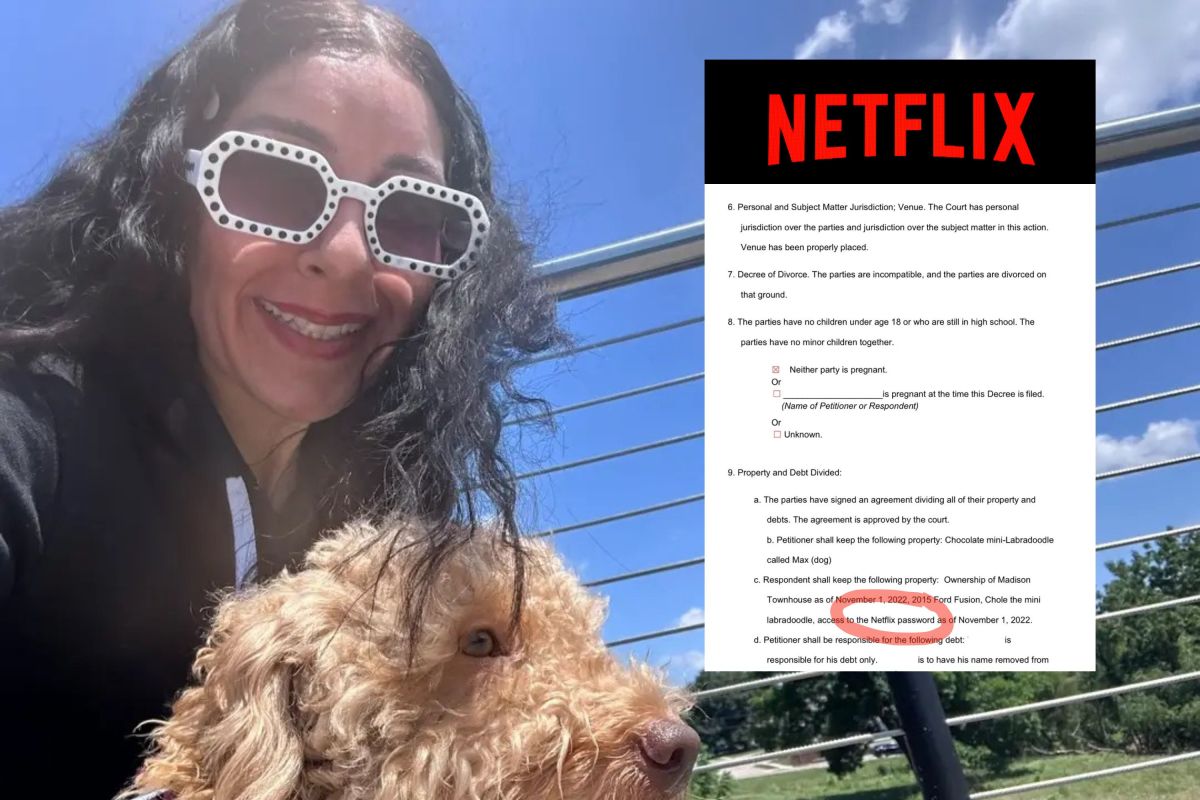
A woman named Ladan Richardson had a Netflix password included in her divorce settlement after she asked for access during her court hearing. Experts say such requests reflect the modern reality that sharing digital accounts is part of daily life, but they are usually unusual and tricky to enforce legally.
Key Facts
Divorce settlements usually cover homes, money, and children but now may include digital subscriptions.
Ladan Richardson asked for her ex-husband’s Netflix password along with the car and dog during her divorce.
The judge included the Netflix access in the official divorce agreement.
Streaming services and shared digital accounts cost money and can be important in separated households.
Lawyers are often reluctant to put password-sharing agreements in legal documents because technology and services can change.
Enforcing password sharing by law is difficult and not an efficient use of court time.
Requests like this often show deeper issues like financial worries or emotional struggles during divorce.
Experts suggest settlements are better focused on financial terms than shared services to avoid future problems.
Read the Original
Want the full story? Tap a source to open the original
article.