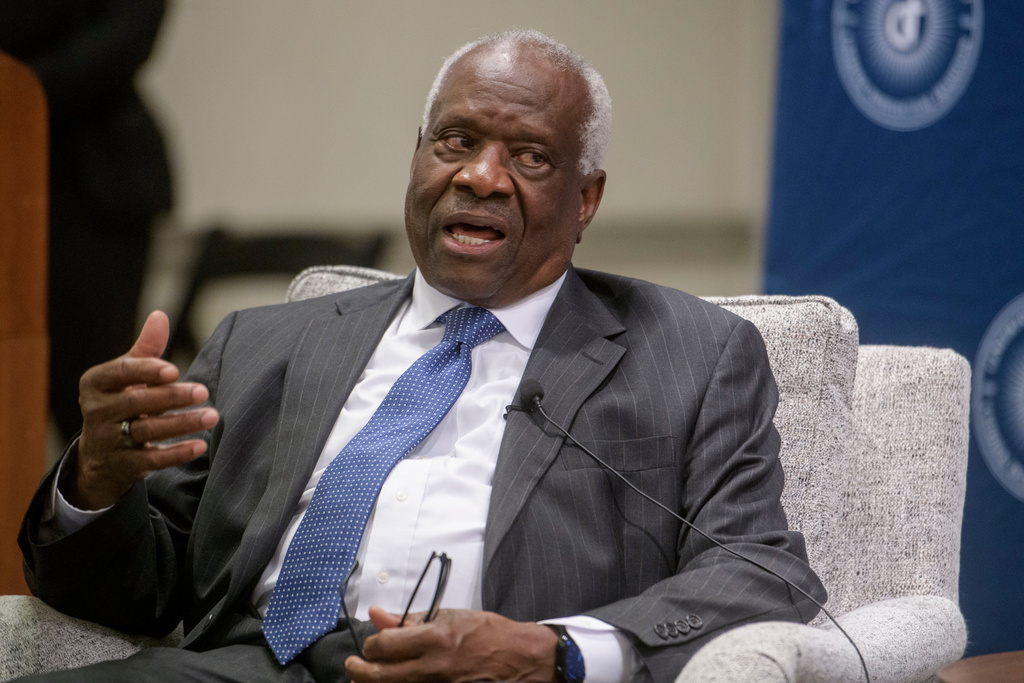
Supreme Court Justice Clarence Thomas disagreed with Justice Neil Gorsuch about President Donald Trump's power to impose tariffs. The court decided that a 1977 law does not give the president broad authority to set tariffs. The decision was split, with some justices supporting Trump's tariff actions and others opposing.
Key Facts
Justice Clarence Thomas and Justice Neil Gorsuch disagreed on an important decision about President Trump's tariff authority.
The Supreme Court ruled that a 1977 law does not allow the president to implement wide-ranging tariffs.
Justice Gorsuch wrote a concurring opinion explaining past congressional decisions against expanding presidential powers.
Justice Thomas argued that Congress has historically given the president authority over foreign trade, including tariffs.
The current Supreme Court has a conservative 6-3 majority but was split on this decision.
President Trump aimed to use tariffs to reduce the trade deficit and boost U.S. manufacturing.
The court's decision limits the president's ability to set tariffs quickly and extensively under certain laws.
Chief Justice John Roberts stated that the president cannot unilaterally impose tariffs under the law cited by Trump.
Read the Original
Want the full story? Tap a source to open the original
article.
President Donald Trump achieved a legal victory as a California law restricting federal agents from wearing masks was blocked. The 9th Circuit Court issued a stay on this mask ban, meaning it will not be enforced while an appeal is pending. The mask-wearing by ICE agents has been a divisive issue, with critics and supporters arguing over its implications.
Key Facts
President Trump opposed a California law limiting mask use by federal agents.
The 9th Circuit Court blocked this California mask ban for now.
The U.S. Attorney General announced the court's temporary blocking decision.
The mask ban law aimed to stop federal agents, like ICE, from hiding identities.
The Department of Homeland Security supports mask use for agent safety.
There has been a political debate over ICE's methods and mask usage.
An online petition against ICE mask use gathered over 150,000 signatures.
The blocked law, if enforced, would have taken effect on January 1, 2026.
Read the Original
Want the full story? Tap a source to open the original
article.
A Virginia judge stopped Democrats from holding a voter referendum in April about changing congressional district maps. The decision is seen as a setback for Democrats seeking to gain more U.S. House seats.
Key Facts
A Virginia court ruled against a planned voter referendum on congressional maps.
The referendum aimed to help Democrats gain four more U.S. House seats.
The Tazewell Circuit Court issued a temporary restraining order.
The Republican National Committee requested the restraining order.
Democrats plan to appeal the court's decision.
The legal dispute involves the timing and wording of the proposed ballot referendum.
Read the Original
Want the full story? Tap a source to open the original
article.
The Department of Justice (DOJ) is trying to take away U.S. citizenship from Phillipe Bien-Aime, a former mayor of North Miami. They claim he used false identities and a fake marriage to stay in the U.S. Bien-Aime could lose his citizenship if these charges are proven true.
Key Facts
The DOJ filed a complaint against Phillipe Bien-Aime, also known as Jean Phillipe Janvier.
Bien-Aime allegedly used a different identity and fake marriage to obtain legal status in the U.S.
He was North Miami’s mayor from 2019 to 2022.
The DOJ claims he entered the U.S. in 2000 with a photo-switched passport.
In 2001, he was ordered to leave the U.S., but he allegedly stayed under a new identity.
He completed U.S. citizenship proceedings in 2006 under his new identity.
Fingerprint comparisons revealed the alleged fraud.
The case is assigned to Judge K. Michael Moore, and a hearing date is not yet set.
Read the Original
Want the full story? Tap a source to open the original
article.
President Donald Trump criticized the Supreme Court's decision to strike down his tariffs, calling it a "disgrace." The decision limits the President's power to impose tariffs without Congress's approval. Trump suggested he has an alternative plan following the ruling.
Key Facts
The Supreme Court ruled that President Trump needs clear Congressional approval to impose tariffs.
Trump's tariffs aimed to reduce the trade deficit and boost U.S. manufacturing jobs.
Critics of the tariffs argued they would lead to higher prices for American consumers.
The tariffs faced legal challenges for potentially exceeding the President's authority under the International Emergency Economic Powers Act (IEEPA).
Chief Justice John Roberts wrote the majority opinion of the court.
Justices Gorsuch and Barrett joined the three liberal-leaning justices in the majority ruling.
Justices Thomas, Alito, and Kavanaugh disagreed with the majority decision.
The decision means the federal government may need to refund billions to U.S. importers affected by the tariffs.
Read the Original
Want the full story? Tap a source to open the original
article.
Marjorie Taylor Greene, a former U.S. representative from Georgia, warned that Social Security could run out of money by 2033. Her comments follow a government report predicting the fund may face financial issues sooner than expected, affecting payments to millions of Americans.
Key Facts
Marjorie Taylor Greene warned that the Social Security trust funds might be depleted by 2033.
The Congressional Budget Office (CBO) predicts the trust fund running out a year earlier, in 2032.
If Social Security funds run out, benefits to recipients would be cut, possibly by 28% by 2036.
Social Security is a primary income source for over 70 million Americans.
The program is funded mainly by payroll taxes on workers and employers.
Some lawmakers propose changes, like taxing higher incomes more or allowing investments to extend fund life.
The CBO warns that reduced payments could slow economic growth and affect employment.
Read the Original
Want the full story? Tap a source to open the original
article.
The Supreme Court ruled against President Donald Trump's global tariffs, stating he overstepped his authority. The court decided tariffs should be managed by Congress, not through presidential emergency powers.
Key Facts
The Supreme Court ruled 6-3 to strike down President Trump's global tariffs.
The tariffs were established using the International Emergency Economic Powers Act (IEEPA).
The court concluded that the Constitution grants Congress, not the president, the power to levy tariffs.
Chief Justice John Roberts wrote that taxing power cannot reside within the Executive Branch.
This decision marks a pushback against President Trump's use of emergency powers for tariffs.
Justice Brett Kavanaugh, in dissent, argued the tariffs were lawful based on history and precedent.
President Trump claimed that the Supreme Court ruling against him could lead to chaos.
The decision received mixed reactions from both Democrats and Republicans.
Read the Original
Want the full story? Tap a source to open the original
article.
Category: us
President Donald Trump faced several challenges on Friday. New data showed the U.S. economy is growing more slowly, inflation is rising, and the Supreme Court rejected certain tariffs that were important to his economic policies.
Key Facts
The U.S. economy grew at an annual rate of 1.4% in the last quarter, slower than expected.
A government shutdown lasting six weeks reduced government spending, affecting economic growth.
Inflation rose by 0.4% in December, with a yearly increase of 2.9%.
Prices for everyday goods like furniture and groceries went up, although gas prices fell.
The Supreme Court ruled 6-3 that certain global tariffs imposed by President Trump exceeded his authority.
Justices involved in the majority included Chief Justice John Roberts, Neil Gorsuch, and Amy Coney Barrett among others.
The tariffs had collected over $133 billion, but the court did not decide whether companies could get that money back.
These developments impact President Trump's trade and economic strategies ahead of his State of the Union address.
Read the Original
Want the full story? Tap a source to open the original
article.
Washington, D.C., Mayor Muriel Bowser declared an emergency due to a major sewage leak into the Potomac River and requested federal assistance. This involves asking President Donald Trump for resources to help fix the problem and reimburse expenses. The leak involves a large pipeline and could take months to repair.
Key Facts
Mayor Muriel Bowser declared an emergency following a sewage leak into the Potomac River.
The leak caused 250 million gallons of sewage to enter the river.
Mayor Bowser requested federal help, including a Presidential Emergency Disaster Declaration.
The leak came from a pipeline called the Potomac Interceptor, which was built in the 1960s.
The leak is affecting recreation and has potential economic impacts.
DC Water and the EPA are working to fix the leak and assess its environmental impact.
President Donald Trump criticized local management of the spill and discussed federal involvement.
Drinking water is safe, but people are advised to avoid direct contact with the Potomac River.
Read the Original
Want the full story? Tap a source to open the original
article.
The podcast episode discusses Tucker Carlson's influence on the Make America Great Again (MAGA) movement in the U.S. It explores how Carlson has become a key voice in conservative media and his connections with President Trump. The hosts also talk about where the MAGA movement might head after Trump's presidency.
Key Facts
Tucker Carlson is a significant figure in the MAGA movement.
Carlson transitioned from a center-right talk show host to a major conservative voice.
He is known for understanding and influencing the mood of MAGA supporters.
The podcast features Jason Zengerle, a writer who studied Carlson's rise.
The episode explores potential future leaders of the MAGA movement after Trump.
Americast is a BBC podcast that covers U.S. political issues.
The hosts of the episode are Justin Webb and Anthony Zurcher.
Read the Original
Want the full story? Tap a source to open the original
article.
President Donald Trump stated that he plans to release government files about aliens and unidentified flying objects. Some critics believe this announcement aims to divert attention from the recent release of documents related to convicted sex offender Jeffrey Epstein.
Key Facts
President Trump announced plans to release files about aliens and UFOs.
Critics say this could be a distraction from Epstein-related documents.
Over 3 million pages of Epstein documents were recently released by the government.
The Epstein documents have led to calls for investigations into public figures mentioned within them.
President Trump claimed significant public interest in extraterrestrial files.
In 2019, Epstein died while awaiting trial for sex trafficking.
Former President Obama said aliens are statistically possible but hasn't personally seen any.
Trump criticized Obama's comments on aliens, suggesting it involved classified information.
Read the Original
Want the full story? Tap a source to open the original
article.
First Lady Melania Trump will donate her 2025 inaugural ball gown to the Smithsonian’s National Museum of American History. The event will take place at the museum, where Melania Trump, along with museum officials, will give speeches.
Key Facts
Melania Trump is donating her 2025 inaugural gown to the Smithsonian.
The event is happening at the National Museum of American History.
The gown will be part of the First Ladies Gallery.
Melania Trump is scheduled to speak at the event.
The event starts at 11 a.m. EST.
Smithsonian Institution Secretary Lonnie Bunch III will also speak.
Anthea Hartig, director of the museum, will give remarks.
Read the Original
Want the full story? Tap a source to open the original
article.
There are no ads, so there is no reason to bait you. Readers who chip in keep it that way. Most choose $3.99/month, and get the daily digest every morning.
The U.S. Supreme Court ruled that the International Emergency Economic Powers Act does not allow President Trump to impose tariffs, affecting his economic plans. Justice Brett Kavanaugh disagreed with the decision, expressing concerns about its potential economic impact.
Key Facts
The Supreme Court decision was 6-3 against the tariffs.
Chief Justice John Roberts wrote the majority opinion.
Justices Sotomayor, Kagan, Gorsuch, Barrett, and Jackson agreed with the majority opinion.
Justice Brett Kavanaugh wrote a dissenting opinion joined by Justices Clarence Thomas and Samuel Alito.
Kavanaugh argued that tariffs are a traditional presidential tool for managing imports.
Kavanaugh warned that refunding billions from tariffs could cause problems for the U.S. Treasury.
The ruling affected an important part of President Trump's economic strategy.
Read the Original
Want the full story? Tap a source to open the original
article.
Stephen Colbert claimed that CBS stopped him from airing an interview with a Texas politician due to concerns about the FCC's "equal time" rule. CBS denied this, saying they provided legal advice and options. The FCC rule requires broadcasters to offer equal airtime to opposing political candidates if requested.
Key Facts
Stephen Colbert said CBS pulled his interview with Texas State Representative James Talarico.
Colbert mentioned CBS lawyers told him not to air the segment due to the FCC's "equal time" rule.
CBS denied stopping the airing, stating they advised on fulfilling legal requirements.
The FCC "equal time" rule applies to legally qualified candidates and requires equal airtime if requested.
Colbert’s interview is available on YouTube and has millions of views.
The Late Show, hosted by Colbert since 2015, is ending its 33-year run in May.
Read the Original
Want the full story? Tap a source to open the original
article.
A recent poll shows President Trump's approval rating at 50%, slightly improving his national standing. This poll contrasts with other surveys that show more negative ratings for Trump. Experts urge caution, noting that one poll might not reflect broader trends.
Key Facts
A national poll showed President Trump with a 50% approval rating and a 46% disapproval rating.
This poll used a mix of text and panel methods and included 800 likely voters.
The poll's margin of error is plus or minus 3.46 percentage points.
Results suggest a slight rebound in Trump's approval after previous declines.
Analyst Eli McKown-Dawson warns that differences in polls can result from methods, timing, and sample differences.
Other polls, like a February Economist/YouGov survey, show Trump's disapproval at 56%.
The same survey found 57% disapproved of Trump's handling of the Jeffrey Epstein issue.
Trump’s polling reflects strong support from core backers but broad national resistance.
Read the Original
Want the full story? Tap a source to open the original
article.
Hundreds of students from a Virginia high school were suspended for three days after walking out of class to protest against the U.S. Immigration and Customs Enforcement (ICE). The protest took place at Woodbridge High School on February 13. School officials stated the walkout was an unexcused absence according to school policy.
Key Facts
303 students from Woodbridge High School were suspended for leaving school during a protest.
The protest happened on February 13, involving students walking off campus.
Students protested against Immigration and Customs Enforcement (ICE) activities.
School officials considered the walkout an unexcused absence.
A school letter explained that leaving campus without permission leads to disciplinary action.
The Prince William County Police Department monitored the protest for safety.
Another student-organized walkout is planned for February 20.
Schools have informed parents about potential consequences of such actions.
Read the Original
Want the full story? Tap a source to open the original
article.
The Supreme Court struck down tariffs imposed by President Donald Trump, saying he overstepped his authority by using emergency powers to implement them. The court's decision follows earlier rulings by lower courts that also found the tariffs exceeded legal limits.
Key Facts
The Supreme Court ruled against President Donald Trump's tariffs with a 6-3 decision.
The justices said Trump overreached his authority by using emergency powers to impose tariffs.
The International Emergency Economic Powers Act (IEEPA) was used by Trump to justify the tariffs.
Trump argued the tariffs were necessary due to national security threats, including the flow of illegal drugs like fentanyl.
The U.S. Constitution assigns Congress the power to levy tariffs.
Lower courts previously ruled in 2025 that the tariffs exceeded the powers granted by the IEEPA.
The Supreme Court heard arguments on the case on November 5, 2025.
Trump warned against the decision, linking it to national security concerns.
Read the Original
Want the full story? Tap a source to open the original
article.
The U.S. Department of Agriculture (USDA), along with other federal agencies, announced a major initiative to crack down on dog welfare violations and dogfighting. This effort aims to enforce the Animal Welfare Act by targeting repeat offenders and unlicensed breeders while supporting those who meet humane care standards.
Key Facts
The initiative is led by the USDA in coordination with the Department of Justice (DOJ) and other federal agencies.
It focuses on enhancing enforcement against repeat offenders of the Animal Welfare Act and those involved in dogfighting.
There are about 10,000 puppy mills in the U.S., but fewer than 3,000 hold federal licenses.
The USDA will increase inspections and enforcement against those with persistent Animal Welfare Act violations.
The USDA is expanding its team to identify unlicensed breeding activities and ensure compliance with dog import regulations.
A memorandum of understanding between USDA and DOJ will strengthen enforcement, focusing on prosecuting dogfighting cases.
Compliance among licensed dog breeding facilities has increased from 67% in 2015 to over 92% in 2025.
All 50 states have felony-level animal cruelty laws that can be used alongside federal law in enforcement efforts.
Read the Original
Want the full story? Tap a source to open the original
article.
On the biggest stories we show what the outlets agree on and where they differ. Readers keep that going, and get the daily digest by email every morning. Most choose $3.99/month.
A large part of the United States is currently experiencing winter storm warnings and advisories. The National Weather Service reports that up to 15 inches of snow could fall in some areas, affecting several states including Michigan, Alaska, Wisconsin, and California. This has led to warnings of hazardous travel conditions.
Key Facts
Up to 15 inches of snow could fall as part of this winter storm.
States affected include Michigan, Alaska, Wisconsin, California, among others.
In Michigan, certain counties could see between 4 to 7 inches of snow.
Alaska's Sitka area is expecting 3 to 5 inches of snow.
Wisconsin counties may receive up to 10 inches of snow in some areas.
Southern California mountains are under warnings for snow and icy roads.
New York's Hamilton and Warren counties could see up to 10 inches of snow.
Vermont and Colorado are also expecting snowfall ranging from 6 to 12 inches.
Read the Original
Want the full story? Tap a source to open the original
article.
Several products sold on Amazon have been recalled nationwide for safety reasons, according to the U.S. Consumer Product Safety Commission (CPSC). The products include bed rails, magnetic toys, balloon lights, and helmets, which pose risks such as entrapment, choking, ingestion hazards, and inadequate protection. No injuries related to these products have been reported as of February 19.
Key Facts
The CPSC announced recalls for products sold on Amazon due to safety risks.
The recalled products are Vive Health Bed Rails, Huaker Magnetic Balls and Rods Sets, JJGoo LED Balloon Lights, and SAMIT Youth Multi-Purpose Helmets.
Vive Health Bed Rails pose a risk of entrapment and asphyxiation as they don't meet safety standards.
Huaker Magnetic Balls contain small parts that are a choking hazard for young children.
JJGoo LED Balloon Lights have batteries that can be swallowed, risking internal injuries.
SAMIT helmets do not meet bicycle helmet safety standards and may not protect users in crashes.
No injuries related to these products have been reported, as of February 19, 2026.
The products were sold on Amazon at various times from 2023 to 2025.
Read the Original
Want the full story? Tap a source to open the original
article.