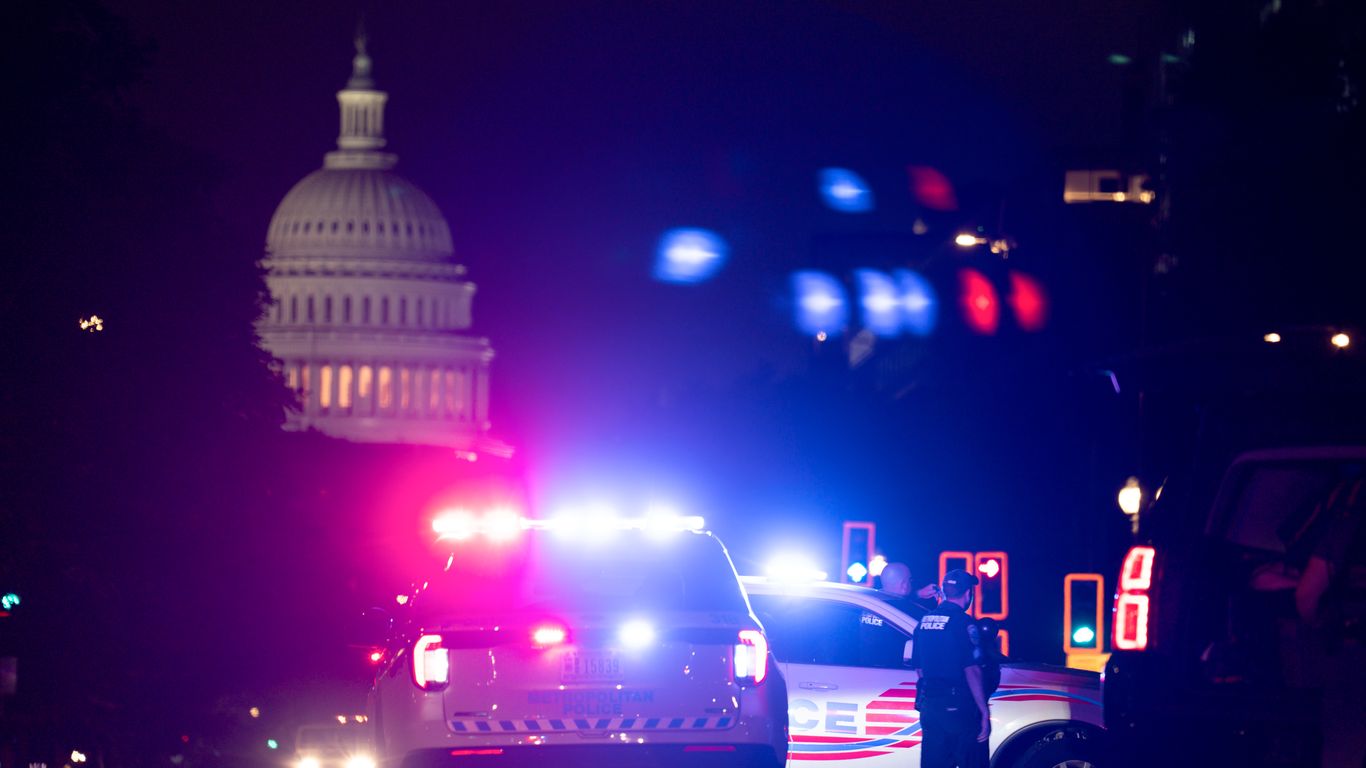
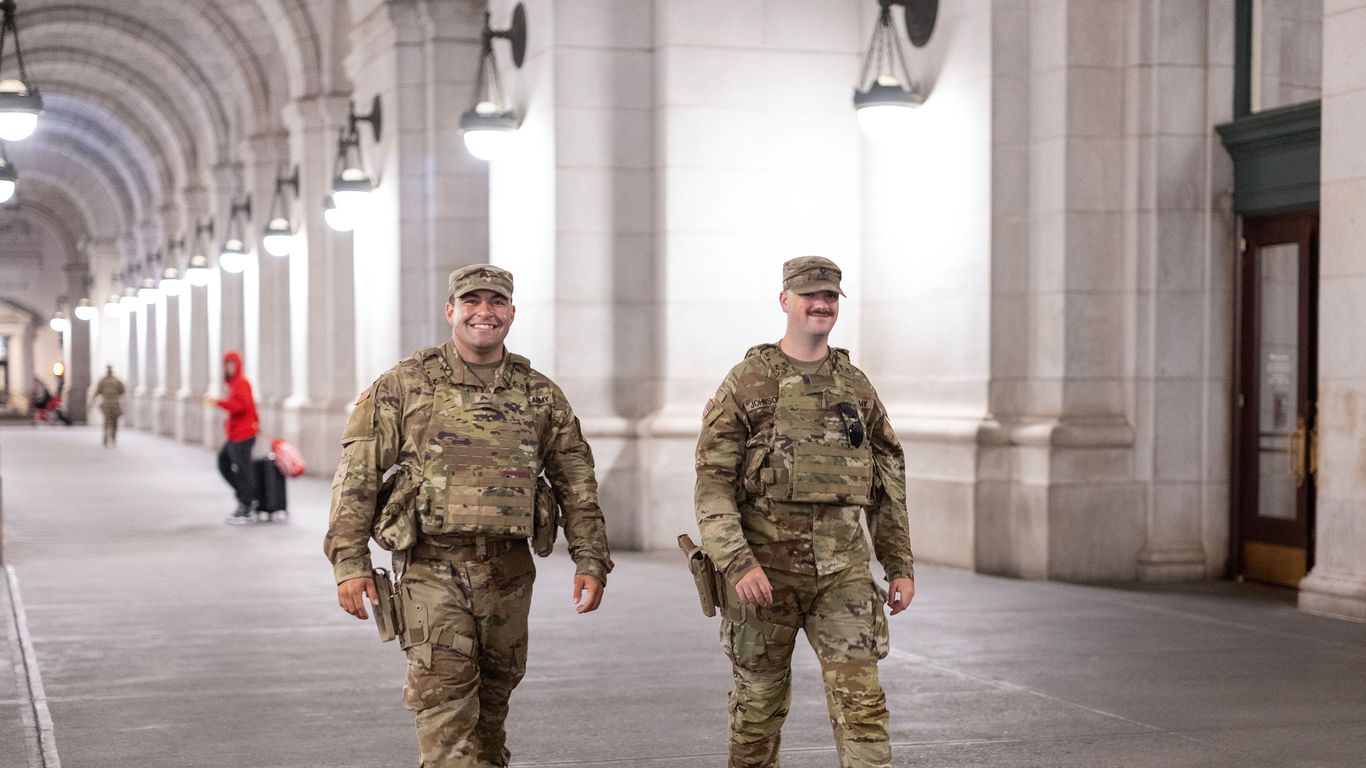
President Trump is making significant changes to Washington D.C., bringing in more control by deploying troops and planning extensive renovations. He also aims to reshape cultural institutions by placing allies in key positions. Trump is seeking further federal influence over D.C. and possibly other Democratic-run cities.
Key Facts
President Trump has increased control over Washington D.C., including deploying more than 2,000 National Guard troops.
Trump plans to request $2 billion from Congress to renovate and beautify D.C.'s infrastructure.
The White House is undergoing major renovations, including plans for a $200 million ballroom.
Trump has influenced cultural institutions, such as the Kennedy Center and the Smithsonian, by placing allies in leadership roles.
The White House is pushing to review and possibly change museum content to better align with Trump's vision of "American ideals."
Trump's administration is using federal agencies to pursue projects, potentially opposing a major stadium project due to the team's name change.
Discussions have surfaced about extending federal control strategies to other cities such as Chicago and New York.
Read the Original
Want the full story? Tap a source to open the original
article.
The Trump administration has intensified efforts to restrict gender-affirming care by investigating hospitals, limiting benefits for federal workers, and clashing with states that support such care. These moves have raised concerns about patient privacy and the rights of transgender individuals. Legal battles are emerging as federal actions potentially conflict with state laws and patient privacy protections.
Key Facts
The administration is investigating hospitals that provide gender-affirming care for minors.
Federal workers and their dependents will lose coverage for gender-affirming care, except for mental health and certain ongoing hormonal treatments.
The Justice Department has requested patient data, including Social Security numbers, from hospitals regarding transition-related care for individuals under 19.
State laws govern medical practice, while the federal government sets health safety standards.
The California teen pregnancy program lost funding for including gender ideology, previously approved as medically accurate.
Legal disputes are arising over demands for patient information, testing the limits of privacy laws.
Missouri's Attorney General has been tapped for a federal role and has a history of initiatives against gender-affirming care.
Read the Original
Want the full story? Tap a source to open the original
article.
Kilmar Abrego Garcia, a man from Maryland originally from El Salvador, was detained by U.S. Immigration and Customs Enforcement (ICE) during a check-in in Baltimore. He had previously been deported to El Salvador by mistake and returned to the U.S. Now, the U.S. government is considering deporting him to Uganda, despite legal challenges and a lawsuit he has filed.
Key Facts
Kilmar Abrego Garcia is a construction worker from Maryland.
He was detained by ICE during a routine check-in in Baltimore.
Abrego Garcia had been mistakenly deported to El Salvador earlier, despite a court order.
The U.S. government now plans to deport him to Uganda.
Abrego Garcia is challenging his detention and possible deportation in court.
He has been charged with conspiracy to transport undocumented immigrants and unlawful transportation of migrants.
The Trump administration’s crackdown on undocumented immigrants is linked to his case.
Uganda has shown reluctance to accept individuals with criminal charges from other countries.
Read the Original
Want the full story? Tap a source to open the original
article.
Kilmar Abrego Garcia, a Salvadoran national, has surrendered to U.S. immigration officials in Baltimore and faces possible deportation to Uganda. He has been involved in legal battles pertaining to immigration and human smuggling charges, which he and his lawyers contest. A federal lawsuit has been filed to prevent his deportation while his legal issues are ongoing.
Key Facts
Kilmar Abrego Garcia is a Salvadoran national facing deportation from the U.S.
He surrendered to U.S. immigration authorities in Baltimore.
The Trump administration labeled him as a community danger and possible MS-13 gang member.
Abrego Garcia denies gang affiliations and has pleaded not guilty to human smuggling charges.
He was previously deported to El Salvador but returned to the U.S. after a court found he faced danger there.
A lawsuit was filed to stop his deportation, claiming his rights need protection.
The U.S. government has suggested deporting him to Uganda.
He has an American wife and children and has lived in Maryland for several years.
Read the Original
Want the full story? Tap a source to open the original
article.
Former President Trump plans to issue an order to end cashless bail in Washington, D.C. He believes this policy is ineffective in preventing crime. The move involves potentially withholding federal funds from the city if it does not comply.
Key Facts
Trump intends to sign an executive order to eliminate cashless bail in Washington, D.C.
Cashless bail means suspects do not need to pay money to be released before trial.
The executive order may threaten to withhold federal funding from D.C. if cashless bail is not ended.
Under current rules, federal law enforcement arrests place suspects in federal custody, while local arrests keep them in local custody.
D.C. removed cash bail in the 1990s; it was one of the first places to do this.
Trump criticized cashless bail as part of his tough-on-crime stance during the 2024 presidential race.
Some states have also limited or eliminated cash bail; supporters say it ensures trial appearances, while critics argue it penalizes those who can't afford bail.
Read the Original
Want the full story? Tap a source to open the original
article.
Central bankers recently expressed concerns at a meeting in Jackson Hole, Wyoming, about threats to their independence and the impact of political actions on economic policymaking. President Trump's actions, including firing officials and nominating partisan figures, have increased worries about a shift toward more politically influenced economic policies. These changes are causing concern among central bankers globally who previously looked up to the Federal Reserve's independence.
Key Facts
Central bankers held a meeting in Jackson Hole, Wyoming, where they talked about challenges to their independence.
President Trump criticized Fed chair Jerome Powell and threatened to fire Fed governor Lisa Cook.
Trump nominated Stephen Miran, who advocates for increased presidential control over the central bank, as a Fed governor.
The commissioner of the Bureau of Labor Statistics was fired by Trump after a weak jobs report.
Some feel U.S. economic policies are becoming more openly political and less focused on technical analysis.
International central bankers who admire the U.S. economic model are now concerned about its shift.
Experts have noted that central banks have made mistakes, contributing to their current political challenges.
Read the Original
Want the full story? Tap a source to open the original
article.
President Trump suggested sending National Guard troops to Chicago to address crime, but local leaders including Mayor Brandon Johnson and Governor JB Pritzker oppose the idea. Additionally, Trump is meeting with South Korea's President to discuss military strategies and trade agreements.
Key Facts
President Trump discussed the possibility of sending the National Guard to Chicago.
Chicago Mayor Brandon Johnson and Illinois Governor JB Pritzker oppose this plan.
Local leaders argue the proposed action is illegal and unnecessary given recent crime decreases.
Trump is meeting with South Korean President Lee Jae-myung in Washington.
They will discuss their military alliance and finalize a new trade deal.
The U.S. wants South Korea to focus its military efforts on China rather than North Korea.
South Korea has pledged a $350 billion investment in the U.S., influencing tariff discussions.
The FBI searched the home of John Bolton, a former national security adviser to Trump.
Read the Original
Want the full story? Tap a source to open the original
article.
Chicago Mayor Brandon Johnson talked about President Trump's threat to send the National Guard to Chicago. The conversation aimed to address concerns and implications of such an action.
Key Facts
Chicago Mayor Brendan Johnson had a discussion about the potential deployment of the National Guard to Chicago.
This conversation was in response to a threat made by President Trump.
The discussion was featured on NPR's Morning Edition.
Journalist Steve Inskeep conducted the interview with Mayor Johnson.
The use of the National Guard in U.S. cities is generally related to maintaining public order during emergencies.
Read the Original
Want the full story? Tap a source to open the original
article.
The article reports that President Trump has threatened to send National Guard troops and federal agents to Chicago. The presence of these forces is already noticeable in Washington, D.C.
Key Facts
President Trump made a threat to send National Guard troops to Chicago.
The purpose is to assist with managing the situation in the city.
National Guard troops and federal agents are already active in Washington, D.C.
This announcement was covered on the radio program Morning Edition.
Federal forces have been used in other cities for maintaining order and security.
Read the Original
Want the full story? Tap a source to open the original
article.
President Trump has threatened to send National Guard troops to Chicago. The Department of Justice is involved in recent actions. South Korea's president will meet with Trump in Washington, D.C. soon.
Key Facts
President Trump mentioned sending National Guard troops to Chicago.
The Department of Justice has been active in recent actions.
The President of South Korea plans to meet Trump in Washington, D.C.
This meeting is scheduled for Monday.
The news was part of a morning news brief on NPR.
Read the Original
Want the full story? Tap a source to open the original
article.
The Department of Justice (DOJ) released transcripts from an interview with Ghislaine Maxwell last week. These transcripts have drawn attention to actions taken by the DOJ under the Trump administration.
Key Facts
The DOJ released the interview transcripts on Friday.
Ghislaine Maxwell is the subject of the interview.
The actions took place under the Trump administration, which means when Donald Trump was President.
The release of these documents has led to ongoing reactions and attention.
The transcripts are related to an interview done by the DOJ with Maxwell.
Read the Original
Want the full story? Tap a source to open the original
article.
There are no ads, so there is no reason to bait you. Readers who chip in keep it that way. Most choose $3.99/month, and get the daily digest every morning.
Waveland, Mississippi, is still facing challenges recovering from the damage caused by Hurricane Katrina, which hit 20 years ago. The storm brought a massive surge that destroyed much of the town.
Key Facts
Hurricane Katrina hit Waveland, Mississippi, 20 years ago.
The storm caused a nearly 30-foot high surge of water.
The surge completely destroyed large parts of the town.
Recovery efforts are ongoing, indicating the long-term impact of the storm.
The town is still working to rebuild and recover from the damage.
Read the Original
Want the full story? Tap a source to open the original
article.
New Orleans' schools have changed a lot in the 20 years since Hurricane Katrina. Almost all the schools are now charter schools, where private groups run them instead of the government. Some people think this has helped the schools, while others have mixed feelings about the change.
Key Facts
Hurricane Katrina hit New Orleans over 20 years ago, leading to major changes in the school system.
Almost all New Orleans schools are now charter schools instead of government-run public schools.
Charter schools are run by private groups who make many decisions about the school.
Mary McLeod Bethune Elementary was one of the few traditional schools that resisted becoming a charter school initially.
The number of students in New Orleans schools has dropped from more than 65,000 in 2005 to less than 44,000.
Many school buildings have been renovated or rebuilt with over $2 billion from FEMA and other funders.
Education researcher Doug Harris notes that test scores and graduation rates have improved since the switch to charters.
Before Katrina, New Orleans schools had poor graduation rates and issues with resources and management.
Read the Original
Want the full story? Tap a source to open the original
article.
Immigration courts in New York have become centers of increased law enforcement activity, with federal immigration officers actively conducting arrests. The rise in enforcement is part of efforts to boost immigration arrests, leading to criticism from immigrant rights groups and legal advocates. There are ongoing protests and opposition to the presence of federal agents at these courts.
Key Facts
Immigration and Customs Enforcement (ICE) officers are actively present at New York's immigration courts.
The courts are part of the Executive Office for Immigration Review, which oversees immigration cases.
Federal agents have increased their presence in the last eight months, aiming to boost immigration arrests.
The New Sanctuary Coalition and other groups oppose these enforcement tactics.
The presence of federal officers has led to regular arrests and occasional clashes with local officials.
New York City Mayor Eric Adams filed a court brief opposing courthouse arrests by federal agencies.
Legal advocates argue that these tactics raise concerns about due process and trust in law enforcement.
There is significant opposition and protest from various groups against the enhanced enforcement efforts.
Read the Original
Want the full story? Tap a source to open the original
article.
A retired U.S. Army General, Russel Honoré, who led the recovery efforts after Hurricane Katrina in 2005, reflects on the chaos and critical lessons from the disaster. He emphasizes that as climate disasters increase, essential lessons like timely evacuation warnings and support for vulnerable populations, such as those without resources, remain unheeded. Honoré also highlights improvements post-Katrina, such as laws allowing animals in evacuation shelters.
Key Facts
Hurricane Katrina struck in 2005 and was the most expensive hurricane in U.S. history.
Army Lt. Gen. Russel Honoré led the recovery efforts as head of Joint Task Force Katrina.
Before Katrina, there were warnings of major damage, but evacuation orders came late for many.
Many people, especially the poor and elderly, stayed behind during Katrina due to late warnings and a lack of evacuation resources.
New federal laws now require shelters to accommodate people with pets during evacuations.
Over 240,000 homes were flooded when the levees broke in New Orleans.
Reports of lawlessness occurred, but Honoré noted that survival efforts were sometimes mistaken for looting.
Honoré stresses the importance of learning from past disasters to improve future preparedness.
Read the Original
Want the full story? Tap a source to open the original
article.
In 2005, Ashley Ludlow received difficult news after her mother, Judy, who had mental health issues, attempted suicide and was on life support. During this challenging time, a nurse called Ludlow to assure her that her mother had passed away peacefully, helping her cope with the guilt of her decisions. This story is part of a series highlighting unsung heroes who have impacted others' lives through small acts of kindness.
Key Facts
Ashley Ludlow's mother, Judy, attempted suicide in 2005 and was hospitalized on life support.
Ludlow had power of attorney and decided to implement a "Do Not Resuscitate" order for her mother.
Travel complications due to Hurricane Katrina prevented Ludlow and her family from being at the hospital.
Judy passed away peacefully in the hospital without regaining consciousness.
A nurse called Ludlow to inform her that her mother experienced no pain, relieving her guilt about the decision.
The story is part of the "My Unsung Hero" series by the Hidden Brain team, showcasing acts of kindness.
The series encourages people to share their own stories of unsung heroes.
Read the Original
Want the full story? Tap a source to open the original
article.
National Guard troops in Washington D.C. started carrying weapons as part of a crime crackdown ordered by President Trump. This was authorized by the Secretary of Defense, and troops will only use force if there is a serious threat. About 2,000 troops are involved in this operation from D.C. and some Republican-led states.
Key Facts
National Guard troops in D.C. are carrying weapons for a new crime crackdown.
The Secretary of Defense approved the carrying of weapons.
Troops follow strict rules for using force, allowed only as a last resort.
Around 2,000 troops are part of this operation.
Troops come from both D.C. and several Republican-led states.
Some troops may have M4 carbine rifles or M17 pistols.
The operation aims to ensure the safety of residents in Washington D.C.
Read the Original
Want the full story? Tap a source to open the original
article.
That's the point of this site, and readers keep it that way. Support for any amount and the daily digest lands in your inbox every morning at 7am Eastern.
National Guard troops in Washington, DC, have started carrying weapons while patrolling the area. This decision follows orders from President Donald Trump, who also hinted at deploying troops to Baltimore due to crime concerns. There have been protests against the use of federal forces in DC, even as crime data shows a decline.
Key Facts
National Guard troops in DC began carrying weapons on August 24, 2025.
The troops can only use force if there's an immediate threat of death or serious harm.
President Trump said there is no crime in DC and hinted at deploying troops to Baltimore.
Crime in Baltimore has decreased according to recent data, with fewer homicides this year.
Thousands of National Guard and other federal officers are patrolling DC streets.
Trump's actions have led to protests and resident concerns.
In 2020, the Democratic-controlled House passed a bill to make DC a state, but it didn't advance.
Read the Original
Want the full story? Tap a source to open the original
article.
A person in Maryland was found with a flesh-eating parasite called the New World screwworm after traveling back from El Salvador. This is the first reported human case of this parasite related to travel in the U.S., but health officials say there is a very low risk to public health.
Key Facts
A case of New World screwworm was detected in a person who traveled from El Salvador to Maryland.
The New World screwworm is a type of parasitic fly that infests living tissue.
The U.S. Department of Health and Human Services reported this as the first travel-associated human case in the U.S.
Health officials say the risk to the general public is very low.
New World screwworm is typically found in South America and the Caribbean.
Efforts have been made to prevent the parasite from entering the U.S., including breeding sterile flies.
A past method used to control the parasite in the U.S. included releasing sterilized insects to eradicate fly populations.
Read the Original
Want the full story? Tap a source to open the original
article.