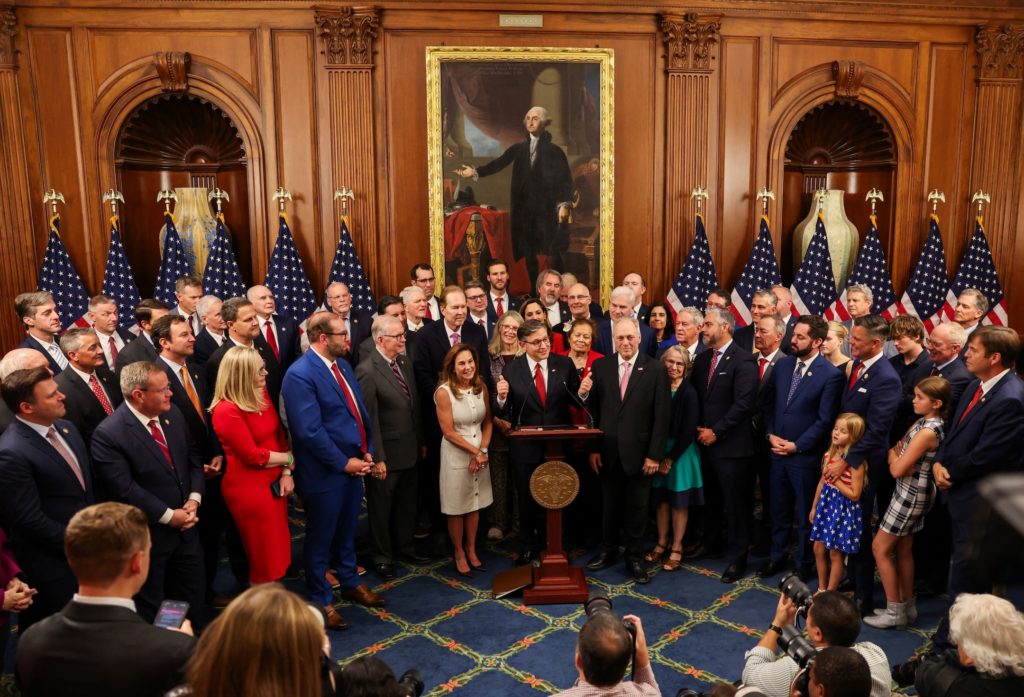
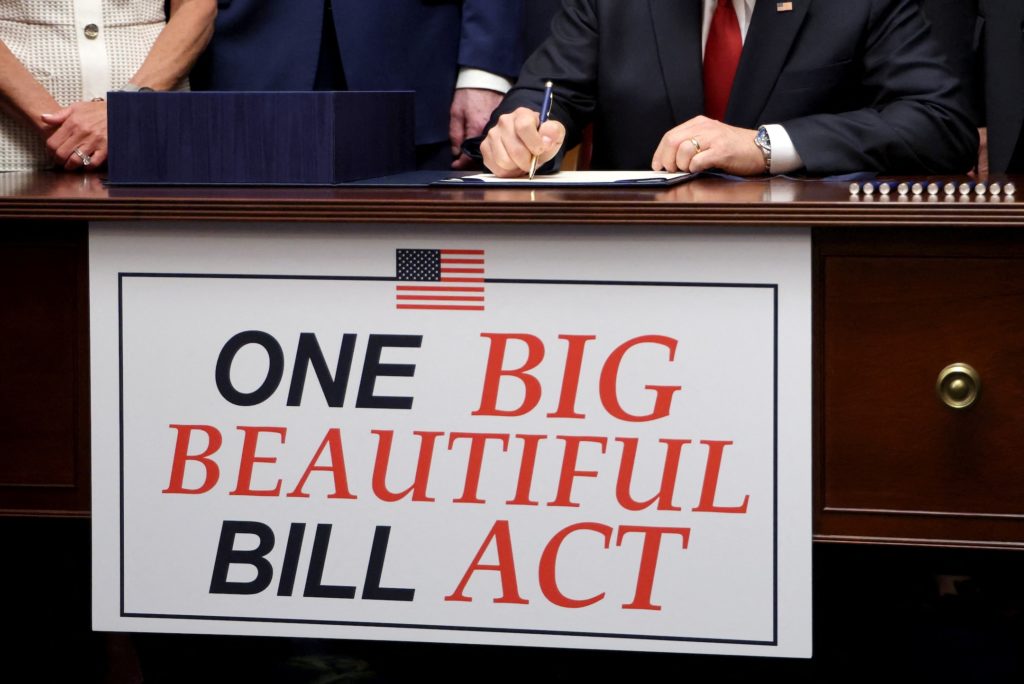
A major bill, dubbed "One Big, Beautiful Bill," was passed after tight negotiations among Republicans. The goal was to finalize it by July 4th, a deadline set by the president.
Key Facts
The bill is named "One Big, Beautiful Bill."
It was supported by a narrow Republican majority.
The president wanted the bill finished by Independence Day, July 4th.
The process involved weeks of negotiations among Republicans.
Congressional correspondent Lisa Desjardins provided information on the bill.
Read the Original
Want the full story? Tap a source to open the original
article.
Sarah Longwell, a Republican strategist and publisher, discussed with William Brangham how some Republicans who were once against a certain bill have changed their stance.
Key Facts
Sarah Longwell is a Republican strategist.
William Brangham conducted the interview.
Sarah Longwell is also the publisher of The Bulwark, a publication.
The discussion was about Republicans changing their views on a bill.
The bill was referred to as "One Big, Beautiful Bill."
Some Republicans initially opposed this bill.
Read the Original
Want the full story? Tap a source to open the original
article.
The article discusses a bill from President Trump that benefits companies and small businesses. It makes tax breaks lasting, increases options for expenses, and lets companies deduct costs for new factories.
Key Facts
President Trump's bill benefits both big corporations and small businesses.
The bill makes previous tax breaks permanent.
It expands the rules for how businesses can report expenses.
Companies can deduct the cost of building new manufacturing plants.
Jay Timmons from the National Association of Manufacturers shared a business perspective on the bill.
Read the Original
Want the full story? Tap a source to open the original
article.
The Supreme Court plans to hear two cases about whether states can stop transgender athletes from joining women’s and girls’ sports. A man named Kilmar Abrego Garcia claims he faced harsh treatment and torture in a well-known prison in El Salvador. A Chicago suburb will purchase the childhood home of Pope Leo and turn it into a museum.
Key Facts
The Supreme Court will look at two cases about transgender athletes in sports next term.
These cases question if states can stop transgender athletes from participating in women’s and girls’ sports.
Kilmar Abrego Garcia says he experienced severe beatings and torture while in prison in El Salvador.
The prison where Garcia was held is infamous for harsh conditions.
A Chicago suburb where Pope Leo lived as a child will buy his childhood home.
The suburb plans to make Pope Leo’s childhood home into a historical site.
Read the Original
Want the full story? Tap a source to open the original
article.
President Trump plans to reduce funding for small airports in rural areas across the United States. Over 180 airports that currently receive federal funds for commercial flights might see a funding cut by half.
Key Facts
President Trump wants to cut funding for small airports in rural America.
More than 180 rural airports currently get federal funding.
The funding ensures these airports can offer commercial air services.
The proposed cuts could reduce the funding by 50%.
This change is part of a broader effort by the Trump administration.
Read the Original
Want the full story? Tap a source to open the original
article.
Earlier this week, the U.S. government decided to pause some weapons shipments to Ukraine. The Defense Department explained it needs these weapons for its own possible future situations.
Key Facts
The U.S. government paused certain weapons deliveries to Ukraine this week.
The decision was announced by the Trump administration.
The Defense Department stated the weapons are needed for U.S. emergencies or plans.
The discussion on this decision involved Kimberly Kagan from the Institute for the Study of War.
Jennifer Kavanagh from Defense Priorities also discussed the move.
Read the Original
Want the full story? Tap a source to open the original
article.
The Trump administration has decided to revert the names of nine Army bases back to their original names honoring Confederate generals. This decision has sparked discussions about acknowledging and moving past the military's history of segregation.
Key Facts
The Trump administration changed the names of nine Army bases back to their original Confederate general names.
Confederate generals were leaders in the Southern states during the Civil War, which was partly about maintaining slavery.
The previous renaming of these bases aimed to address the military's segregationist history.
This reversal has led to debates about how the military should handle its history.
The change comes after previous efforts were made by a bipartisan group, meaning people from different political parties worked together.
Read the Original
Want the full story? Tap a source to open the original
article.
The Education Department stopped the release of nearly $7 billion, which was meant for school programs. This decision will affect millions of children and families.
Key Facts
The Education Department has paused the distribution of almost $7 billion.
The funding was scheduled to be released on July 1.
This money was intended for important school programs.
Millions of children and working families will be impacted by this funding freeze.
The department has offered little explanation for the delay.
Laura Barrón-López and Jodi Grant discussed the situation, highlighting the consequences.
Read the Original
Want the full story? Tap a source to open the original
article.
The U.S. House of Representatives passed a tax cut and spending bill, known as the “One Big Beautiful Bill,” by a narrow vote of 218 to 214. The bill will raise the debt ceiling by $5 trillion, increase spending on immigration enforcement, and maintain earlier tax cuts, but it will reduce funding for programs like Medicaid and SNAP. The bill now moves to President Trump to be signed into law.
Key Facts
The House of Representatives passed the bill after 29 hours of debate.
The vote was close: 218 in favor and 214 against.
All Democrats opposed the bill, and two Republicans joined them.
The bill will allow the U.S. government to borrow an additional $5 trillion.
It increases spending significantly on immigration enforcement.
It maintains tax cuts from 2017, which primarily benefit high earners.
Funding for Medicaid and SNAP will be reduced to cover costs.
The Congressional Budget Office estimates 17 million more people will be without health insurance over 10 years because of this bill.
The national deficit is projected to grow by $3.3 trillion over the next decade.
Democratic Leader Hakeem Jeffries spoke for almost nine hours in protest before the bill was passed.
Read the Original
Want the full story? Tap a source to open the original
article.
The CIA is revisiting its 2016 findings on Russian interference in the U.S. presidential election. CIA Director John Ratcliffe asked analysts to review their earlier conclusions.
Key Facts
The CIA's initial report was about Russia interfering in the 2016 U.S. presidential election.
John Ratcliffe is the current CIA Director.
Ratcliffe instructed CIA analysts to re-examine the 2016 findings.
The review is focused on the CIA's original conclusions.
This task took place during President Trump's administration.
Read the Original
Want the full story? Tap a source to open the original
article.
Chicago experienced a significant decrease in the number of homicides in the first half of the year, similar to a trend seen across the United States. Jeff Asher's Real-Time Crime Index collects data from many law enforcement groups in the country to look closely at violent crime.
Key Facts
Chicago saw a notable drop in homicides during the first half of the year.
This decrease in homicides is part of a national trend.
William Brangham discussed the state of violent crime in the U.S. with Jeff Asher.
Jeff Asher uses the Real-Time Crime Index to gather crime data.
The Real-Time Crime Index collects information from hundreds of law enforcement agencies across the U.S.
Read the Original
Want the full story? Tap a source to open the original
article.
The U.S. Supreme Court will hear two cases challenging state bans on transgender women and girls participating in school and college sports. These cases come from Idaho and West Virginia and will address laws that have sparked debate on fairness and discrimination in athletics.
Key Facts
The Supreme Court will review state laws banning transgender women and girls from sports at publicly funded schools and colleges.
The laws aim to ensure fairness in sports but face criticism for alleged discrimination.
Twenty-seven states have enacted these types of laws.
The debate involves the U.S. Constitution's equal treatment and Title IX, which requires equal opportunities in schools receiving federal funds.
Participation of transgender athletes in sports is rare, with fewer than 10 in major leagues like the NCAA.
A brief supporting the state bans is signed by 102 female athletes and family members who argue about fairness.
Prior to recent orders, most sports organizations allowed transgender athletes to compete if they met certain medical conditions.
Read the Original
Want the full story? Tap a source to open the original
article.
Staying informed here is free for everyone. If it's worth something to you, pay what you want. Supporters also get the daily digest by email every morning.
This year, 86% of pensioners in Northern Ireland will qualify for a winter fuel payment, according to Communities Minister Gordon Lyons. This policy change comes after an earlier decision to limit these payments was reversed. Now, pensioners with incomes of £35,000 or less can receive the grant.
Key Facts
86% of pensioners in Northern Ireland will be eligible for the winter fuel payment this year.
The eligibility change follows a previous decision to restrict payments for cost-saving reasons.
Pensioners with an income of £35,000 or lower can qualify for the payment.
288,000 pensioners in Northern Ireland are expected to receive this payment.
Across the whole UK, about 80% of pensioners will keep the payment, but in Northern Ireland, the percentage is higher due to generally lower incomes.
Winter fuel payments started in 1997 to help pensioners with heating costs during winter.
Previously, Northern Ireland had to follow a policy where payments were restricted to those on benefits and pension credit.
Minister Lyons had secured £17 million from Stormont for a one-off payment for pensioners affected by last winter's cuts.
Read the Original
Want the full story? Tap a source to open the original
article.
In Chicago, four people were killed and 18 were shot during an event at a restaurant when gunfire came from a fast-moving vehicle. The incident happened during an album release party, and police are asking the public for help in finding those responsible as the investigation continues.
Key Facts
A shooting took place in a busy Chicago neighborhood known for its nightlife.
Four people died, and 18 people were shot from a vehicle.
The event was an album release party for rapper Mello Buckzz.
Police stated the crime scene showed signs of targeted violence, not a random act.
Police are still looking to identify the suspects and are asking for public assistance.
The shooting happened at Artis Restaurant and Lounge, a space that serves the Black, Brown, and LGBTQ+ communities.
The victims included two men and two women, with some victims critically injured.
This location experienced a similar violent incident in 2012.
Read the Original
Want the full story? Tap a source to open the original
article.
The House of Representatives passed a bill called the One Big Beautiful Bill. This bill extends tax cuts, reduces Medicaid spending, and increases funding for border security and defense.
Key Facts
The bill was passed by the House of Representatives.
It is called the One Big Beautiful Bill.
The bill extends temporary tax cuts.
It reduces the amount of money spent on Medicaid, which is a government program that helps people with healthcare.
It increases spending on border security, which involves protecting the nation's borders.
The bill also raises spending on defense, related to military and national security.
Read the Original
Want the full story? Tap a source to open the original
article.
The first group of immigrants has been moved to a new detention center in the Florida Everglades, a project linked to state officials and dubbed "Alligator Alcatraz." The center can initially hold about 3,000 detainees and may expand to 5,000. There are concerns about the center's environmental impact and living conditions for detainees.
Key Facts
A new immigrant detention center called "Alligator Alcatraz" opened in the Florida Everglades.
Florida Attorney General James Uthmeier confirmed the center's operational status.
The center was built quickly, taking just eight days to complete.
It can initially hold up to 3,000 detainees and might expand to 5,000 beds.
Florida officials, with no federal funding, are running the center under state authority.
The facility will house immigrants detained under the federal 287(g) program, which lets officers hold individuals for possible deportation.
Concerns have been raised by Democratic lawmakers and activists about detainee conditions and environmental effects.
Native American tribes argue the site is on sacred land and may harm the Everglades ecosystem.
Read the Original
Want the full story? Tap a source to open the original
article.
Congress passed a new law, supported by former President Trump, creating temporary tax exemptions for tipped workers. This law allows workers to deduct up to $25,000 in tips from their taxable income, but it applies only until 2028 unless Congress extends it.
Key Facts
Congress approved a tax package called the One Big Beautiful Bill Act.
Tipped workers can now deduct up to $25,000 in tips from their taxable income annually.
This tax benefit is temporary and will end in 2028 unless Congress decides otherwise.
Workers earning more than $150,000 annually will still have their tips taxed.
The tax exemption applies to jobs that typically receive tips, but these jobs are not specifically listed in the law.
The bill faced opposition, particularly due to concerns over cuts to Medicaid.
The law could reduce health insurance coverage by over ten million people according to a government analysis.
Both Republicans and some Democrats supported parts of the bill, despite disagreements.
Read the Original
Want the full story? Tap a source to open the original
article.
That's the point of this site, and readers keep it that way. Support for any amount and the daily digest lands in your inbox every morning at 7am Eastern.
President Trump's new bill focuses on increasing immigration enforcement in the U.S. It includes large funding for border security, detention centers, and immigration enforcement personnel. The bill aims to improve border security infrastructure and increase detention capacity.
Key Facts
The bill plans to spend $170 billion on border and immigration goals.
It allocates $45 billion for immigration detention centers to expand detention facilities.
About $30 billion will hire more ICE personnel and support operational costs.
The funding could add space for at least 116,000 beds in detention centers.
$46.5 billion is set aside to finish constructing the border wall.
The bill allocates $5 billion for Customs and Border Protection facilities.
The planned funding for border security comes despite a reported decrease in border crossings.
Some experts express concerns about potential overcrowding and challenges for detainees.
Read the Original
Want the full story? Tap a source to open the original
article.
House Republicans passed a large tax and policy bill, extending Trump's 2017 tax cuts and increasing spending on defense and immigration enforcement. The bill also raises the national debt limit by $5 trillion and reduces spending on Medicaid and other social programs, which may lead to millions losing coverage. Democrats oppose the bill and plan to use it in their campaign to regain control of Congress.
Key Facts
The bill was passed by House Republicans and is now awaiting President Trump's signature.
The legislation extends tax cuts from 2017 and adds new funding for defense and immigration enforcement.
It raises the U.S. debt limit by $5 trillion.
Funding cuts will affect Medicaid, a program that helps low-income, elderly, and disabled Americans get healthcare.
Early estimates suggest 12 million people could lose their healthcare coverage.
All Democrats voted against the bill, citing major cuts to the social safety net.
The bill has become a central issue for Democrats aiming to regain control of Congress in the 2026 elections.
Read the Original
Want the full story? Tap a source to open the original
article.