The United States has carried out attacks on Iran for 13 nights in a row, hitting military and communication targets. Meanwhile, despite a naval blockade declared by Yemen’s Houthis, some Chinese oil tankers passed through a strategic waterway, and tensions remain high with threats of even bigger US strikes.
Key Facts
The US Central Command said it targeted Iranian military centers, drone facilities, surveillance sites, and maritime capabilities.
Explosions and missile strikes were reported in several Iranian cities, including Khorramabad, Ahvaz, and Bandar Abbas.
Iran’s army claimed drone attacks on military bases in Bahrain and Jordan.
Yemen’s Houthis announced a naval blockade against Saudi Arabia, but two Chinese supertankers still passed through Bab al-Mandeb strait.
Shipping through the Strait of Hormuz was disrupted, with only one tanker crossing on Thursday.
President Donald Trump said he may launch the largest strikes on Iran yet and threatened to use Iran’s frozen assets to pay for damages if Iranian attacks continue.
Iran’s foreign minister warned that using frozen assets for future claims would create a dangerous precedent in international relations.
The situation reflects ongoing tensions and military actions between the US and Iran, affecting regional security and global shipping routes.
Read the Original
Want the full story? Tap a source to open the original
article.
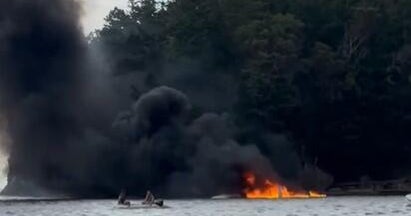
A seaplane crashed and caught fire in Puget Sound, north of Seattle, on Thursday evening. All 11 people on board survived, but several were injured, with one person in critical condition.
Key Facts
The crash happened around 5:15 p.m. near Shallow Bay, close to Sucia Island.
The plane had 10 passengers and 1 pilot on board.
Everyone was rescued from the water by emergency responders, including the Coast Guard.
Injuries reported include head wounds, broken bones, and cuts.
One patient was in critical condition, but there were no deaths.
Three airlift ambulances were at the scene to provide medical help.
A video showed the plane flying low, wobbling, crashing, and then catching fire.
Kenmore Air confirmed the accident and accounted for everyone on board.
Read the Original
Want the full story? Tap a source to open the original
article.
Spain declared a national emergency after wildfires forced about 10,000 people to leave their homes near Madrid. The government took control of firefighting efforts as the fires, fueled by a heat wave, continued to spread in the central region.
Key Facts
Spain’s government declared a national emergency on July 24, 2026.
Around 10,000 people were evacuated from villages near Madrid due to wildfires.
The interior ministry now oversees firefighting across the affected regions.
The fires are spreading during a heat wave, which makes them worse.
Spain has lost more than 100,000 hectares (about 247,000 acres) to fires so far this year.
One recent large fire burned 32,000 hectares (79,000 acres) in Guadalajara province.
Earlier in July, 13 people died in a wildfire in southern Spain.
Many evacuees spent the night in emergency centers like sports facilities.
Read the Original
Want the full story? Tap a source to open the original
article.
Heavy monsoon rains caused severe flooding in Assam, a state in northeastern India, killing at least 50 people and forcing 700,000 to leave their homes. The Brahmaputra River overflowed, flooding nearly 900 villages and several parts of Guwahati, the state capital.
Key Facts
At least 50 people died due to flooding in Assam, India.
Around 700,000 people were displaced by the floods.
The Brahmaputra River, which flows through Assam, overflowed after heavy monsoon rains.
Nearly 900 villages were submerged and more than 7,000 homes lost electricity.
About 300,000 people took shelter in government relief camps.
Authorities provided food and supplies through airdrops from helicopters.
Rescue teams, police, and volunteers worked to help stranded residents.
Climate change is making South Asian monsoon rains more intense and unpredictable.
Read the Original
Want the full story? Tap a source to open the original
article.
Chinese coast guard ships used water cannons on Philippine fishing boats near the Scarborough Shoal, marking the third clash in the South China Sea this week. The Philippines and China both claim these waters, which are important for global trade, and the dispute was discussed at a regional meeting in Manila.
Key Facts
Chinese coast guard fired water cannons at two Philippine fishing vessels on Friday.
The incident happened near Scarborough Shoal, a disputed area claimed by both countries.
A Chinese ship came within 23 feet of a Philippine government boat, causing a risk of collision.
China claims almost the entire South China Sea, despite a 2016 court ruling against its claims.
The Philippines called China’s actions dangerous and unprofessional, stating the shoal is part of its territory.
Southeast Asian and Western countries expressed concern about incidents and environmental damage in the area during a Manila meeting.
ASEAN diplomats said they made progress on a code of conduct to avoid armed conflict in the South China Sea.
U.S. Secretary of State Marco Rubio met with China’s foreign minister to discuss recent clashes and regional tensions.
Read the Original
Want the full story? Tap a source to open the original
article.
An 18-year-old woman noticed large bruises, itchy skin, coughing, and tiredness over several months in early 2026. After medical tests, she was diagnosed with stage 2 Hodgkin’s lymphoma, a type of cancer, and began chemotherapy treatment.
Key Facts
The patient is an 18-year-old woman who plays tennis.
She developed bruises, itchy skin, night sweats, cough, shortness of breath, and fatigue.
Initial doctor visit suggested seasonal asthma and prescribed an inhaler, which did not help.
Chest X-ray and CT scan revealed an eight-centimeter mass on her lung and swollen lymph nodes.
Blood tests confirmed she has stage 2 Hodgkin’s lymphoma.
She started treatment with Nivolumab AVD chemotherapy, with sessions every two weeks.
Chemotherapy causes fatigue, nausea, hair loss, and infections.
The illness affected her physically and emotionally during her senior year in high school.
Read the Original
Want the full story? Tap a source to open the original
article.
Deadly wildfires are burning in parts of France, Spain, and Italy, forcing thousands of people to leave their homes. Firefighters and planes are working hard to stop the fires, but strong winds and hot weather are making it difficult.
Key Facts
Thousands of people fled wildfires in France, Spain, and Italy on July 24, 2026.
France requested help from the European Union to fight the fires.
Spain declared a state of emergency in the Madrid region and Ávila province because of the fires.
Over 100,000 hectares (about 247,000 acres) have burned in Spain since January.
In Spain, 13 people died in wildfires earlier this month.
In France, more than 50,000 hectares have burned since January.
Around 800 firefighters are fighting a large fire in France’s Nouvelle-Aquitaine region.
Winds and hot temperatures are making it harder to control the fires, especially near Madrid.
Read the Original
Want the full story? Tap a source to open the original
article.
Four Palestinians and one Israeli were killed in a shooting near Nablus in the northern West Bank, with several others injured. The Israeli military said their soldiers responded to an attack on Israeli hikers and imposed a temporary blockade around Nablus and a nearby village.
Key Facts
The shooting occurred near the city of Nablus in the northern West Bank.
Four Palestinians were killed, according to the Palestinian Health Ministry.
One Israeli man was also killed, but it is unclear who shot him.
Several people were injured, including four Palestinians and two Israelis.
Three of the injured Palestinians are in critical condition.
Israeli rescue services are airlifting two injured Israelis out of the West Bank.
The Israeli military responded to a reported attack on hikers near the Havat Gilad settlement.
A temporary cordon was set up around Nablus and the nearby Palestinian village of Tell.
Read the Original
Want the full story? Tap a source to open the original
article.
German Chancellor Friedrich Merz has changed top government positions to improve his unpopular administration. These moves come as a far-right party may gain a state governor position in upcoming regional elections.
Key Facts
Chancellor Merz has been in office for less than 15 months.
He promised to reform Germany’s economy but progress has been slow.
His coalition includes center-right and center-left parties, traditional rivals.
Merz’s popularity is very low while the far-right Alternative for Germany (AfD) is gaining support.
A senior ally resigned from a key party leadership role due to personal issues.
Merz will assign his chief of staff, Thorsten Frei, to lead the party’s parliamentary group.
Health Minister Nina Warken will replace Frei as head of the chancellery, which manages government operations.
Carsten Linnemann, the party’s general secretary, will become health minister.
Merz said more changes will happen but did not provide details.
Read the Original
Want the full story? Tap a source to open the original
article.
Indian activist Sonam Wangchuk stopped his 26-day hunger strike after Prime Minister Narendra Modi promised to create fast-track courts. These courts will quickly deal with people involved in cheating on medical entrance exams.
Key Facts
Sonam Wangchuk is an Indian activist.
He went on a hunger strike that lasted 26 days.
The hunger strike was to protest leaks in medical entrance exams.
Prime Minister Narendra Modi responded to the protest.
Modi promised to set up fast-track courts for quick punishment.
The courts will focus on those involved in the exam leaks.
After the promise, Wangchuk ended his hunger strike.
Read the Original
Want the full story? Tap a source to open the original
article.
French authorities ordered the evacuation of the entire Cap Ferret peninsula due to a large wildfire burning in the Gironde region. Hundreds of people escaped by boat, and firefighters are still fighting the fire that has burned over 8,700 hectares. Meanwhile, Spain declared a national emergency as wildfires near Madrid continue to spread.
Key Facts
The wildfire in southwestern France started on Tuesday in Saumos and has consumed about 8,700 hectares (21,500 acres).
The Cap Ferret peninsula has been fully evacuated, with hundreds leaving by boat and road.
Two firefighters died while fighting the fires near Bordeaux airport. No new injuries were reported recently.
French President Emmanuel Macron called the situation "very tense" and requested help from the European Union.
Assistance is coming from aircraft from Croatia, Portugal, the Czech Republic, and Slovakia.
Spain declared a national emergency over wildfires near Madrid, including Villa del Prado and San Martín de Valdeiglesias.
Spain's Interior Minister Fernando Grande-Marlaska announced the emergency as fires burn out of control near Madrid and Ávila.
Read the Original
Want the full story? Tap a source to open the original
article.
The U.S. government under President Trump is officially trying to dismantle the International Criminal Court (ICC), which prosecutes war crimes and crimes against humanity. The U.S. is using sanctions and pressure on countries that support the ICC, including allies like the UK, and may work with nations like Russia and China against the court.
Key Facts
President Trump's administration wants to "dismantle the ICC brick by brick," making it official U.S. policy.
The U.S. threatens countries that support the ICC by increasing scrutiny and withholding assistance, especially those under the U.S. security umbrella.
Sanctions have been imposed on ICC judges and officials, blocking them from banking, apps, websites, and email services tied to U.S. companies.
The U.S. rejected signing the Rome Statute (the ICC's founding treaty) in 2002 but allowed the ICC to investigate some conflicts like in Sudan.
Under President Biden, the U.S. supported the ICC’s prosecution of Vladimir Putin for alleged war crimes in Ukraine, a different stance than under Trump.
President Trump has repeatedly opposed the ICC, sanctioning its officials over investigations into alleged U.S. military war crimes in Afghanistan.
The U.S. campaign against the ICC includes potentially aligning with countries like Russia and China, which are not ICC members.
The move raises concerns about the future of international justice and accountability for serious crimes such as genocide and war crimes.
Read the Original
Want the full story? Tap a source to open the original
article.
President Donald Trump said the U.S. would use frozen Iranian money to pay for damage to ships and cargo near the Strait of Hormuz. Iran’s government strongly criticized this plan, calling it a dangerous precedent. Meanwhile, tensions have risen with attacks between the two countries and new drone strikes by Iran on U.S. military bases.
Key Facts
President Trump promised to use frozen Iranian funds to cover damage to ships and cargo in the Strait of Hormuz.
Iran’s Foreign Minister Abbas Araghchi called this a “dangerous precedent” and warned it could lead to more global asset seizures.
The U.S. has held frozen Iranian assets for decades, with estimates around $100 billion.
The assets were first frozen in 1979 after the U.S. embassy hostage crisis in Tehran.
Iran and the U.S. had a temporary agreement in June to ease tensions, but it has now collapsed.
Iran launched new drone attacks on U.S. military bases in Bahrain and Jordan very recently.
Ship traffic through the Strait of Hormuz decreased to just one tanker, the lowest since early May.
President Trump also warned of a possible “massive attack” on Iran in response to attacks linked to Iran and its allies.
Read the Original
Want the full story? Tap a source to open the original
article.
A seaplane with 11 people on board made an emergency landing and caught fire near Sucia Island, Washington state. Several people were injured, including one critically, but there are no reported deaths.
Key Facts
The seaplane crashed around 5:30 p.m. near Sucia Island in the San Juan Islands.
The plane was a Kenmore Air de Havilland DHC-3 Otter.
The crash happened about 45 minutes after taking off from Lake Union in Seattle.
The pilot and 10 passengers were rescued from the water.
Injuries reported include head injuries, broken bones, and cuts.
One person is in critical condition; no deaths reported so far.
Kenmore Air canceled all flights scheduled for the next day.
The airline is cooperating with investigators and thanked emergency responders.
Read the Original
Want the full story? Tap a source to open the original
article.
A Ukrainian drone attack caused a fire at a warehouse owned by Wildberries, a major Russian online retailer, near Saint Petersburg, injuring three people. This attack is part of a series of strikes on Wildberries warehouses since mid-July, which Ukraine says target facilities linked to military supply chains.
Key Facts
A drone strike by Ukraine hit a Wildberries warehouse near Saint Petersburg early on July 24, 2026.
The fire from the attack sent smoke over the city and wounded three people.
Since July 18, Ukraine has targeted five Wildberries warehouses, damaging about 10% of the company’s logistics capacity.
A previous attack on a warehouse near Moscow killed eight night-shift workers.
Wildberries is Russia’s largest online retailer and, along with competitors, accounts for a significant part of Russia’s consumer economy.
Ukrainian President Volodymyr Zelensky said the warehouses supply parts used in drone production and navigation.
Russia denies that Wildberries warehouses handle military supplies.
The attacks are part of Ukraine’s ongoing long-range strikes against Russian energy, military, and logistics sites.
Saint Petersburg’s airport temporarily suspended flights during the drone attack.
Russia reports shooting down hundreds of Ukrainian drones during these attacks, marking one of the largest drone swarms sent by Kyiv.
Read the Original
Want the full story? Tap a source to open the original
article.
Protests and strikes in Pakistan-administered Kashmir have caused major disruptions, including roadblocks and a shutdown of mobile and internet services. These issues have made it difficult for residents to travel, get supplies, and access services like healthcare, especially in rural areas near the border with India.
Key Facts
Protests began in June after the government banned a political group called the Joint Awami Action Committee (JAAC).
The group was protesting reserved legislative seats for Kashmiri refugees and other issues.
Clashes during protests led to dozens of deaths among both protesters and police.
Mobile data and internet services have been shut down across the region since June 5.
Roadblocks have stopped supplies like government-subsidized wheat from reaching some areas.
Ambulance and emergency transport are often unavailable, leaving families to carry patients by foot and find fuel for long, difficult journeys.
The scheduled legislative assembly election is set to start on July 27 amid continued unrest.
The internet shutdown has especially affected students and businesses that rely on online access.
Read the Original
Want the full story? Tap a source to open the original
article.
The US military has launched air strikes on Iran for thirteen nights in a row, targeting military and maritime sites. President Donald Trump said the US will use frozen Iranian funds to pay for any damage to ships or cargo caused by these conflicts, while Iran warned this could set a dangerous precedent.
Key Facts
The US began strikes aimed at reducing Iran's ability to threaten civilian ships in regional waters.
Iran said the strikes killed four people and injured five.
President Trump promised "major military punishment" in response to attacks linked to Iran and Yemen's Iranian-backed Houthis.
The US plans to use Iranian assets frozen in the US to cover damages to ships and cargo.
Iran's foreign minister called the US plan a dangerous precedent threatening international asset safety.
Only one tanker passed through the strategic Strait of Hormuz on 24 July, the lowest since May, causing a rise in global oil prices above $100 a barrel.
The US and Iran had a ceasefire agreement in June, but it ended after continued attacks and US strikes.
Regional alarms were sounded in Bahrain and Jordan due to rising tensions.
Read the Original
Want the full story? Tap a source to open the original
article.
A new $4.5 billion bridge connecting Detroit and Windsor was built to improve trade but has become a symbol of tension between the U.S. and Canada. Due to recent tariffs and disagreements, Canadian officials canceled joint opening celebrations, showing strained relations between the two countries.
Key Facts
The Gordie Howe International Bridge links Detroit, Michigan, and Windsor, Ontario, and cost C$6.4 billion ($4.5 billion) to build.
Canada paid for the entire bridge after U.S. political resistance delayed the project.
The bridge helps support over C$1 billion ($710 million) in daily trade between the two cities.
President Trump threatened to block the bridge’s opening unless the U.S. shared ownership and control.
Canada agreed to split half the bridge’s revenue for 15 years with a U.S.-controlled economic fund.
The bridge’s opening was delayed to allow more negotiations after Trump’s demands.
The Moroun family, owners of the nearby Ambassador Bridge, opposed the new bridge and influenced U.S. officials.
Prime Minister Mark Carney faces criticism in Canada for making concessions to the U.S. amid ongoing trade disputes.
Read the Original
Want the full story? Tap a source to open the original
article.
Mykhailo Drapatyi, a Ukrainian military colonel known for his daring actions since 2014, was appointed as the new top commander of Ukraine’s armed forces by President Zelenskyy. Drapatyi replaces General Oleksandr Syrskii and is recognized for using modern Western military tactics rather than Soviet-era strategies, as Ukraine continues its conflict with Russia.
Key Facts
Drapatyi gained attention in 2014 by rescuing police hostages in Mariupol during early fighting with pro-Russian separatists.
He became commander of Ukraine’s land forces and then joint forces before his recent promotion to head of the general staff.
General Oleksandr Syrskii, whom Drapatyi replaced, helped defend Kyiv and led successful counteroffensives early in the 2022 war.
Syrskii studied in Soviet-era military schools in Moscow, while Drapatyi is viewed as adopting Western military methods.
Ukrainian soldiers respect Drapatyi for caring about troops and taking measured risks.
Drapatyi helped stop Russian advances near Kryvyi Rih in early 2022.
He has stated that Russia’s current leadership undermines its legitimacy as a neighbor.
Ukraine’s military leadership structure still follows Soviet-style systems, differing from NATO’s independent reporting lines, which Ukraine aims to reform.
Read the Original
Want the full story? Tap a source to open the original
article.
Experts are discussing the risks and benefits of Saudi Arabia having the ability to enrich uranium, which is a key step in developing nuclear energy and possibly nuclear weapons. The conversation includes nuclear security concerns and the political implications of a potential nuclear deal with Saudi Arabia.
Key Facts
Saudi Arabia wants to enrich uranium, which is used for nuclear power and can also be used for weapons.
There are risks involved in allowing Saudi Arabia this technology, related to security and regional stability.
Matthew Bunn, a nuclear security expert from Harvard, talks about these complexities.
The topic is important because of Middle East tensions and global nuclear non-proliferation efforts.
The news is part of broader discussions on U.S. foreign policy and Middle East security.
President Donald Trump has made statements about related Middle East security issues, including Iran.
The article is from ABC News and was published on July 23, 2026.
Read the Original
Want the full story? Tap a source to open the original
article.