Representatives from Russia, Ukraine and the United States met in Abu Dhabi on Nov. 10 for another round of peace talks. The sides remain far apart on a settlement, though earlier negotiations led to some prisoner exchanges and brief local ceasefires.
Key Facts
U.S. envoys Steve Witkoff and Jared Kushner are leading the American delegation.
Ukraine's delegation is led by Rustem Umerov, with Kyrylo Budanov and Davyd Arakhamia also attending.
Kremlin aide Vladimir Medinsky is leading Russia's delegation, according to Kremlin spokesperson Dmitry Peskov.
The first U.S.-brokered trilateral meeting took place in Geneva in February 2026.
Russian Foreign Minister Sergey Lavrov said the talks would focus on security issues and principles for a comprehensive settlement.
Ukraine said it is prioritizing an end to hostilities, post-war security guarantees, economic recovery and humanitarian measures.
The article says Russian President Vladimir Putin has repeatedly rejected U.S.-Ukrainian ceasefire proposals.
Read the Original
Want the full story? Tap a source to open the original
article.
Israel’s new 120-seat parliament is set to be sworn in as opposition leader Gadi Eisenkot tries to form a government. Neither Eisenkot’s bloc nor Prime Minister Benjamin Netanyahu’s bloc has a majority, and Eisenkot has 28 days, with a possible 14-day extension, to build a coalition.
Key Facts
President Isaac Herzog gave Eisenkot the mandate to form a government on Sunday.
A government needs 61 votes in parliament to take office.
Eisenkot’s core opposition bloc has 48 seats, while 19 Arab-Israeli lawmakers could help it reach a majority if they support a government without joining it.
Avigdor Lieberman has opposed relying on Arab-Israeli lawmakers and has proposed an alliance with ultra-Orthodox parties, which hold 13 seats.
Eisenkot’s Yashar party said it would nominate Matan Kahana for parliament speaker.
The opposition plans to seek a commission investigating security failures before Hamas’s October 7, 2023 attack.
The opposition also plans to nominate Lieberman to chair parliament’s foreign affairs and defence committee.
Read the Original
Want the full story? Tap a source to open the original
article.
U.S., Russian and Ukrainian negotiators are set to hold two days of talks in Abu Dhabi aimed at ending the war. The discussions are expected to address Ukraine’s postwar security and economic recovery, while the sides remain far apart on territorial demands and European officials will not take part directly.
Key Facts
The talks are scheduled to begin Tuesday and are described as the first substantive discussions aimed at ending the war since February.
U.S. envoys Steve Witkoff and Jared Kushner are leading the American delegation.
Ukrainian President Volodymyr Zelenskyy said Ukrainian battlefield successes were strengthening Kyiv’s position in negotiations.
A U.S. official said security guarantees for Ukraine, including a possible NATO-style mutual defense commitment, would be a central topic.
Ukraine wants Russia pushed back to the countries’ original border, while Russian President Vladimir Putin seeks control of all of eastern Ukraine’s Donbas region.
European officials from countries including France and Germany and the European Commission will not join the talks directly; Ukraine’s delegation plans to brief them separately.
Ukrainian delegation head Rustem Umerov said priorities include ending the fighting, postwar security guarantees, economic recovery and humanitarian measures.
Read the Original
Want the full story? Tap a source to open the original
article.
Conservative leader Kemi Badenoch outlined a proposed £36bn reduction in UK welfare spending in a policy document called *Welfare That Works*. She defended cuts to sickness and disability benefits, while Labour accused the Conservatives of creating the problems they now promise to address.
Key Facts
The Conservatives say their proposals would reduce welfare spending by £36bn.
Badenoch said the party was publishing its plans before an election to avoid giving voters “nasty surprises” later.
The article says more than a third of the proposed savings would come from cuts to sickness and disability benefits.
Badenoch argued that some people with serious health challenges can still contribute to work and their communities.
Labour said the Conservatives could not be trusted to fix welfare problems they had created.
Labour said the welfare bill rose by £33bn in the Conservatives’ final year in government.
Labour said it was improving face-to-face assessments and providing personalised employment support, with further reforms to follow reviews by Alan Milburn and Stephen Timms.
Read the Original
Want the full story? Tap a source to open the original
article.
Sheikh Hasina has applied for a new passport and national identity card and, according to exiled Awami League members, plans to return to Bangladesh in December 2026. Bangladesh says she could return only under a prisoner-exchange arrangement; she faces arrest after a tribunal sentenced her to death for crimes against humanity, charges she rejects.
Key Facts
Hasina has lived in India since leaving Bangladesh in August 2024 after a mass uprising toppled her government.
Exiled Awami League members told the Guardian that Hasina is confident she will return in December and that some party figures have already gone back to Bangladesh.
A UK lawyer acting for Hasina requested a new passport and national identity card from Bangladesh’s high commission.
A Bangladeshi tribunal convicted Hasina of crimes against humanity over a crackdown on student protests and sentenced her to death.
Hasina rejects the charges and says the tribunal that convicted her was illegitimate.
Bangladesh has pressed India to extradite Hasina, but India has not acted on the request, according to the article.
Bangladesh’s government says Hasina could return only through an acceptable prisoner exchange under the two countries’ extradition treaty.
The Awami League remains banned in Bangladesh, and thousands of its members are in jail, the article reports.
Read the Original
Want the full story? Tap a source to open the original
article.
Polly Toynbee argues that recent election results in several countries should not be taken as proof that voters have rejected Donald Trump’s politics, and says economic pressures may explain some shifts in support. She examines the implications for UK politics, where Andy Burnham has highlighted the cost of living and linked it to conflicts in the Middle East and Ukraine, while warning that economic shocks could hurt the government.
Key Facts
The article cites recent election results in Serbia, Hungary and Brazil, and refers to Israel as an upcoming political test.
Toynbee says voters elected Donald Trump twice despite his conduct and policies, including his actions after the 2020 election and his support for Russia’s Vladimir Putin.
The article says Kansas elected its first Democratic senator since 1932, two years after voting for Trump.
Toynbee suggests economic concerns, including blocked supplies of fertilizer and fossil fuels through the Strait of Hormuz, may have influenced voters in Kansas.
Andy Burnham said the cost of living was a central focus of his first three months in Downing Street and linked price pressures to conflicts in the Middle East and Ukraine.
The article reports that Burnham has offered payments of £45 and £100 to ease financial pressures, and anticipates higher energy bills and possible interest-rate increases.
Rob Ford warns that economic crashes can damage leaders’ standing and says incumbency tends to weigh on leaders.
The article says recent UK figures showed gains in growth, productivity, investment and wages, although wages rose only slightly faster than inflation.
Read the Original
Want the full story? Tap a source to open the original
article.
The United States, Ukraine and Russia began two days of talks in Abu Dhabi aimed at ending the war, with security guarantees among the main issues. The sides remain divided over territory, Ukraine’s military and its NATO ambitions, and Ukraine says a ceasefire should come before broader negotiations.
Key Facts
The talks are the first trilateral meeting since February.
Jared Kushner and U.S. Special Envoy Steve Witkoff are representing the United States.
Kushner said the talks could build momentum toward future negotiations and suggested a security arrangement could involve European countries and Russia.
Vladimir Putin has demanded that Ukraine withdraw from four regions Russia claims to have annexed, give up its NATO bid, limit its military and ease restrictions on the Russian language and a Moscow-affiliated church.
Volodymyr Zelenskyy has rejected demands to cede territory or limit Ukraine’s military and ties with Western partners.
Ukraine says an immediate ceasefire should be the first step toward a broader settlement and that Putin and Zelenskyy must meet to resolve territorial issues.
The article says the countries held three other rounds of trilateral talks this year, in January and February, before diplomatic efforts stalled after the United States launched a war on Iran.
Read the Original
Want the full story? Tap a source to open the original
article.
Benjamin Netanyahu remains Israel’s caretaker prime minister while opposition leader Gadi Eisenkot tries to form a government after an election that left no bloc with a Knesset majority. Israeli law lets the outgoing government continue managing the state, security and foreign relations, though its actions are expected to show restraint and may face extra scrutiny.
Key Facts
Neither Eisenkot’s alliance nor Netanyahu’s coalition secured the 61 Knesset seats needed for a majority.
President Isaac Herzog gave Eisenkot the opportunity to form a government.
If Eisenkot fails, Herzog could ask Netanyahu to try to form a coalition.
Israel’s Basic Law: The Government says the outgoing administration continues until a replacement government takes office.
As caretaker prime minister, Netanyahu retains authority over the executive branch, security and foreign relations.
Netanyahu’s cabinet can approve a new war, but Netanyahu cannot launch one on his own.
Netanyahu retains authority over military appointments and security decisions, which are expected to receive extra scrutiny.
The Shin Bet, Israel’s internal intelligence agency, continues to report directly to the prime minister.
Read the Original
Want the full story? Tap a source to open the original
article.
Global fossil fuel carbon dioxide emissions are projected to fall 0.4 percent in 2026, the first annual decline since the Covid pandemic, according to the Global Carbon Budget report. Researchers attributed the forecast decline to renewable energy growth and lower oil use following the Iran-related oil price shock, but warned emissions could rebound when oil tensions ease.
Key Facts
Fossil fuel emissions rose by an average of 0.9 percent a year over the past decade and reached a record high in 2025.
The report projects 2026 emissions from oil will fall 1.9 percent and emissions from gas will fall 0.3 percent, while coal emissions will rise 0.6 percent.
Fossil fuel carbon dioxide emissions are forecast to total 38.2 billion tonnes in 2026.
Including emissions from land-use change, total carbon dioxide emissions are projected to rise to 43.3 billion tonnes in 2026, from 42.8 billion tonnes in 2025.
Researchers said solar and wind power and electric vehicles meet two-thirds of the increase in global energy demand.
Land-use emissions are projected to rise partly because of peat fires and forest degradation in Southeast Asia amid drier conditions linked to a strong El Niño.
The report estimates the remaining carbon budget for limiting warming to 1.5°C at 150 billion tonnes, which would be used up in less than four years at current emissions levels.
Read the Original
Want the full story? Tap a source to open the original
article.
Hungarian Prime Minister Péter Magyar said authorities detained Aron Orbán, the brother of former prime minister Viktor Orbán, in a people-smuggling investigation. Officials said four people are suspected of arranging travel for Vietnamese citizens to western Europe in 2024 and charging fees through Hungary’s diplomatic missions in Vietnam.
Key Facts
Hungary’s anti-graft office and police detained four people and searched homes in Budapest and Pest county.
Authorities suspect the four helped Vietnamese citizens reach western Europe for several months in 2024.
Police said a woman and three men are suspected of human smuggling as part of a criminal conspiracy for financial gain.
Viktor Orbán called his brother’s detention political revenge in a Facebook post.
Magyar established the anti-graft office to investigate alleged corruption during Orbán’s 16 years in power; Orbán has denied the allegations.
Separate investigations have led to the arrests of two former ministers and former central bank chief György Matolcsy over graft allegations.
The anti-graft office said one planned area of investigation involved selling political connections to obtain employment residence permits.
Read the Original
Want the full story? Tap a source to open the original
article.
Meghan, Duchess of Sussex, made her first public appearance since her father, Thomas Markle, was charged in Florida with possessing child sexual abuse images. She joined Prince Harry at the European Parliament in Brussels for an online child safety event but withdrew from a planned speech; Harry was due to speak instead.
Key Facts
Thomas Markle appeared in court in Florida on Friday and was charged with possessing child sexual abuse images.
Markle is under home detention and electronic monitoring; he has previously denied the allegations.
Meghan said last month that she was deeply distressed by reports about her father and hoped justice would be served.
Harry and Meghan were in Brussels to unveil the Lost Screen Memorial, a collection of images of young people whose parents believe they died because of online harm.
The memorial includes images of Breck Bednar, who died in 2014, and Jools Sweeney, who died in 2022.
The couple’s Archewell charity supports their campaign for social media companies to better support families after a child’s death.
Harry was expected to address tech companies’ commitments on child safety and take part in a panel discussion.
Read the Original
Want the full story? Tap a source to open the original
article.
Ukraine’s General Staff said Russian forces suffered 2,980 casualties—dead and wounded—in the 24 hours before its Monday update, which it described as the highest daily total of the war. The article notes that Ukraine’s casualty figures are claims by its military and compares them with estimates from leaked Russian data and independent projects; Russia has not published updated official loss figures since September 2022.
Key Facts
Ukraine said the previous one-day record was 2,500 Russian casualties, reported on November 2.
Ukraine’s Unmanned Systems Forces said drone units killed 281 Russian troops and wounded 520 on Sunday.
Ukraine’s military reported 1,609,380 Russian casualties since February 24, 2022, including 400,410 so far that year.
Two hacker groups cited by the article reported estimates of 393,881 and 450,100 Russian deaths based on data they said they obtained from Rosstat.
A BBC News Russian Service and Mediazona database contained about 286,000 named Russian military deaths; the article says the database is thought to be incomplete.
A Meduza and Mediazona study using inheritance registry data estimated about 350,000 Russian military deaths.
The article said U.S.-led peace negotiations between Russia and Ukraine were scheduled to begin in Abu Dhabi on Tuesday.
Read the Original
Want the full story? Tap a source to open the original
article.
The Wall Street Journal reported that the U.S. moved two refuelling tankers and other aircraft from RAF Mildenhall in England to Germany and other locations after a reported threat from Iran. The report said security at RAF Mildenhall and RAF Lakenheath was raised to FPCON Charlie, while U.S. and UK officials did not publicly confirm the threat’s details.
Key Facts
The Wall Street Journal cited people familiar with the matter in reporting the aircraft movements.
Two U.S. refuelling tankers and several other tankers diverted from RAF Mildenhall on Monday, according to the report.
The report said the exact nature of the threat to RAF Mildenhall remained under discussion among U.S. officials.
Security at RAF Mildenhall and RAF Lakenheath was raised to FPCON Charlie, the report said.
FPCON Charlie is the second-highest U.S. Defense Department security level and is used when intelligence indicates a terrorist act is likely.
The UK Ministry of Defence said aircraft and other assets move regularly for operational reasons and declined to comment on other nations’ activity.
The report followed arrests connected to a September security incident near RAF Fairford, after which the U.S. removed B-1 bombers from the base.
Iran’s ambassador to the UK denied that Tehran was involved in a plot against RAF Fairford; the Islamic Revolutionary Guard Corps had said in July that bases used to attack Iran could be legitimate targets.
Read the Original
Want the full story? Tap a source to open the original
article.
Several U.S. military refueling aircraft left or moved from RAF Mildenhall in Suffolk on Monday, according to a Wall Street Journal report citing U.S. officials. The report said the moves responded to a threat from Iran; UK officials declined to comment on the aircraft’s activity or ongoing operations.
Key Facts
Two U.S. refueling tankers at RAF Mildenhall diverted to Germany on Monday, the Wall Street Journal reported.
The report said several other tankers at the base were moved to Germany and other locations later that day.
The Wall Street Journal cited U.S. officials who said the aircraft moves were made in response to a threat from Iran.
The report follows the withdrawal of U.S. bombers from RAF Fairford weeks earlier after a suspected Iran-linked security incident.
A UK Ministry of Defence spokesperson said aircraft and other assets move regularly according to operational requirements.
Education Secretary Lucy Powell said the UK takes the security and safety of its bases seriously and acts on security intelligence when needed.
Former UK National Security Adviser Lord Ricketts said the aircraft and airbase could be vulnerable, and suggested the move may have been an abundance of caution.
Read the Original
Want the full story? Tap a source to open the original
article.
A scientific assessment presented at COP31 in Antalya forecasts that carbon dioxide emissions from oil, gas and coal will be nearly flat in 2026, about 0.4% below last year. Researchers said higher oil and gas prices linked to the Iran war and the growth of renewable energy and electric vehicles contributed to the change, but rising emissions from land use more than offset the decline.
Key Facts
COP31 is holding its second day in Antalya, Turkey.
The assessment forecasts a 2% drop in emissions from oil use in 2026.
Researchers said the decline in fossil fuel emissions could be temporary.
Emissions from deforestation and other land-use changes increased, following major fires in southeast Asia and conversion of wild land to agriculture.
The assessment cited higher oil and gas prices after the Iran war and the expansion of solar and wind power as factors in the emissions trend.
The conference expects leaders from more than 90 countries to arrive the next day; the heads of the United States and China are listed as absent.
Tuesday’s conference theme focuses on energy and transport, including expanding the share of energy used through electricity.
Read the Original
Want the full story? Tap a source to open the original
article.
France says it will seek European measures against Iran over cyberattacks that disrupted supermarket refrigeration systems. Foreign Minister Jean-Noël Barrot said Iran’s ambassador would be summoned and that France had not ruled out further responses, while prosecutors investigate an alleged Iranian cyber unit.
Key Facts
The attacks on October 11 and 12 affected hundreds of French supermarkets and raised the temperatures in refrigerators, spoiling perishable food.
Barrot said France would summon Iran’s ambassador and seek European-level sanctions.
Barrot said France could take other measures it considers necessary to deter further attacks.
Barrot accused Iran’s Islamic Revolutionary Guard Corps of orchestrating the attacks.
Prosecutors opened an investigation into Shahid Kaveh, which they describe as a cyber unit of the Revolutionary Guard.
The prosecutor’s office requested international arrest warrants for two Shahid Kaveh officials.
Similar suspected attacks on freezer systems were reported on November 2 in at least nine other European countries.
Read the Original
Want the full story? Tap a source to open the original
article.
A military court in Walikale, eastern Democratic Republic of Congo, sentenced 66 soldiers to death for charges including cowardice, mutiny and disobeying orders. The army said the trial aimed to improve discipline as government forces fight armed groups in the region; no executions have been carried out since the death penalty was reinstated in 2024.
Key Facts
The court tried 71 soldiers in Walikale, North Kivu province.
Four soldiers were acquitted, and one received a 10-year prison sentence.
The soldiers were reportedly arrested on 20 October and accused of abandoning their positions during clashes with FRN fighters.
The Front for the Refoundation of the Nation is a rebel coalition that includes the M23 group.
The article says 27 soldiers received death sentences on similar charges the previous month.
The Democratic Republic of Congo lifted a 20-year moratorium on the death penalty in March 2024.
Figures compiled by French broadcaster RFI say at least 507 soldiers had been convicted since the start of 2025, including 381 death sentences.
The article reports that no formal executions have taken place since the moratorium ended.
Read the Original
Want the full story? Tap a source to open the original
article.
Sonia Gandhi’s memoir, Belonging, recounts her life in India, private losses and experiences during major political events. The book also describes growing political hostility in India, including Gandhi’s account of her limited contact with Narendra Modi and her view of how women navigate a male-dominated political world.
Key Facts
Belonging was published on the date of the article.
Gandhi writes about losing her first child shortly after birth.
She recounts the discovery of grenades in a room of her house after Operation Blue Star in 1984.
The memoir covers the assassinations of her mother-in-law, Indira Gandhi, in 1984 and her husband, Rajiv Gandhi, in 1991.
Gandhi revisits the Emergency, imposed in June 1975, when civil liberties were suspended, political opponents were jailed and the press was restricted.
Gandhi writes that she has had practically no real contact with Narendra Modi during his 12 years leading India.
She contrasts current political relations with an earlier period when leaders from opposing parties treated one another cordially.
Gandhi describes a 2012 conversation with Hillary Clinton about women leaders and their backgrounds.
Read the Original
Want the full story? Tap a source to open the original
article.
Dense fog is expected to disrupt travel across parts of England and eastern Wales into Tuesday morning, with visibility possibly falling below 100 metres. The Met Office warning runs until 10:00 GMT, and forecasters say rain and stronger winds later in the week should make widespread fog less likely.
Key Facts
The fog warning covers the Midlands, East Anglia, the northern Home Counties, Yorkshire and the Humber, parts of Cheshire, and several north-eastern counties of Wales.
The warning began at 18:00 GMT on Monday and ends at 10:00 GMT on Tuesday.
Forty flights were cancelled at Heathrow on Monday before the fog cleared.
Fog contributed to a 30-car pile-up on the M20 in Kent and a 19-car collision on the A303 in Hampshire on Saturday; two people were seriously injured in the M20 crash.
Visibility could fall below 100 metres in places on Tuesday, and dense fog may linger in some areas after the morning.
Rain and brisk easterly winds are forecast to move north across England and Wales later on Tuesday, making fog less likely there on Wednesday morning.
A cold front is expected to bring northerly winds and colder, drier air later in the week, reducing the likelihood of widespread fog while bringing morning frosts.
The Met Office advises drivers to check road conditions, allow extra time and use fog lights when visibility is seriously reduced; travellers should check with transport operators for updates.
Read the Original
Want the full story? Tap a source to open the original
article.
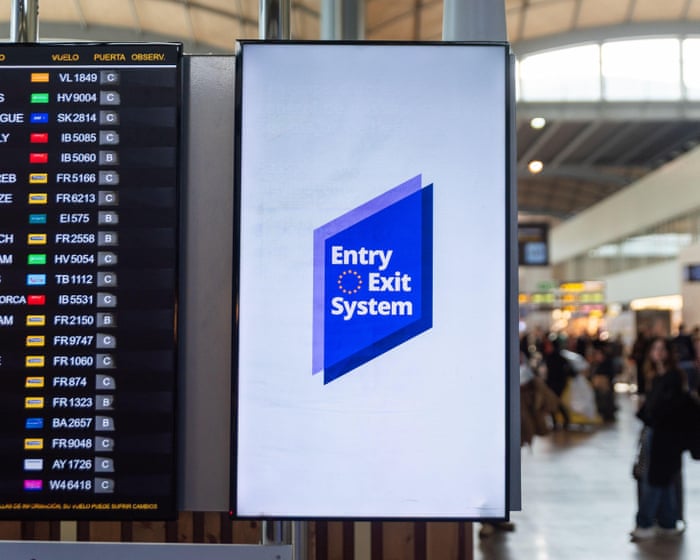
UK travellers, including novelist Jojo Moyes, say glitches in the EU’s digital Entry/Exit System have wrongly recorded their travel and made them appear to exceed the Schengen area’s 90-day limit. Moyes said French officials warned her she could face a €10,000 fine and a two-year ban, while other travellers reported incorrect records that blocked trips or led to detention and deportation.
Key Facts
The EU Entry/Exit System uses biometric data and replaced passport stamps at Schengen-area borders.
The system may fail to record a traveller’s departure if border staff collect arrival biometrics but do not record the exit.
Moyes said she spent 23 days in the EU over six months, but her departure from Portugal was missing from the system.
French border guards detained Moyes after a holiday and warned her not to re-enter Europe until her record was corrected.
Jane Nolan said the EU’s online stay calculator showed zero days remaining after she and her husband spent 40 days in France.
Some countries suspended the system over the summer and used manual passport checks amid technical problems and staff shortages.
The EU is suing three firms over failures linked to the system.
The UK Foreign Office said it knew of reports of inaccurate records affecting British nationals.
Read the Original
Want the full story? Tap a source to open the original
article.