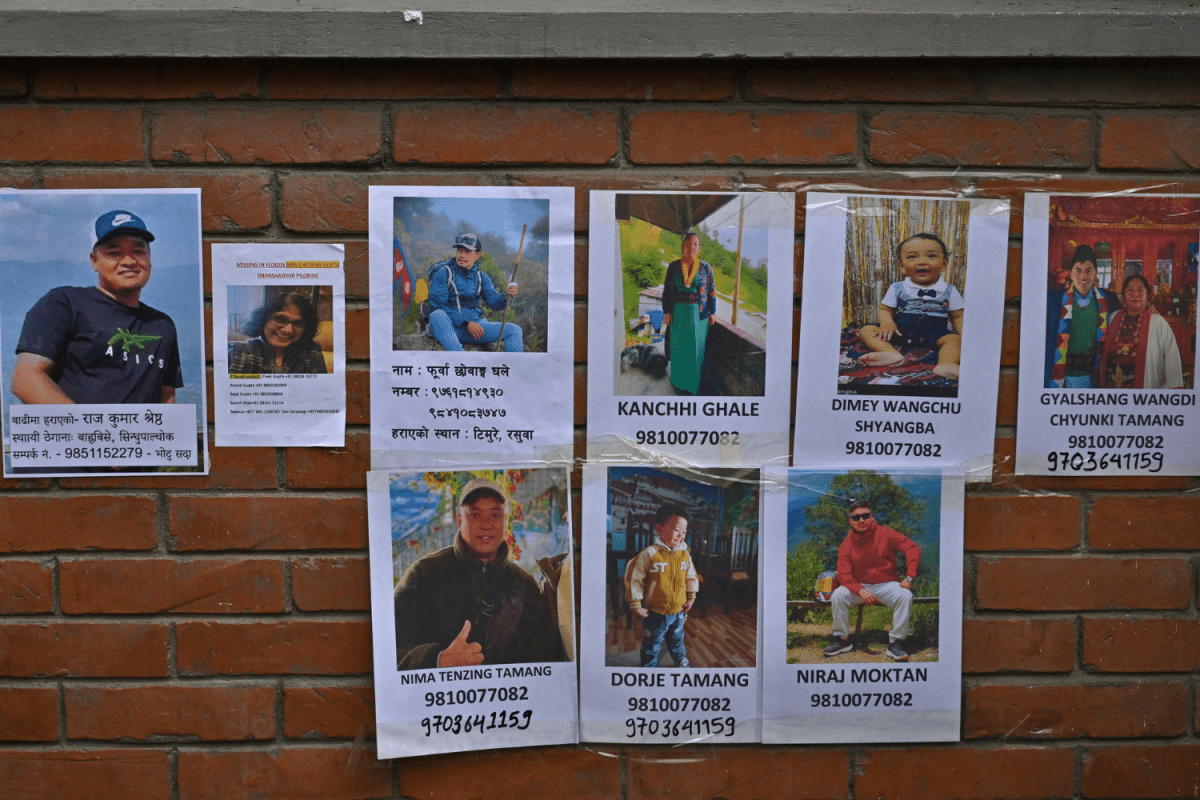
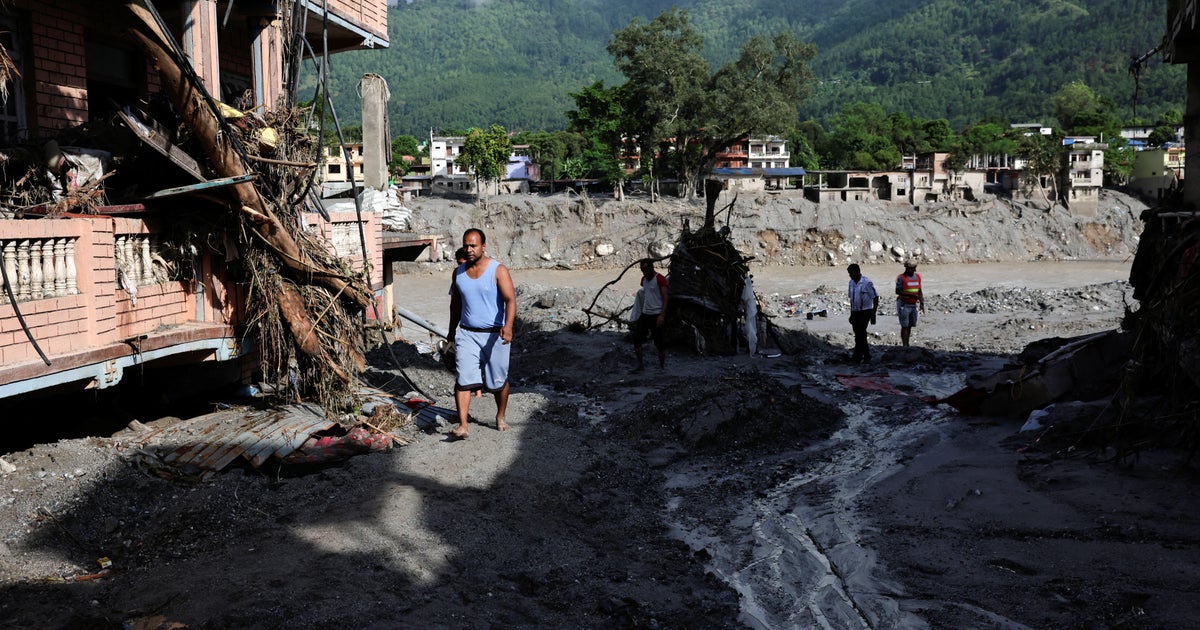
The Nepal army is rescuing hundreds of people trapped in a tunnel after severe floods caused by heavy rains. The floods have killed hundreds and left more than 1,400 people missing, affecting nearly 100,000 people in the region.
Key Facts
Heavy floods struck Nepal, causing widespread damage and casualties.
Hundreds of people were trapped in a tunnel and are being rescued by the Nepal army.
More than 1,400 people are reported missing due to the flooding.
The Red Cross has warned of urgent humanitarian needs in the area.
Nearly 100,000 people have been affected by the flood disaster.
The flood risk remains high, raising concerns about more possible deaths.
Rescue operations are ongoing to find missing people and provide help.
The floods also affected nearby regions in the Himalayas, including Tibet.
Read the Original
Want the full story? Tap a source to open the original
article.
A new lake formed after a landslide near the Nepal-Tibet border may overflow and cause another flood. China has warned that this poses a "high risk" just days after a deadly flash flood hit the same area.
Key Facts
A recent landslide near the Nepal-Tibet border created a new barrier lake.
China has issued a warning about the high risk of this lake breaching its banks.
The warning comes after a deadly flash flood occurred in the same region on Wednesday.
Scientists say the earlier flood was caused by a mountain glacier collapsing into a river.
Rescuers are concerned that another flood downstream could happen if the lake overflows.
The affected area is along the border between Nepal and Tibet (a region in China).
The situation is being closely monitored by officials and experts to prevent more damage.
Read the Original
Want the full story? Tap a source to open the original
article.
Emily Wilson, a professor at the University of Pennsylvania, is creating a completely new English translation of Homer’s epic poem "The Odyssey," after completing her first widely praised version in 2017. She aims to improve her work by using more accurate language and better reflecting ancient social details.
Key Facts
Emily Wilson published a major English translation of "The Odyssey" in 2017, the first by a woman.
Her 2017 translation sold over one million copies and was praised for modern language but faced some criticism.
She is now working on a full retranslation, not just a revision, and is about halfway done.
Wilson says her new version will be longer and more accurate, using different terms for enslaved people as in the original Greek.
Retranslating a major work so soon and after success is very unusual in literary translation.
Her decision was controversial, and she acknowledges it might be difficult for teachers to deal with two editions by her.
Wilson’s first translation inspired filmmaker Christopher Nolan’s recent version of "The Odyssey."
Her editor describes her new approach as exciting because of her deep scholarship and involvement.
Read the Original
Want the full story? Tap a source to open the original
article.
The Ebola outbreak in eastern Congo has spread to two more health zones, bringing the total affected areas to 60. The outbreak is growing very fast, with nearly 5,800 confirmed cases and almost 2,800 deaths reported so far.
Key Facts
The outbreak reached two new health zones called Biena and Manguredjipa in North Kivu province.
A total of 60 health zones in eastern Congo are now affected by Ebola.
There are 5,794 confirmed Ebola cases reported.
The total number of deaths is 2,786.
The fatality rate in North Kivu is higher than the overall 48% death rate.
Delayed response efforts contributed to the higher death rates in some areas.
The Ebola outbreak is spreading faster than health officials can track and control it.
Congo’s Health Minister Roger Kamba recently vaccinated a health worker in Kisangani as part of the response.
Read the Original
Want the full story? Tap a source to open the original
article.
Imran Khan, the former prime minister of Pakistan, has been in jail for three years facing many legal cases, which he denies and says are politically motivated. His family says he is suffering from poor health and mental stress due to solitary confinement, while the Pakistani government denies these claims and says they are following court orders for his care.
Key Facts
Imran Khan has been imprisoned since 2023 in Adiala Jail, Pakistan.
He faces over 100 legal cases including bribery and leaking secrets, which he denies.
Most of his convictions have been suspended or overturned, with appeals ongoing.
Khan’s sons have not spoken to him since March 2027 except for a 20-minute call.
His family says he is anxious, mentally tortured, and has severe health issues including poor vision.
The Pakistani government denies neglecting his medical care and says it respects court decisions.
A Supreme Court order in August 2027 required Khan to be moved to a private hospital and allowed family visits, but he was sent back to jail after a short check-up in a government hospital.
Khan’s party has filed a legal petition accusing the government of not following the court’s orders properly.
Read the Original
Want the full story? Tap a source to open the original
article.
A large group of fake social media accounts linked to China tried to spread false information in the U.S. about the costs and energy use of AI data centers. These efforts aim to influence public opinion on American AI infrastructure and may be part of China's broader strategy to slow down U.S. technological progress.
Key Facts
Elon Musk’s social media platform X shut down a suspected Chinese bot farm with 200,000 fake accounts.
These accounts spread misleading messages saying AI data centers increase household electric bills and burden local power grids.
AI data centers use powerful computer chips and require lots of energy and cooling, causing public concern in some U.S. states.
The White House supports data center growth but also promotes a pledge to protect consumers from energy cost increases.
Some states welcome data centers for their tax revenue, while environmental groups worry about land use and ecological impacts.
China is investing heavily in AI as a top technology priority and uses propaganda to influence U.S. public debates.
China may target the U.S. power grid, which is crucial for running AI data centers and related technology.
The campaign exploits democratic processes by trying to shape voters' opinions on energy and AI policy.
Read the Original
Want the full story? Tap a source to open the original
article.
This article invites readers to test their memory of recent major news events through a quiz. It highlights that many important stories happened in the past week.
Key Facts
The article references a photo of Dolly Parton and Miley Cyrus performing at the 2019 Grammy Awards.
It focuses on recent news from around the world during the last week.
Readers are encouraged to check their knowledge about major current events.
The quiz is provided by The Associated Press, a global news agency.
The article itself does not report specific news but promotes awareness of recent stories.
Read the Original
Want the full story? Tap a source to open the original
article.
King Oyo Nyimba Kabamba Iguru Rukidi IV, the King of Tooro in western Uganda and once the world's youngest reigning monarch, has died at age 34. He was crowned at the age of three and led his kingdom, which holds mainly cultural influence within Uganda's republic system.
Key Facts
King Oyo Nyimba became king in 1995 at just three years old.
He ruled the Tooro kingdom in western Uganda near the Democratic Republic of Congo border.
Uganda is a republic but has traditional kingdoms with mostly cultural roles.
The king died on Thursday night; the cause of death was not made public.
He left behind an heir, ensuring the continuation of the royal line.
His death was widely mourned across Uganda on social media and in the news.
The prime minister of Tooro said the king was young but brought energy and fresh ideas to his role.
The king was unmarried at the time of his death.
Read the Original
Want the full story? Tap a source to open the original
article.
Flash floods in Nepal have caused severe damage, destroying homes and communities and leaving many people missing. Rescue teams are working to find survivors and provide urgent help like food, water, shelter, and medicine while long-term rebuilding efforts will take years.
Key Facts
Nepal recently experienced severe flash floods causing widespread destruction.
Many people are missing, and rescue teams are actively searching for them.
Immediate aid includes providing drinking water, food, shelter, clothing, and medicine.
Entire villages and communities have been washed away by the floods.
Recovery will require more than emergency help; rebuilding trust and communities will take years.
Nepal has experience with natural disasters but faces new challenges in preparedness for large-scale events.
International organizations like the Red Cross are involved in the relief efforts.
The flood disaster affects Nepal and nearby areas such as Tibet.
Read the Original
Want the full story? Tap a source to open the original
article.
Heavy flooding caused by a glacier avalanche in Nepal's Rasuwa district has killed at least 475 people and left many others unaccounted for. Authorities reported that 63 Americans are currently out of contact, and rescue operations are in progress. The U.S. government has offered help and sent aid to support relief efforts.
Key Facts
Flooding in Nepal began on Wednesday after a glacier avalanche blocked a river, causing a sudden flood downstream.
At least 475 people have died in the Rasuwa district due to the floods.
Over 500 foreign nationals are currently out of contact; among them, 63 are U.S. citizens.
Two Americans previously reported missing have since been rescued.
Rescue teams are working to clear roadblocks and restore access to affected areas.
President Donald Trump said the U.S. offered Nepal any needed help and is sending aid.
The U.S. State Department deployed a disaster response adviser to Nepal.
The U.S. is providing $500,000 for emergency shelter, supplies, and water services in the flood areas.
Read the Original
Want the full story? Tap a source to open the original
article.
Experts warn that climate change is making extreme weather more intense and unpredictable. Natural events like El Niño can increase this effect, causing dangerous heat, droughts, storms, and floods to happen more often in Europe.
Key Facts
Climate change is making extreme weather events stronger and less predictable.
El Niño is a natural climate event that can worsen the effects of climate change.
The combination of El Niño and climate change can make heatwaves, droughts, and storms worse.
Europe is already experiencing more severe heat, drought, water shortages, and flooding.
These extreme weather events are becoming more common and should be expected as part of the new normal.
Governments in Europe are currently not well prepared to handle these increasing climate risks.
Experts say this growing climate instability affects not only weather but also ecosystems and human health.
Read the Original
Want the full story? Tap a source to open the original
article.
Heavy floods have caused serious damage in Nepal, especially near the Tibetan border in Trishuli. Roads are blocked, and entire villages have been destroyed by the floodwaters, making rescue efforts difficult.
Key Facts
The floods hit areas between Nepal’s capital, Kathmandu, and Trishuli near the Tibetan border.
Many roads are blocked due to the flooding and damage.
Ambulances and hearses have been seen traveling to and from the affected areas.
Rescue teams say entire villages have been washed away by the floodwaters.
The BBC correspondent Azadeh Moshiri reports from the site.
Rescue operations are ongoing as the disaster unfolds.
The flooding is part of severe weather conditions affecting the region.
Read the Original
Want the full story? Tap a source to open the original
article.
Sudipto Bhattacharya’s wife, Subhrasree Chakraborty, was about to cross from Nepal into Tibet for a religious pilgrimage to Mount Kailash when her messages suddenly stopped. She is now one of at least 290 Indians reported missing after deadly flash floods hit the Nepal-Tibet border area during the pilgrimage.
Key Facts
Subhrasree Chakraborty was on a pilgrimage to Mount Kailash, a sacred Hindu site in Tibet.
She sent her last message on 26 August at 08:03 local time after completing Nepal immigration and waiting to enter China.
At least 290 Indians are missing following flash floods near the Nepal-Tibet border.
The pilgrimage resumed recently after disruptions due to COVID-19 and tensions between India and China.
Subhrasree was traveling with a group of about 30 people, but without her family.
The group faced some travel difficulties before, including a landslide that blocked their road for several hours.
Subhrasree had been excited about the trip and shared photos from Kathmandu just before setting out.
Her husband has not heard from her since the messages stopped and is uncertain of her whereabouts.
Read the Original
Want the full story? Tap a source to open the original
article.
Nepal and China have stopped rescue efforts near their border after a natural dam, called a barrier lake, formed by a glacier collapse began to overflow. This lake threatens to cause another big flood, forcing rescue teams to move to safer areas while residents prepare for possible flooding.
Key Facts
A glacier collapsed in the Himalayas, causing a flash flood with ice, rock, mud, and water.
The flood blocked a river, forming a natural dam called a barrier lake.
The barrier lake started to overflow, raising the risk of another large flood wave downstream.
Rescue operations were paused temporarily in both Nepal and China due to safety concerns.
Over 470 people have died, about 1,550 rescued, and more than 1,500 people remain missing.
Around 90,000 people are affected by the disaster.
Roads are destroyed, making it hard to deliver supplies and reach survivors.
China and Nepal have deployed thousands of security and military personnel for rescue and relief missions.
Read the Original
Want the full story? Tap a source to open the original
article.
The United States has taken control over most of the Strait of Hormuz, a key waterway for global oil transport, reducing Iran's influence in the area. This change has allowed more ships to pass safely and helped lower oil prices after months of disruption caused by Iran's threats and attacks.
Key Facts
The Strait of Hormuz is a crucial route for global oil shipments.
Iran initially tried to close the strait and threatened to attack ships.
Iran deployed naval mines in the main shipping lane early in the conflict.
The U.S. and the UAE worked together to guide ships safely through the strait.
The U.S. military struck Iranian military positions to reduce attacks.
Special teams cleared over 200 mine-like objects, with only 11 confirmed as real mines.
About 20 to 30 oil tankers now pass through the strait each night, carrying roughly half the usual amount of oil.
Iran still fires at ships but hits only a small percentage of them.
Read the Original
Want the full story? Tap a source to open the original
article.
Heavy flash floods in Nepal and China have caused over 470 deaths and left more than 1,500 people missing. Rescue teams are working to save survivors, including people trapped in a hydropower tunnel, while authorities monitor the risk of additional flooding from a barrier lake.
Key Facts
Over 470 people have died due to flash floods in Nepal and China.
More than 1,500 people remain missing after the disaster.
Helicopters have evacuated over 3,000 people to safety in Nepal.
Nepal rescuers are helping people stuck in a hydropower tunnel covered by mud.
Scientists say a glacier collapse caused the floods, with a large rockfall triggering a river surge.
Hundreds of foreigners, including at least 65 Americans, were among those missing.
Nepal police issued warnings about a burst dam in Tibet and flood risks from a nearby barrier lake.
Chinese state media reported evacuations and relief efforts but gave fewer details on survivors.
Read the Original
Want the full story? Tap a source to open the original
article.
New satellite images and video analysis show that deadly floods in Nepal started when part of a glacier near the China border broke off. This caused a fast-moving flow of rocks and water that destroyed areas over 80 kilometers. Officials say the disaster may continue because a new lake upstream is spilling over.
Key Facts
A glacier near the border between Nepal and China collapsed.
The collapse triggered a debris flow moving at up to 150 km/h (about 93 mph).
The flood affected communities along more than 80 kilometers of the river.
Scientists are working to understand the exact chain of events causing the flood.
Authorities warn that the disaster might worsen due to an overflowing new lake upstream.
Rescue teams are searching for people missing after the floods.
The disaster has caused significant damage and loss in Nepal and nearby regions.
Relief and aid efforts are being carried out to help affected communities.
Read the Original
Want the full story? Tap a source to open the original
article.
During China’s one-child policy era, many children were taken from their families and put up for adoption abroad. Some adoptees are now adults searching for their origins, while Chinese authorities have worked to stop child trafficking and set up a DNA database to help match children with their birth families.
Key Facts
China began allowing international adoption in 1992.
Over 150,000 Chinese babies have been adopted by foreign families since then.
Some children were taken from their families illegally and sold for adoption or marriage.
Chinese authorities cracked down on child trafficking related to adoption.
A DNA database was created in 2009 to verify children’s family connections before adoption.
This database is now also used to help adoptees find their birth parents.
Many adoptees from the one-child policy period have unanswered questions about their past.
The one-child policy officially ended about ten years ago.
Read the Original
Want the full story? Tap a source to open the original
article.
Flash floods have struck the Himalayan border region between Nepal and China, killing at least 472 people and leaving more than 1,500 missing. Over 3,250 people have been evacuated by helicopter, and rescuers are working to find survivors while warning of potential further flooding from an overflowing lake upstream.
Key Facts
At least 472 people have died due to flash floods in the Himalayan border area between Nepal and China.
More than 1,500 people are reported missing after the floods.
Over 3,250 people have been evacuated by helicopter from affected areas.
Rescue teams are searching for survivors amidst dangerous conditions.
Authorities warn that a nearby lake is overflowing, which could cause more flooding.
The floods caused widespread destruction including landslides and washed-out villages.
The disaster affected both Tibet (China) and Nepal regions along the Himalayan border.
Emergency aid and rescue efforts are ongoing to assist those impacted.
Read the Original
Want the full story? Tap a source to open the original
article.
The European Union is asking Meta, the company behind Facebook and Instagram, to apply the same safety rules for teenagers in Europe that Meta has agreed to follow in the United States. These rules include limits on how much screen time teens have and stronger controls for parents over their children’s accounts. The EU also wants Meta to add more safety measures for young users in Europe.
Key Facts
The EU wants Meta to protect users under 18 years old on Facebook and Instagram in Europe.
Meta has agreed to special teen safety rules in the United States in a legal settlement.
These rules include limits on how long teens can use the platforms each day.
Parents get stronger tools to manage their teen children’s social media accounts.
The EU is pushing Meta to extend these protections to European users under 18.
Brussels (the EU’s main office) is also asking Meta to add extra safety measures beyond what is in the US rules.
The goal is to make social media safer for teenagers in Europe.
Read the Original
Want the full story? Tap a source to open the original
article.