The Powerball lottery jackpot has reached $975 million after 43 drawings without a winner, starting in early May. This large prize has attracted significant public attention as the lottery continues.
Key Facts
The Powerball jackpot is currently $975 million.
There have been 43 consecutive drawings without a jackpot winner.
The streak without a winner dates back to early May.
Powerball is a popular lottery game in the United States.
Large jackpots often lead to increased ticket sales.
The jackpot amount can grow when no one wins in a drawing.
Bigger jackpots can result in more public interest and media coverage.
Read the Original
Want the full story? Tap a source to open the original
article.
Monterey Car Week, a multi-day automotive event in California, has grown from a post-World War II car race into a series of over 30 events that generate $130 million annually for Monterey County. Key gatherings like McCall’s Motorworks Revival and The Quail attract diverse audiences, including new groups, blending car culture with social and culinary experiences.
Key Facts
Monterey Car Week started as a car race in the Del Monte Forest after World War II.
The event now includes over 30 individual gatherings over several days.
It brings $130 million a year to the local Monterey County economy.
Gordon McCall, a lifelong Monterey resident, helped create two major events: McCall’s Motorworks Revival and The Quail: A Motorsports Gathering.
McCall’s original party at Monterey Jet Center grew from a small gathering to 3,000 people before being sold and renamed Motorlux in 2021.
The Quail event focuses on people and socializing more than just the cars, featuring fine dining and music.
One evening event, Eve on the Green, combines Michelin-starred food and a concert celebrating Route 66’s 100th birthday.
The event has attracted new audiences but also raised concerns about the impact of free events and influencer activities.
Read the Original
Want the full story? Tap a source to open the original
article.
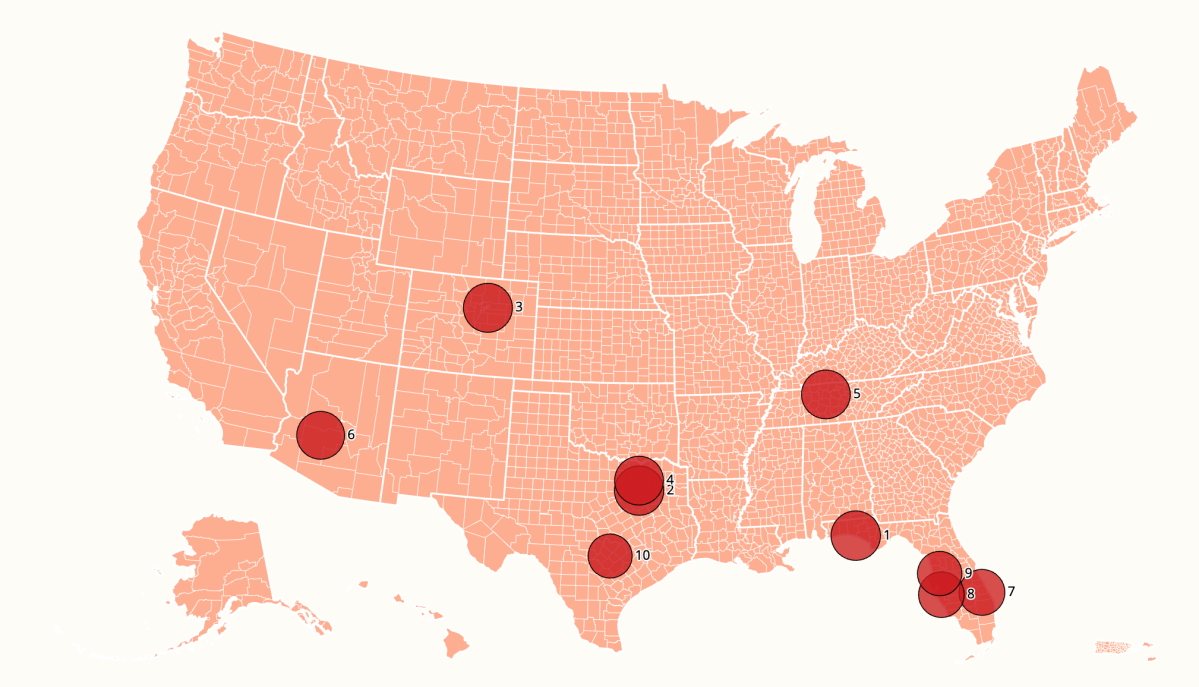
A new report shows that Florida and Texas have the most popular ZIP codes for people moving across states in early 2026. Inlet Beach, Florida, is the top destination by moves per capita, while other affordable areas in both states are also attracting many newcomers.
Key Facts
The report analyzed over 5 million moves from January to May 2026.
Inlet Beach, FL, had 106.1 moves per capita, making it the most popular ZIP code for movers.
Other top Florida ZIP codes include Port Saint Lucie, Bradenton, and San Antonio.
Texas ZIP codes Crandall, Lavon, and Maxwell are also among the top ten destinations.
Inlet Beach attracts retirees and second-home buyers and has a median home price around $700,000.
Port Saint Lucie, Bradenton, and San Antonio offer more affordable housing options ranging from about $265,000 to $400,000.
Crandall and Lavon, Texas, provide affordable alternatives near Dallas-Fort Worth, with median home prices under $350,000.
These popular moving areas have shifted from previously popular cities like Austin and Miami due to rising home prices.
Read the Original
Want the full story? Tap a source to open the original
article.
The Senate passed a bill that could change the design of nickels and modify how people use cash for payments. These changes aim to update physical money and possibly affect everyday cash transactions.
Key Facts
The Senate approved a new bill related to U.S. nickels and cash payments.
The bill includes suggestions to change the design of nickels.
It may also influence how people pay with cash in daily life.
Changes could affect the way coins are produced or used.
The goal is to update some aspects of physical currency and payment methods.
Read the Original
Want the full story? Tap a source to open the original
article.
The article explains that if flexible work arrangements become common, employers can better judge employees based on their actual work and cooperation. This could reduce bias against people who work remotely for family reasons.
Key Facts
Flexible work means employees can choose when and where to work.
Employers would focus on results and teamwork rather than physical presence.
Bias against remote workers with family duties could decrease.
Better flexibility helps identify who adds value to the company.
It encourages fairer opportunities for all employees.
Read the Original
Want the full story? Tap a source to open the original
article.
Grubs are young beetle larvae that can damage lawns by eating roots, causing brown patches. Homeowners should check for grubs by digging a small section of lawn and only treat the area if more than 10 grubs per square foot are found. Natural treatments like milky spore powder and beneficial nematodes work best in late summer, while chemical treatments may harm the environment.
Key Facts
Grubs are white larvae of beetles like Japanese beetles and European chafers.
They live close to the soil surface and eat grass roots, which can kill lawns.
To check for grubs, dig a 3-4 inch deep, 12 inch square patch where the grass is unhealthy.
Fewer than 10 grubs per square foot is normal and doesn’t need treatment.
Treatment should be done in late summer when grubs are young and most vulnerable.
Milky spore powder targets Japanese beetle grubs but is less effective in cooler areas.
Beneficial nematodes are natural microscopic worms that kill grubs quickly and work on all grub types.
Avoid chemical pesticides as they can harm earthworms, bees, pets, and wildlife.
Read the Original
Want the full story? Tap a source to open the original
article.
The article gives advice to college students on how to manage their money well. It explains the importance of building credit, creating a budget, and developing good spending habits while in school to ensure financial stability later.
Key Facts
College students should start building their credit score early to help with future loans and financial services.
A credit score ranges from 300 to 850 and shows lenders how likely you are to repay money.
Secured credit cards and student credit cards are good options for beginners to build credit safely.
Students should only spend what they can fully repay each month on credit cards.
Budgeting helps manage money from different income sources like jobs, financial aid, or family support.
Budgeting can be done using apps, spreadsheets, or writing things down on paper.
Setting clear financial goals makes it easier to stick to a budget and manage expenses.
Managing money well in college influences financial security when students start their careers.
Read the Original
Want the full story? Tap a source to open the original
article.
The article discusses the growing problem of extreme wealth concentration in American capitalism. It highlights concerns about trillionaires like Elon Musk and the political backlash fueled by rising inequality. The piece suggests that while capitalism drives progress, excessive inequality threatens the system’s stability.
Key Facts
American capitalism has created great wealth but also extreme inequality.
Rising wealth for billionaires contrasts with high costs in housing, education, and healthcare.
Elon Musk recently approached a net worth of one trillion dollars, a sum larger than many countries’ annual economies.
Extreme wealth can lead to large amounts of power concentrated in few hands, sometimes controlling vital technologies and infrastructures.
Almost 40% of Americans now have a positive view of socialism, reflecting dissatisfaction with current inequality.
Not all high earners are seen as problematic; the focus is on those with wealth comparable to entire countries.
Tech billionaires own platforms and technologies that influence daily life and society, giving them unique influence.
The article calls for addressing extreme wealth to preserve capitalism and prevent social unrest.
Read the Original
Want the full story? Tap a source to open the original
article.
Medicare has reduced its payments for cataract surgery by about 20% over the past decade. As a result, many doctors are using laser technology during cataract operations, which allows them to charge patients extra money, even though studies show laser surgery does not provide better results than the traditional scalpel method.
Key Facts
Cataract surgery is common and usually covered by Medicare, with patients paying a small amount out-of-pocket.
Medicare pays about $520 for a standard cataract procedure, including doctor visits before and after surgery.
Doctors can charge patients extra, from $1,000 to $3,000 per eye, when using laser-assisted methods that correct vision with premium lenses or fix astigmatism.
Laser cataract surgery equipment can cost up to $500,000 for a medical practice.
Research shows no better outcomes or fewer complications with laser surgery compared to the traditional scalpel method.
Nearly 12% of the 5 million cataract surgeries done annually in the U.S. use laser assistance, and this number is growing.
Premium lenses that reduce the need for glasses cost patients between $1,000 and $4,000 out-of-pocket.
Medicare rules generally prevent doctors from charging more than what Medicare pays, except for charges related to laser-assisted vision improvements.
Read the Original
Want the full story? Tap a source to open the original
article.
YouTube educator Ms. Rachel (Rachel Griffin Accurso) will release her first music album, "I’m So Happy," on September 25. The album features 23 songs designed to help young children learn and develop social skills, with various musical styles and real instruments.
Key Facts
Ms. Rachel is a popular YouTube music teacher for toddlers and launched her channel in 2019 with her husband Aron Accurso.
The debut album "I’m So Happy" includes 23 tracks and will be available on September 25.
The album aims to encourage parent-child bonding through music and uses real instruments like the clarinet.
Songs teach social skills and are inclusive, considering children with disabilities and autism.
Musical styles on the album vary, including bossa nova and bluegrass versions of classic children’s songs.
Aron Accurso co-produced the album with Grammy winner Scott Riesett and used a large team of vocalists and musicians.
Ms. Rachel is also an advocate for children’s rights and uses her platform to speak on humanitarian issues.
The creators hope the album inspires families to enjoy music together away from screens.
Read the Original
Want the full story? Tap a source to open the original
article.
Texas has seen fast population growth and many companies moving there, especially around Dallas-Fort Worth. This trend is attracting financial firms like Goldman Sachs, the New York Stock Exchange, and Nasdaq to open large offices in Texas, making it an emerging financial center.
Key Facts
Texas added over 391,000 residents between July 2024 and July 2025, more than any other U.S. state.
From 2015 to 2024, 314 corporate headquarters moved to Texas, with 154 relocating specifically to Dallas-Fort Worth.
Twenty-four companies moved from New York to Texas; California lost 157 companies to Texas in that time.
Texas offers a large labor and consumer market, room to grow cities, and a business-friendly government.
The shift to Texas began before the pandemic and continues as a long-term trend.
Goldman Sachs is building a large office in Dallas for over 5,000 employees, making it its second-largest U.S. location.
The New York Stock Exchange created NYSE Texas in Dallas, noting Texas leads in NYSE-listed companies by market value.
Nasdaq also opened a regional headquarters in Dallas and serves about 800 Texas-based clients.
The Texas Stock Exchange received government approval in 2025 to operate nationally from Dallas.
Read the Original
Want the full story? Tap a source to open the original
article.
This article discusses important money talks couples should have before marriage. It covers why being honest about finances matters, what to know about prenuptial agreements, and how to handle money disagreements.
Key Facts
Belle Burden’s bestselling book warned women about financial risks after divorce but didn’t mention her own family’s wealth.
Full honesty about money is important for couples to avoid problems later.
Couples should understand prenuptial agreements before signing them.
Talking about finances before marriage can help couples make better decisions together.
The article includes advice on resolving money disagreements, like deciding if a couple can afford a bigger home.
Jill Schlesinger and Mark offer guidance on these money conversations.
The content is part of the CBS News series "Money Moves with Jill Schlesinger."
Read the Original
Want the full story? Tap a source to open the original
article.
Workers at HCA Healthcare, the largest for-profit hospital system in the US, are protesting to ask for higher pay, better benefits, and more staff during contract talks. The hospital system reported almost $7 billion in profits last year, but many employees say their wages have not kept up with rising living costs.
Key Facts
HCA Healthcare employs over 300,000 people in the US and the UK; 22,000 US workers are represented by the Service Employees International Union (SEIU).
Workers want a minimum wage of $25 an hour, better pay increases, paid vacation and sick time, and stronger job protections.
Esther Reyes, a worker in El Paso, Texas, earns $16.80 an hour and struggles to cover basic bills.
HCA reported $6.8 billion in profits in 2025, a 17.8% increase from 2024, and announced a $10 billion stock buyback program in early 2026.
The HCA CEO earned over $26.5 million in 2025, about 420 times more than the average employee salary of $62,955.
Nurses report that understaffing hurts patient care and increases risks, with some states blocking laws to ensure safer nurse-to-patient ratios.
Union members are holding protests and pickets at hospitals in states including California, Texas, Nevada, and Florida.
HCA says it is negotiating in good faith with union representatives and values its employees.
Read the Original
Want the full story? Tap a source to open the original
article.
A mother found a designer dress at a Goodwill thrift store for $14.99 that originally sold for $4,900. The dress was made by Carolina Herrera, a famous fashion designer, and is part of a recent collection.
Key Facts
Ruth Kornatz found the dress while shopping at her local Goodwill.
The dress is bright orange with butterfly decorations.
It is a Carolina Herrera design, known for dressing prominent figures including U.S. first ladies.
The dress was from the 2025 Resort collection and retailed for $4,900 when new.
Kornatz paid only $14.99 for the dress.
Many people in the U.S. buy secondhand clothing; about a third of apparel purchases are secondhand.
Kornatz posted about the dress on Instagram and received various guesses why it was donated.
She is considering keeping, tailoring, passing it to her daughter, or selling the dress.
Read the Original
Want the full story? Tap a source to open the original
article.
The article calls for clear and easy-to-understand labels at fuel pumps to warn boaters that E15 fuel should not be used in boats. The goal is to prevent damage by making sure boaters know this fuel is not safe for their engines.
Key Facts
E15 is a type of gasoline that contains 15% ethanol.
Boats should not use E15 fuel because it can harm their engines.
Current fuel pump labels are not clear enough for boaters.
The article suggests using simple, standardized wording on pumps.
The recommended label is: "E15 is not for boats."
Better labels would help prevent accidents and engine problems.
Clear warnings at pumps are important for boaters' safety.
The article focuses on protecting boat engines from wrong fuel use.
Read the Original
Want the full story? Tap a source to open the original
article.
French newspapers have asked France’s competition authority to investigate Google’s use of AI-generated article summaries. They say these summaries reduce traffic to their websites and violate a 2022 agreement about using media content.
Key Facts
Nearly 300 French newspapers filed a complaint against Google with the competition watchdog.
Google's AI summaries show up above regular search links and pull information from many sources.
The media groups say Google did not get their consent before launching these summaries in France in July 2026.
The newspapers want fair compensation for the use of their content in AI summaries.
Google was fined 250 million euros in 2024 for breaking parts of a 2022 compensation deal with French media.
Media companies have lost revenue as advertising moves online and tech companies take a large share.
Critics say AI summaries reduce clicks to original articles, hurting publishers’ income.
Google claims the AI helps users find new information and offers ways for publishers to control their content.
Read the Original
Want the full story? Tap a source to open the original
article.
Benoit Castel, a pastry chef from Paris, was named World Confectioner of the Year by the International Union of Bakers and Confectioners. He runs several pastry shops in Paris, focuses on quality ingredients, and creates pastries inspired by his home region of Brittany.
Key Facts
Benoit Castel won the World Confectioner of the Year award in July 2026.
He owns three restaurants and a delicatessen in Paris.
Castel emphasizes the importance of using high-quality products in his pastries.
His signature pastry is a chocolate choux decorated with a small shortbread biscuit.
Ingredients like fruits and vegetables come from his own gardens in Brittany.
He started wanting to be a chef at age seven and was inspired by a sugar art display at age ten.
Castel works closely with his head baker, Romain Montbabut, to try new recipes.
He developed unique breads including one made from unsold bread to reduce waste.
Read the Original
Want the full story? Tap a source to open the original
article.
Oil prices briefly rose above $90 a barrel and gold reached a two-month high after President Donald Trump made new demands for a deal with Iran. At the same time, UK housebuilder Bellway lowered its profit forecast due to weaker demand and higher costs, reflecting challenges in the housing market.
Key Facts
Brent crude oil price jumped over 2% to above $90 per barrel before falling slightly to $87.53.
A small cargo ship flying Tanzania’s flag was reportedly attacked by Yemen’s Iran-aligned Houthis in the Red Sea, possibly causing crew deaths.
This attack would be the first Houthi strike causing casualties on a ship since conflict escalated in the Middle East after U.S.-Israeli attacks on Iran.
Bellway, a major UK housebuilder, cut its full-year profit outlook to at least £320 million, down from a previous range up to £330 million.
Bellway’s sales slowed after April due to higher mortgage rates, political uncertainty, and rising energy costs.
The company completed nearly 9,700 homes in the past year, better than expected, but has a smaller forward order value.
Bellway announced a new £50 million share buyback, adding to an ongoing £150 million program.
Flexible office space provider IWG saw its shares drop over 11% after analysts flagged cash flow risks.
Read the Original
Want the full story? Tap a source to open the original
article.
China’s stock market dropped in July despite government efforts to support it. Investors sold technology stocks even after China announced major tech advances, showing concern over profits and the wider economy.
Key Facts
China’s CSI 300 stock index fell 7.9% in July despite government support.
Chinese state-owned firms bought $8.9 billion in shares to try to stabilize the market.
Authorities held meetings urging stable and healthy capital markets.
China announced two major technology developments: a deep ultraviolet lithography machine and an advanced AI model called Kimi K3.
Investors sold technology stocks because they doubted these advances would lead to profits.
The biggest new stock offering was CXMT, a memory-chip company, but investors saw it as heavily subsidized and risky.
The Chinese economy faces challenges like a falling property market, 20% unemployment, and many people working gig jobs.
The government is trying to boost market confidence to encourage spending.
Read the Original
Want the full story? Tap a source to open the original
article.
A mining company in Rwanda called Trinity Metals exports tungsten from its Nyakabingo mine. This tungsten makes up about 20% of the tungsten used in the United States, including for defense purposes.
Key Facts
Trinity Metals is a mining company based in Rwanda.
It operates the Nyakabingo tungsten mine.
Tungsten from this mine accounts for up to 20% of the US primary tungsten concentrate consumption.
The tungsten is part of the US defense supply chain.
The article was issued on August 11, 2026.
Tungsten is a metal used in various industries, including defense.
This connection shows Rwanda as a supplier to the US mineral needs.
No further details about contract terms or volumes were given.
Read the Original
Want the full story? Tap a source to open the original
article.