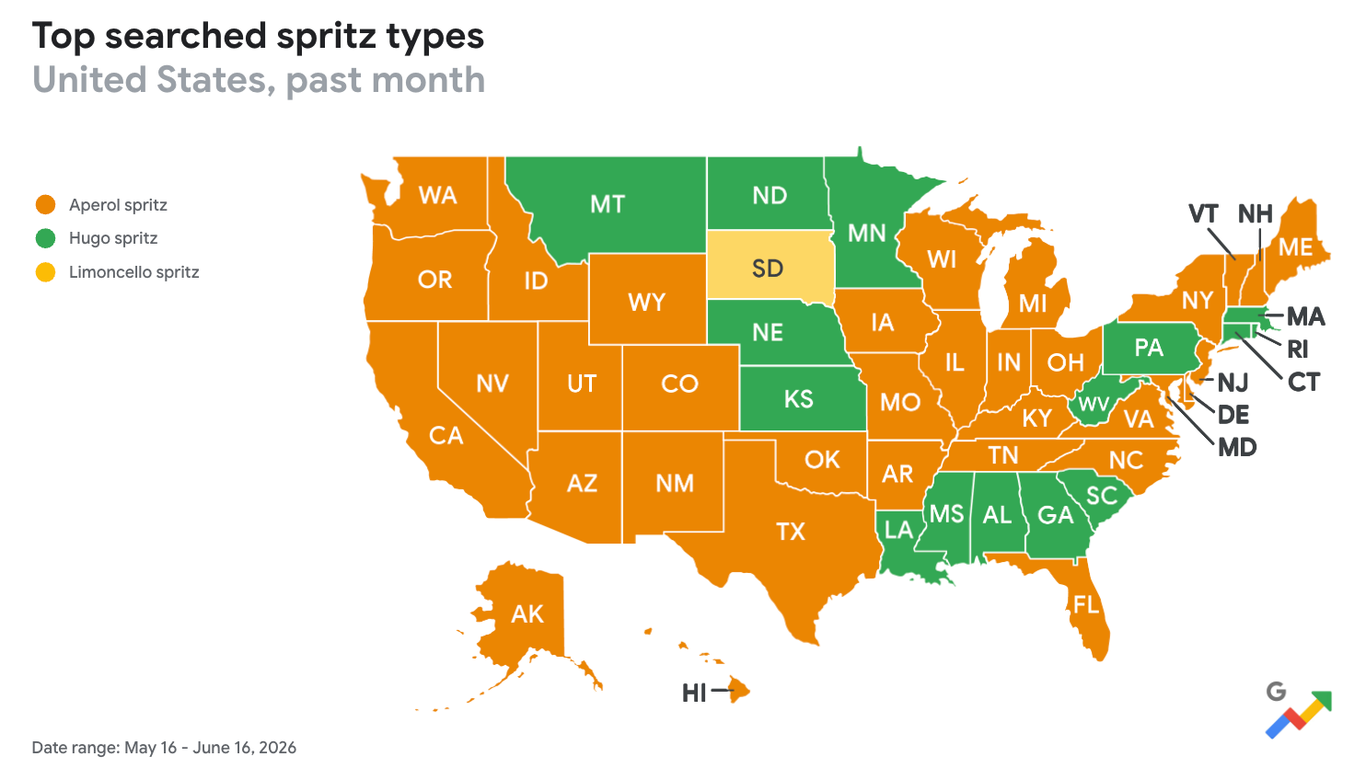
The Hugo spritz, a pale green cocktail made with Prosecco, elderflower liqueur, soda water, mint, and lime, is becoming a popular summer drink in the U.S. Searches for how to make a Hugo spritz have increased sharply, and it is outselling the traditional Aperol spritz in many states.
Key Facts
The Hugo spritz is made with Prosecco, elderflower liqueur, soda water, mint, and lime.
Searches for "how to make a hugo spritz at home" rose by 2,200% in the last month.
In over a dozen U.S. states, the Hugo spritz was searched more than the Aperol spritz.
Linden Pride, owner of Dante cocktail bar in New York City, said the Hugo spritz is very popular.
The Hugo spritz is also a top seller at Dante bars in Beverly Hills and London.
Other drinks gaining search interest include Sancerre, chilled red wine, Hōjicha (a roasted green tea), horchata (a traditional drink made from rice or nuts), and the Viennese "einspänner" coffee drink.
Read the Original
Want the full story? Tap a source to open the original
article.
The European Union and China have agreed to start three months of talks to address the EU’s large trade deficit with China, which is about €360 billion a year. They aim to find solutions to balance trade and avoid a trade war before their next meeting in Beijing in October.
Key Facts
The EU runs a €360 billion annual trade deficit with China, meaning it imports much more from China than it exports.
The EU and China issued their first joint statement in seven years to begin formal trade consultations.
Talks focus on rebalancing trade, export controls (including rare earth metals), intellectual property rights, and World Trade Organization reforms.
Both sides will use a joint monitoring system to watch for sudden changes in trade that could trigger political discussions.
The EU’s trade commissioner, Maroš Šefčovič, hopes these talks will produce real results before the October meeting in Beijing.
The EU imposed tariffs on electric vehicles this year, but those tariffs have not stopped imports from rising.
Industry groups warn that Chinese imports threaten European factories that depend on components from China.
The EU is considering other measures like quotas on hybrids and chemicals to protect its industries.
Read the Original
Want the full story? Tap a source to open the original
article.
A certificate of deposit (CD) account can offer a safe way to earn interest on $80,000 with rates currently around 4%. The amount earned depends on how long the money is kept in the account, with longer terms providing more interest but less access to the funds.
Key Facts
CD interest rates today range from about 3.95% to 4.20% depending on the term and lender.
Interest earnings for $80,000 in a CD vary from hundreds to over $18,000 depending on the length of the CD term.
Shorter CDs (3 to 6 months) pay a few hundred to a couple thousand dollars in interest.
Longer CDs (3 to 5 years) can pay over $10,000 and up to $18,271 in interest.
Early withdrawal from a CD account usually results in penalties that reduce the earned interest.
CDs offer fixed interest rates, meaning the amount earned is guaranteed if the funds stay until maturity.
High-yield savings accounts offer similar interest rates but allow easier access to the money.
Choosing the right CD term depends on personal financial needs and willingness to lock up the funds.
Read the Original
Want the full story? Tap a source to open the original
article.
This article explains how people struggling with debt can negotiate with debt collectors to potentially pay less than they owe. It offers practical tips to help borrowers handle negotiations wisely and improve their chances of reaching a good settlement.
Key Facts
Many people face increasing debt due to high borrowing costs and inflation.
About half of surveyed people lose sleep because of money worries.
Debt collectors might accept less than the full amount to get paid sooner.
Before negotiating, you should confirm the debt is valid by requesting a written validation letter.
Knowing if the collector is the original creditor or a debt buyer affects negotiation tactics.
Debt collectors prefer a one-time lump-sum payment over installment plans.
Settlements often reduce the debt by 30% to 50%.
Staying calm and persistent during negotiations helps improve results.
Read the Original
Want the full story? Tap a source to open the original
article.
Homeowners can use the value built up in their homes, called home equity, to pay off expensive credit card debt. Two main borrowing options are home equity loans, which have fixed payments, and home equity lines of credit (HELOCs), which work like credit cards with variable rates and flexible borrowing amounts.
Key Facts
Credit card interest rates are high, averaging over 21%, making balances hard to reduce.
Many homeowners have increased their home equity due to rising home prices in recent years.
A home equity loan gives a lump sum with a fixed rate and fixed monthly payments.
This loan is good if you want payment certainty and your debt amount is stable.
A HELOC works like a credit line, letting you borrow as needed with a variable interest rate.
HELOCs offer more borrowing flexibility and are better if your debt repayment plan may change.
Fixed rates from home equity loans protect against rising interest costs if rates go up in the future.
Using home equity borrowing can help consolidate credit card debt potentially at a lower interest rate.
Read the Original
Want the full story? Tap a source to open the original
article.
Kalshi, a large prediction market platform for sports bets, sued the state of Illinois to stop new laws that would tax and regulate it like a regular sports betting company. Kalshi argues that only the federal government, through the Commodity Futures Trading Commission (CFTC), has the authority to regulate its business nationwide.
Key Facts
Illinois passed a law imposing new taxes on sports bets made through prediction markets like Kalshi.
Starting July 1, Kalshi would owe 1.75% tax on the first $5 million in sports wagers annually, then 3.5% on additional wagers.
Illinois requires Kalshi to get a state license costing $15 million for the first four years and $1 million annually after.
Kalshi filed a lawsuit against Illinois officials, saying the regulations and taxes are too costly and burdensome.
Kalshi says Illinois is wrongly treating it like a traditional sports betting company, while it believes the CFTC has sole authority over prediction markets.
The company claims that following Illinois law would force it to restrict users in Illinois, conflicting with federal rules requiring equal access nationwide.
Illinois aims to regulate prediction markets more tightly after a record $1.5 billion in legal sports betting losses in 2025.
Meta is considering launching a similar sports betting platform, which increases Illinois’ urgency on regulation.
Read the Original
Want the full story? Tap a source to open the original
article.
A $25,000 long-term certificate of deposit (CD) opened in July can earn a fixed amount of interest depending on the term length. Current top interest rates range from about 4.15% to 4.30%, offering guaranteed returns over periods from 18 months to 10 years.
Key Facts
A CD is a savings account with a fixed interest rate and fixed term.
Interest rates on CDs do not change once you open the account.
For a $25,000 deposit in July, interest earned ranges from about $1,591 (18 months) to $13,087 (10 years).
Example rates: 18-month CD at 4.20%, 2-year at 4.16%, 3-year at 4.15%, 5-year at 4.20%, 10-year at 4.30%.
The Federal Reserve has kept interest rates steady during the first half of 2026.
Savers should pick the best rate now because if interest rates rise later, the CD rate will not increase.
CDs can be a good option for people who want a low-risk, guaranteed return on money they can leave untouched.
Online marketplaces make it easy to compare CD rates and terms from different banks.
Read the Original
Want the full story? Tap a source to open the original
article.
Investors’ share of home purchases in the U.S. rose slightly from 11% in 2024 to 11.3% last year, mostly due to small investors, not large corporations. Large institutional buyers have reduced their activity, while small “mom-and-pop” investors are focusing on affordable homes in the Midwest and Sunbelt regions.
Key Facts
Investor home purchases increased to 11.3% of all U.S. home sales in 2025, up from 11% in 2024.
Small investors now make up 63% of investor purchases, the highest in over 15 years.
Large institutional investors (those buying 350+ homes) only account for 7.5% of investor purchases, down nearly 70% since 2021.
Roughly 534,000 homes were bought by investors last year, a 0.7% increase from the year before.
Investors sold 442,000 homes in 2025, 1.5% fewer than the previous year, showing stabilized selling activity.
The rise in investor buying has shifted from the Northeast to more affordable areas like Memphis, Kansas City, St. Louis, Birmingham, and Oklahoma City.
These cities attract investors due to affordable prices, strong demand for rentals, and active housing markets.
President Donald Trump stalled the bipartisan 21st Century ROAD to Housing Act, which targets large corporate buyers, demanding separate legislation on citizenship proof first.
Read the Original
Want the full story? Tap a source to open the original
article.
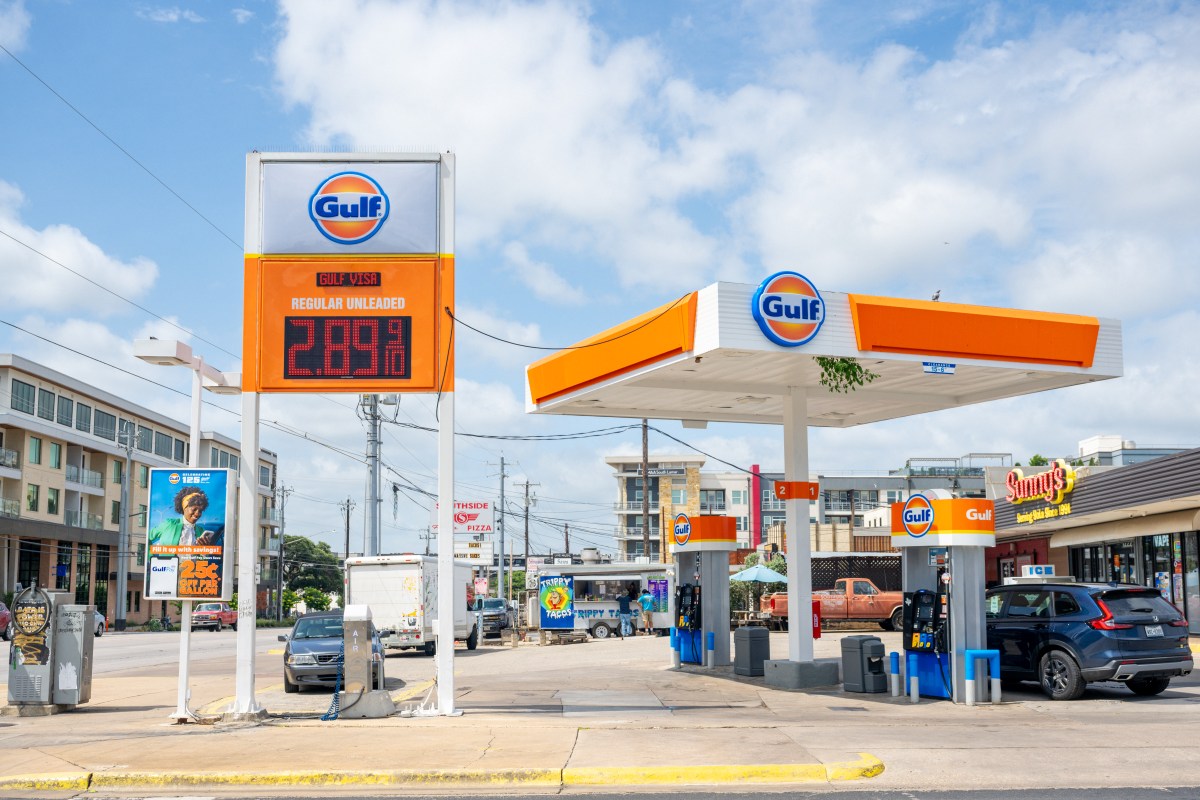
US gas prices have started to fall, dropping from $4.48 in mid-May to $3.86 per gallon. This change comes amid ongoing conflicts and a potential peace deal between the US and Iran affecting oil supply and prices.
Key Facts
President Donald Trump announced that US gas prices are going down.
The average gasoline price is $3.86 per gallon, down from $4.48 in mid-May.
Prices are still higher than $2.98 per gallon in late February before US and Israeli strikes on Iran.
The Strait of Hormuz, a key route for oil exports, has seen ongoing clashes affecting oil supply.
New peace talks between the US and Iran have kept oil prices from rising more sharply.
Oil prices increased by about one percent after recent attacks but did not spike further.
The US Strategic Petroleum Reserve is at its lowest level since the 1980s, limiting oil supply options.
Saudi Aramco continues loading large oil shipments despite the unstable situation.
Read the Original
Want the full story? Tap a source to open the original
article.
Nippon Steel bought U.S. Steel a year ago. Since then, workers have received bonuses, new investments have been made in U.S. steel factories, the company’s main office stayed in Pittsburgh, and the U.S. government keeps close supervision over the company.
Key Facts
Nippon Steel acquired U.S. Steel one year ago.
Workers at U.S. Steel were given the bonuses that were promised.
New money has been invested in American steel mills.
U.S. Steel's headquarters remain in Pittsburgh.
The U.S. government has strong oversight powers over the company.
The acquisition has been seen as successful so far.
The deal involved cooperation between allied countries (Japan and the U.S.).
Washington maintained a level of control not common in such acquisitions.
Read the Original
Want the full story? Tap a source to open the original
article.
Andy Burnham, the departing mayor of Greater Manchester, spoke about shifting power from the central UK government to cities and regions to help improve the economy. While he offered broad ideas on business, housing, education, and infrastructure, he did not provide a detailed economic plan with specific tax or spending levels.
Key Facts
Andy Burnham called for more power for cities and regions in the UK, similar to other advanced countries.
He criticized the UK government for focusing on arguments instead of real economic change.
Burnham shared his past experience where a big northern infrastructure project was stopped due to cost rules.
His speech did not include detailed plans on taxes, investments, or strategies for trade and technology.
Burnham said he will follow current government borrowing rules and support reviews aimed at improving young people’s employment.
His plan has five parts, including devolution of power and an industrial strategy.
Questions remain about how Burnham will handle welfare spending and Brexit-related trade issues.
The announcement of his choice for chancellor will come in three weeks.
Read the Original
Want the full story? Tap a source to open the original
article.
Rocket Lab is buying the satellite communications company Iridium for about $8 billion in cash and shares. This deal combines Rocket Lab’s satellite launch services with Iridium’s existing network of 80 satellites and 2.55 million customers, aiming to offer more space-based communication services quickly and efficiently.
Key Facts
Rocket Lab announced the acquisition of Iridium Communications for about $8 billion.
The deal includes payment in cash and Rocket Lab stock.
Iridium operates 80 satellites in low-Earth orbit that provide phone and internet services.
Iridium serves around 2.55 million customers globally.
Iridium holds valuable L-band radio spectrum used for satellite communication.
The acquisition helps Rocket Lab move from just launching satellites to also operating satellite services.
Rocket Lab plans to use this deal to grow new space-based services, including navigation as an alternative to GPS.
Rocket Lab is developing a larger rocket called Neutron to launch bigger satellites necessary for future growth.
Read the Original
Want the full story? Tap a source to open the original
article.
Comcast plans to split into two separate public companies: one for media, including NBCUniversal and Sky, and one for internet and wireless services. This change aims to help each company focus on its own growth and priorities. The separation is expected to finish in about a year, pending approvals.
Key Facts
Comcast will create two publicly traded companies: a media company and a broadband/wireless company.
The media company will include NBCUniversal (which has theme parks, film studios, and TV networks) and the European media company Sky.
Comcast’s internet services will stay with the broadband and wireless company.
Comcast co-CEO Mike Cavanagh will become CEO of the new media company, NBCUniversal.
Michael Angelakis, former CFO, will become CEO of Comcast’s broadband and wireless company after the split.
Comcast Chairman Brian Roberts will remain involved in leading both companies.
Shareholders will get shares in both companies once the separation is done.
The split still needs approval from the board and regulators and is expected to be completed in about a year.
Read the Original
Want the full story? Tap a source to open the original
article.
Many pet owners face rising veterinary costs that can be hard to pay all at once. Using a credit card can help cover these unexpected bills quickly, but if the balance is not paid off soon, interest charges can make the debt costly over time.
Key Facts
Veterinary care costs are rising each year, making it difficult for some pet owners to afford.
About 77% of pet owners see their pet like a child, but 76% say the rising vet costs force them to limit spending on care.
One in three pet owners might decline life-saving treatment if it costs more than $1,000.
Paying vet bills with a credit card can be helpful if the full balance is paid within a few months or within the interest-free grace period.
The average credit card interest rate is above 21%, which can make unpaid balances expensive.
Some credit cards offer a 0% interest period for up to a year, which can help manage large veterinary bills without extra interest if paid on time.
Alternatives to credit cards include vet payment plans, medical financing cards, and emergency savings.
Pet insurance may help owners avoid unexpected large bills and reduce the need to use credit cards for vet expenses.
Read the Original
Want the full story? Tap a source to open the original
article.
Gas prices in the U.S. have fallen to about $3.86 per gallon, down from a high of $4.56 in May due to tensions in the Middle East. While the lower prices help drivers now, experts warn this drop could cause new problems for the economy, including increased demand that may raise inflation.
Key Facts
U.S. average gas prices dropped to $3.86 per gallon as of Monday, down from $4.56 in May.
The price drop follows reduced oil tension despite recent conflicts between the U.S. and Iran near the Strait of Hormuz.
Brent crude oil prices fell to around $73 per barrel, near prewar levels.
The Justice Department, under President Donald Trump, started an investigation into possible price gouging by oil companies.
The American Petroleum Institute denies the price gouging claims and says gasoline prices don’t always move directly with crude oil prices.
Economists warn that lower gas prices might increase consumer demand and slow or reverse progress on reducing inflation.
Yale economists note that while increased demand could raise inflation, lower oil prices also tend to decrease energy costs, which might ease inflation pressures overall.
The U.S. economy is less sensitive to oil price changes now compared to past crises like the 1970s energy crisis.
Read the Original
Want the full story? Tap a source to open the original
article.
M&M’s, the popular candy brand, will start making their candies without artificial dyes. However, two of their well-known candy colors will not be changed right away.
Key Facts
M&M’s has been around for nearly 85 years.
The brand plans to remove artificial dyes from their candy.
Not all candy colors will switch away from artificial dyes immediately.
Two iconic colors will remain with artificial dyes for now.
This change is part of a bigger movement toward more natural ingredients in food.
The update affects the look of M&M’s candies but aims to keep their taste the same.
Consumers seeking candies without artificial colors will have more options soon.
Read the Original
Want the full story? Tap a source to open the original
article.
Two major musical tours and an opera canceled shows in Australia due to rising costs and lower ticket sales. Industry leaders are asking the government to change tax rules to help keep live theatre running.
Key Facts
The musicals Waitress and Beetlejuice canceled parts of their Australian tours because of high production and touring costs.
Waitress ended its Melbourne run early and will not go to Sydney as planned.
Beetlejuice stopped its tour after Brisbane and canceled shows in Perth, Adelaide, and Sydney.
Rising costs include production expenses, touring logistics, and impacts from the cost of living and interest rate rises.
The opera Aida canceled its Adelaide shows planned for 2027 due to increased costs linked to international conflicts.
Losing these shows means many theatre workers, like performers and technical staff, are out of jobs for months.
Theatre leaders say buying tickets is a major personal expense, making it harder for audiences to commit.
Industry experts want government tax reforms to help the theatre sector survive these challenges.
Read the Original
Want the full story? Tap a source to open the original
article.
Comcast announced a major change to its business by planning to separate NBCUniversal and other broadcast assets into a separate company. Comcast will then focus on broadband internet, wireless services, and entertainment outside of NBCUniversal.
Key Facts
Comcast will spin off NBCUniversal, which includes NBC, Universal film and TV studios, Telemundo, Peacock streaming service, and Bravo.
The company aims to create two focused businesses: Comcast for broadband, wireless, and entertainment, and NBCUniversal as a separate entity.
This restructuring was announced on a Monday.
NBCUniversal is a major producer of movies, TV shows, and operates several broadcast networks.
Peacock is Comcast's streaming service included in the spin-off.
The spin-off is part of Comcast’s effort to reorganize and sharpen its business focus.
Read the Original
Want the full story? Tap a source to open the original
article.
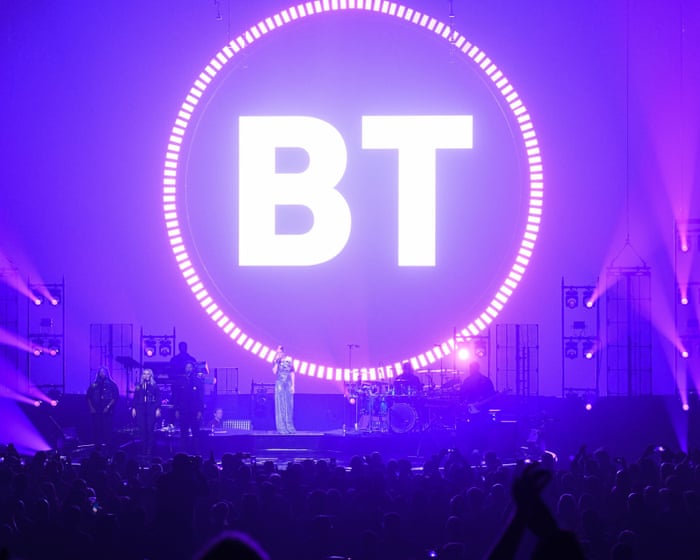
BT and Verizon are joining their international businesses to create a new company with yearly revenue of about $4 billion. Verizon will pay BT a fee to ensure they share control equally. This deal ends BT's long search for a buyer as it focuses more on its UK market.
Key Facts
BT and Verizon will form a 50/50 joint venture combining their global business operations.
Verizon will pay BT $625 million as an equalization fee for equal voting rights.
The new company will have over 3,000 customers in about 180 countries and $4 billion in annual revenue.
BT’s CEO, Allison Kirkby, started in February 2024 and is focusing BT more on the UK market.
BT is cutting costs and aims to save £3.7 billion by 2030, with staff numbers expected to be between 75,000 and 80,000 by then.
Verizon announced job cuts of around 13,000 in late 2023 to simplify operations.
The joint venture will be led by Martijn Blanken, headquartered in the UK and incorporated in Jersey.
The deal needs approvals from regulators and employee consultations before it is finalized.
Read the Original
Want the full story? Tap a source to open the original
article.
Fox News apologized for broadcasting claims by Kevin O’Leary about people opposing his data center project. O’Leary said the opponents had links to China, but these statements were not proven.
Key Facts
Kevin O’Leary is a businessman and TV personality.
He talked about a data center project he is involved in.
O’Leary claimed that some people opposing the project were connected to China.
Fox News aired his statements on May 24.
The claims were unsubstantiated, meaning no solid proof was shown.
Fox News apologized over the weekend for broadcasting these claims.
The issue relates to a controversy about the planned data center.
Read the Original
Want the full story? Tap a source to open the original
article.