Four well-known UK chefs and restaurant owners asked the government to lower the value added tax (VAT) on pubs and restaurants from 20% to 10%. They said the hospitality industry is struggling with high costs and fewer customers, making it very hard to keep businesses open. A government minister said tax cut requests are common but must be balanced against public spending needs.
Key Facts
Chefs Tom Kerridge, Yotam Ottolenghi, Ravneet Gill, and Simon Rogan want VAT on pubs and restaurants cut to 10%.
The current UK VAT rate for hospitality is 20%, which is the second highest in Europe.
Countries like Germany, Ireland, France, Italy, and Spain have VAT rates near or below 10% for hospitality.
The hospitality industry faces high costs from energy prices, wages, and taxes like National Insurance and business rates.
Since 2026, three hospitality businesses have closed every day in the UK.
Government support during Covid, like the "Eat Out to Help Out" scheme, helped temporarily but didn’t solve long-term issues.
Chefs say lowering VAT would help businesses survive and allow them to invest and keep staff.
A government minister said tax cuts must be weighed against other demands on public money.
Read the Original
Want the full story? Tap a source to open the original
article.
Asda has agreed to use Ocado’s technology for its online grocery shopping and home delivery services starting in early 2027. This deal will help Asda improve its website and delivery options, while Ocado will manage Asda’s online orders, including those from delivery apps like Uber Eats and Just Eat.
Key Facts
Asda will use Ocado software to run its online grocery orders and home deliveries from stores and special warehouses called dark stores.
The partnership starts in early 2027 and includes managing click-and-collect services.
Ocado already supports online deliveries for Morrisons and sells groceries with Marks & Spencer on its Ocado.com site.
Asda will not use Ocado’s robot warehouses nor sell directly on Ocado.com.
Ocado’s shares rose nearly 14% after the deal was announced, showing investor confidence.
Asda’s market share fell from 14.3% in 2021 to 11.5% recently, and it faces strong competition from Aldi and Lidl.
Ocado has faced challenges, including closing warehouses in the US and Canada, and has rarely made a profit in its 26 years.
Leaders from both companies expressed optimism that the partnership will help Asda improve customer experience and keep pace in a competitive market.
Read the Original
Want the full story? Tap a source to open the original
article.
A UK thinktank backed by the Trades Union Congress (TUC) says workers need more power to influence how artificial intelligence (AI) is used at work so they can share its benefits fairly. The report suggests new rules requiring employers to consult staff on AI and a worker support fund that helps employees with things like training and insurance.
Key Facts
The Institute for Public Policy Research (IPPR) says AI is changing work and workers need more say in how it is adopted.
Survey data shows 20% of workers feel AI improves their job, 21% say it makes work worse, and 4% believe AI has cost them a job.
The report identifies three AI effects: helping workers (augmentation), harming work experience (degradation), and replacing workers (displacement).
It recommends a legal requirement for employers to discuss AI adoption with employees.
A proposed "worker support levy" would fund benefits like union membership, insurance, and training that workers could carry between jobs.
Employee consultation could happen through unions, worker board representatives, or new advisory groups.
TUC General Secretary Paul Nowak says AI’s benefits depend on workers actively shaping its use, drawing parallels with the Industrial Revolution’s impact on labor.
The UK government supports AI adoption as a key driver for economic growth and public sector improvement.
Read the Original
Want the full story? Tap a source to open the original
article.
Power NI will raise electricity prices by 6.2% starting July 1, adding about £5 per month to the average household bill. Firmus will increase its natural gas prices by 15.65%, which means an extra £10.70 a month for customers in the Ten Towns area. Both companies point to higher global energy costs, linked to ongoing conflicts in the Middle East, as the main reason for the price hikes.
Key Facts
Power NI’s electricity prices in Northern Ireland will rise by 6.2% from July 1.
The average household with Power NI will pay about £5 more per month.
Firmus will increase natural gas prices by 15.65% for Ten Towns customers.
This increase equals roughly £2.47 extra per week or £10.70 per month for Firmus customers.
Both companies blame higher global energy and gas prices due to conflicts in the Middle East.
Power NI delayed the price increase as long as possible but could not avoid it because of rising costs.
Firmus previously reduced its tariffs by over 27% in the past year, saving customers around £300 annually before this increase.
The Utility Regulator confirms global conflicts have pushed energy costs up, affecting heating oil, petrol, and diesel prices as well.
Read the Original
Want the full story? Tap a source to open the original
article.
America's richest people are concerned that artificial intelligence (AI) could increase wealth inequality and cause political unrest. Some billionaires and AI leaders propose new ideas like shared wealth funds, lower taxes for low-income earners, and universal access to AI tools to address these issues.
Key Facts
AI technology could eliminate millions of jobs and create some of the world's first trillionaires.
Jeff Bezos suggested that the poorest 50% of earners should pay no federal income tax.
OpenAI CEO Sam Altman supports giving people access to AI's power instead of just cash payments.
Elon Musk called for "universal high income" checks, predicting growth without inflation due to robots.
AI companies warn that wealth and power might become more concentrated if no action is taken.
OpenAI committed $250 million to support workers affected by AI and test ways to share AI benefits.
Politicians like Sen. Elizabeth Warren are pushing for new taxes on wealth and AI-related businesses.
California unions want a one-time 5% wealth tax on billionaires to fund public services, supported by some progressive politicians.
Read the Original
Want the full story? Tap a source to open the original
article.
Oil prices dropped sharply as hopes grew for a peace deal between the US and Iran to end their conflict. The potential ceasefire helped calm the global market, boosting stock prices in Asia, Europe, and the US.
Key Facts
Brent crude oil price fell 1.3% to $91.54 per barrel, nearing a 17% drop since early May.
West Texas Intermediate oil dropped 1.4% to $87.64 per barrel, down 7% from its recent peak.
President Trump shared a draft peace deal on the Iran conflict with allies.
A tentative ceasefire extension deal between the US and Iran may add 60 more days.
The US vice-president, JD Vance, said the deal is close but not finalized.
The Iran war, lasting 90 days, caused global economic disruption by blocking the Strait of Hormuz, a major oil export route.
Global markets reacted positively, with major Asian and European stock indexes rising.
US 10-year Treasury bond yields fell as investors anticipated lower inflation.
Read the Original
Want the full story? Tap a source to open the original
article.
South Korea’s SK Hynix has become one of the few companies in the world worth over $1 trillion. This growth is due to strong demand for its memory chips, driven by the rise of artificial intelligence (AI) technology.
Key Facts
SK Hynix is the world’s second-largest maker of memory chips.
The company’s market value reached about $1.1 trillion recently.
Its share price has increased 240% since the start of 2026.
SK Hynix’s profit in the first three months of 2026 was nearly five times higher than last year.
Global demand for DRAM and NAND memory chips is growing rapidly because of AI technology.
SK Hynix joins only 17 companies worldwide valued at over $1 trillion.
Most $1 trillion companies are based in the United States; SK Hynix is one of the few outside the U.S. in this group.
Other non-U.S. companies worth $1 trillion include Samsung Electronics, TSMC of Taiwan, and Saudi Aramco.
Read the Original
Want the full story? Tap a source to open the original
article.
KPMG Australia’s CEO Andrew Yates has resigned after the firm failed to properly address whistleblower complaints about misuse of client information. Another senior executive, Julian McPherson, will also step down as the company continues its investigation.
Key Facts
Andrew Yates became KPMG Australia’s CEO in 2021 and resigned immediately over a whistleblower scandal.
The whistleblower raised concerns about improper sharing of client documents within KPMG.
KPMG’s initial internal investigation did not find proof but was later admitted to be insufficient.
Julian McPherson, head of audit and assurance, will leave the company after transitioning his client work.
KPMG acknowledges it did not meet internal and public expectations in handling the whistleblower’s case.
The Australian Securities and Investments Commission (ASIC) is conducting a preliminary investigation into KPMG auditors.
KPMG states it is continuing to look into the matter internally.
The firm expressed a commitment to a culture where employees feel safe to report problems (“speak-up culture”).
Read the Original
Want the full story? Tap a source to open the original
article.
Phillips Distilling Company, an American liquor maker, moved some of its Sour Puss production to Canada after provinces there boycotted U.S.-made liquor. The boycott started in 2025 as a response to tariffs imposed by President Donald Trump, which strongly affected Phillips Distilling’s sales in Canada.
Key Facts
Sour Puss is a fruity liqueur popular mainly in Canada, especially among university students.
Canadian provinces began boycotting American-made liquor in spring 2025 to respond to U.S. tariffs.
Phillips Distilling lost 70% of its Canadian business because of the boycott.
The company started producing Sour Puss in Canada to regain access to Canadian stores.
Most Canadian provinces stopped selling U.S. liquor, except Alberta and Saskatchewan, which have private liquor sales.
Canadian provincial governments control alcohol sales through liquor boards.
The trade dispute between the U.S. and Canada continues with no clear resolution yet.
Canadian officials suggest the boycott may end if President Trump removes or reduces tariffs on Canadian products like cars and metals.
Read the Original
Want the full story? Tap a source to open the original
article.
American shoppers continue to spend money but are more careful about where they shop because of higher costs like gas and food. Retailers that offer good value and convenience, such as Dollar Tree, Burlington, Best Buy, Kohl's, Costco, and Gap, are seeing sales growth as customers look for bargains and affordable treats.
Key Facts
Dollar Tree had a 3.5% increase in sales and raised its financial outlook.
Burlington saw a 6% sales rise and improved its future expectations.
Best Buy surprised analysts with a 2% increase in sales, driven by demand for technology and gaming products.
Kohl’s posted its best sales results in over four years, helped by lower-priced store brands and coupons.
Costco reported a strong 9.8% sales growth and saw record fuel purchases due to higher gas prices.
Consumers are focusing on value and often shop at discount and off-price stores to stretch their budgets.
Shoppers still buy some higher-priced items when they see good deals or need new technology.
Gap Inc. had its ninth straight quarter of sales growth, supported by its Gap and Old Navy brands.
Read the Original
Want the full story? Tap a source to open the original
article.
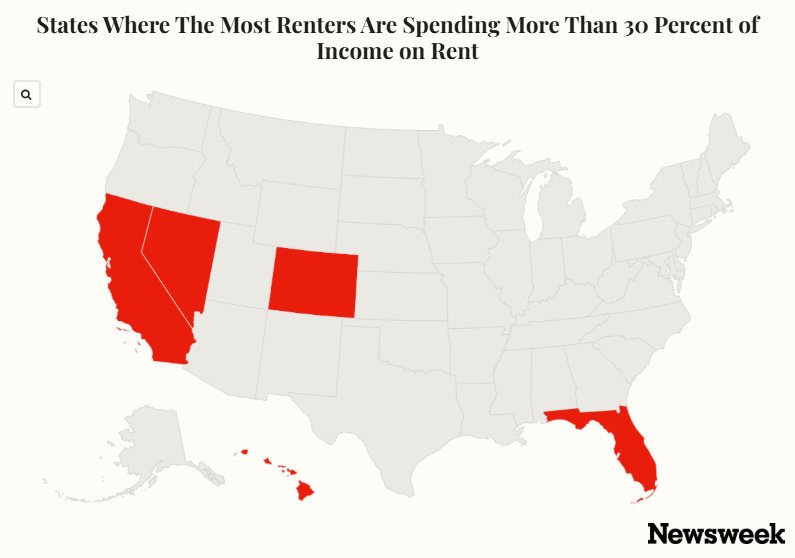
Nearly half of renters in the U.S. spend more than 30% of their income on housing, a level that economists say indicates financial stress. This problem is most common in expensive states and big cities, where rents rise faster than incomes.
Key Facts
About 49.7% of renters nationwide spend over 30% of their income on rent, which is considered a "cost burden."
States with the highest share of cost-burdened renters include Florida (56.3%), Nevada (52.8%), California (52.5%), Hawaii (52.1%), and Colorado (50.4%).
Paying more than 50% of income on housing is viewed as a "severe cost burden," which can cause financial instability and risk of eviction.
Rent increases are fastest in the Midwest and Northeast, where limited housing supply drives prices up.
Rents have slowed or decreased in parts of the South and West, where new apartment construction has added housing options.
Lower-income renters and younger people face more challenges due to stagnant wage growth and rising rents.
High housing costs push some workers to live farther from their jobs, increasing commute times and transportation expenses.
States with lower housing costs and less financial strain tend to be in the Midwest and South.
Read the Original
Want the full story? Tap a source to open the original
article.
Using money from your home's value, called home equity, can help pay off expensive debts like credit cards by offering lower interest rates and simpler payments. However, this method involves risks because your home is used as security, meaning you could lose it if you fail to make payments.
Key Facts
Credit card interest rates are high, averaging about 22%, making debt harder to manage.
Home equity loans and home equity lines of credit (HELOCs) have lower interest rates, around 7% on average.
Using home equity can save borrowers money over time by reducing interest costs.
Consolidating debt into one home equity loan simplifies payments and deadlines.
Home equity loans are secured by your house, so missing payments could lead to foreclosure.
Credit card debt is unsecured, so defaulting affects credit but doesn’t risk losing your home.
HELOCs often have variable interest rates, which can rise and increase monthly payments.
The housing market has boosted home values, giving many owners large amounts of equity to borrow against.
Read the Original
Want the full story? Tap a source to open the original
article.
Dollar stablecoins have become popular in Latin America because they help people avoid problems like inflation and difficult banking access. However, relying too much on these digital dollars can cause new risks, such as businesses and households borrowing in dollars but earning local money, which may lead to financial trouble if local currencies lose value.
Key Facts
Dollar stablecoins are digital currencies pegged to the US dollar, used widely in Latin America to protect savings and bypass banking issues.
These stablecoins speed up dollarization, where the dollar is not only saved but also used for pricing and lending, even when local currencies are still used for daily transactions.
Households and small businesses might face higher debt risks because they earn in local money but borrow in dollars, which can cause problems if exchange rates change.
Businesses using dollar stablecoins can unknowingly face currency risks, affecting their profits and costs unpredictably.
Increased use of dollar stablecoins reduces local monetary policy power, as economic activity shifts outside traditional local banking systems.
Changes in U.S. monetary policy, like Federal Reserve interest rate hikes, can affect dollar liquidity costs in Latin America, impacting borrowers.
Most dollar stablecoins depend on U.S.-linked entities, which adds regulatory and geopolitical risks to Latin American financial systems.
Read the Original
Want the full story? Tap a source to open the original
article.
The European Union has fined Chinese online retailer Temu €200 million for selling products that the EU says are toxic or unsafe, including baby toys and electronics. Temu disagrees with this decision, which was made under the EU’s Digital Services Act that aims to protect consumers from harmful goods sold online.
Key Facts
Temu is a Chinese e-commerce company.
The EU fined Temu €200 million for selling unsafe products.
The unsafe items include baby toys and electronic devices.
The fine comes under the EU’s Digital Services Act.
This law requires online platforms to protect consumers from harmful products or content.
Temu disputes the EU’s ruling.
The news was reported on May 28, 2026.
The EU is increasing consumer safety rules for online sellers.
Read the Original
Want the full story? Tap a source to open the original
article.
Mortgage interest rates have recently risen due to economic factors, affecting homebuyers and those refinancing. In June, three key dates—June 5, June 10, and June 17—could influence these rates based on new government reports and a Federal Reserve meeting.
Key Facts
Mortgage rates went up by more than half a percentage point since early March and mid-April.
Higher rates have discouraged many homebuyers during a normally active buying season.
June 5 will see the release of the unemployment report, which could affect mortgage rates if unemployment rises.
June 10 will bring the inflation report, which could lead to rate increases or decreases depending on the inflation numbers.
The Federal Reserve meeting on June 17 could change mortgage rates based on decisions about interest rates.
A possible Fed rate cut is considered unlikely in June but comments on future cuts could influence rates.
Borrowers should watch these dates closely and be ready to lock in a rate if it becomes favorable.
External factors like overseas conflicts and inflation affect the overall interest rate environment.
Read the Original
Want the full story? Tap a source to open the original
article.
The best time to buy a new furnace or air conditioner is during slow seasons when demand is lower. Early spring is usually cheaper for air conditioners, while late summer or early fall is better for furnaces. Buying during extreme weather often means higher prices and fewer discounts.
Key Facts
Furnace and air conditioner prices have risen due to higher equipment costs, labor shortages, and energy prices.
HVAC demand peaks in extreme temperatures, causing longer wait times and higher costs.
Early spring is a good time to buy an air conditioner because demand is low and discounts may be available.
Late summer or early fall is the best time to buy a furnace before the cold season starts.
Buying during slow periods gives homeowners better chances for discounts, rebates, and flexible financing.
Waiting until a system breaks during extreme weather often leads to paying more and having fewer options.
Manufacturers and retailers sometimes offer end-of-year promotions on older furnace models.
Planning purchases ahead can help avoid emergency price spikes and scheduling difficulties.
Read the Original
Want the full story? Tap a source to open the original
article.
Nick Bilton, a former technology columnist for the New York Times, has been chosen by Bari Weiss, editor in chief of CBS News, to lead the TV news program "60 Minutes." He will replace Tanya Simon as the executive producer of the show.
Key Facts
Nick Bilton was a technology columnist at the New York Times.
Bari Weiss is currently the editor in chief of CBS News.
Bilton was appointed to lead the primetime news show "60 Minutes."
He replaces Tanya Simon as executive producer of "60 Minutes."
The announcement highlights Bilton’s entrepreneurial skills in journalism.
Read the Original
Want the full story? Tap a source to open the original
article.
Lawmakers are working to stop "surveillance pricing" in grocery stores, a practice where stores use personal data to set prices or offers for each shopper. Maryland has banned some forms of this pricing, and many Americans support banning it because they worry it could raise grocery costs.
Key Facts
Surveillance pricing uses data like shopping history, location, and loyalty program activity to set prices or discounts for individual shoppers.
Maryland is the first state to ban certain types of surveillance pricing in grocery stores.
About 67% of Americans want to ban electronic shelf labels and surveillance pricing in groceries.
68% of Americans think surveillance pricing could increase the cost of groceries.
Supporters say the system can help stores react faster to demand and reduce food waste by adjusting prices quickly.
Critics say it could mean some customers pay more than others for the same items, especially loyal shoppers or during busy times.
People who don’t use apps or loyalty programs might get fewer discounts than those who share their data.
The Federal Trade Commission has said companies can use shopping and personal data to create personalized pricing and promotions.
Read the Original
Want the full story? Tap a source to open the original
article.
A $125,000 certificate of deposit (CD) can earn interest rates around 4% or higher, offering a safe way to grow money with fixed returns. Depending on the term length, savers could earn between about $1,200 and $16,200 in interest over up to three years.
Key Facts
Interest rates on CDs are currently around 4% or higher.
A 3-month CD at 3.90% pays about $1,201 in interest on $125,000.
A 3-year CD at 4.15% pays about $16,217 in interest on $125,000.
Longer terms generally offer more interest but require keeping the money locked in.
CDs have fixed interest rates, so the earnings don’t change with market shifts.
Early withdrawal from a CD can cause penalties, reducing earned interest.
Investing in stocks or bonds could offer higher returns but comes with more risk.
Alternatives like high-yield savings or money market accounts offer easier access but usually lower fixed returns.
Read the Original
Want the full story? Tap a source to open the original
article.
The U.S. Treasury Department is preparing plans for a special $250 bill featuring President Donald Trump's portrait and signature if a new law is passed. This would be the first time in over 150 years that a living person appears on U.S. currency.
Key Facts
The bill would be a $250 Federal Reserve note honoring the nation’s upcoming 250th anniversary.
Current law only allows deceased people to be on U.S. money.
Republican Representative Joe Wilson introduced a bill to authorize this new currency with President Trump’s image.
The bill has 15 Republican supporters but has not passed and is stalled in the House Financial Services committee.
The Treasury’s Bureau of Engraving and Printing is preparing plans in case the bill becomes law.
The bill requires a 60-vote bipartisan majority in the Senate to pass.
The Treasury says no taxpayer money will be used to produce the new bill.
The State Department will issue special passports featuring Trump’s portrait and signature for the 250th anniversary.
Read the Original
Want the full story? Tap a source to open the original
article.