Macklemore announced a new concert tour called the "Free Palestine" Tour with three European shows planned for October. He said some ticket sales will help charities that support Palestinian people, and more U.S. dates will be shared later.
Key Facts
Macklemore is launching the "Free Palestine" Tour.
The tour will start with three arena concerts in Europe in October.
More U.S. concerts will be announced in the future.
Proceeds from the tour will aid humanitarian and advocacy groups supporting Palestinians.
The tour follows Macklemore's removal from Ed Sheeran's U.S. tour after he said "Free Palestine" on stage.
Macklemore made the announcement on Instagram.
Fans, venues, and advocacy groups are watching for more artist involvement and tour dates.
Read the Original
Want the full story? Tap a source to open the original
article.
Starbucks will close 250 stores in North America soon, marking its second large round of closures under CEO Brian Niccol this year. The company said the stores are closing because they are not meeting financial goals or providing the right experience for customers and employees.
Key Facts
Starbucks plans to close 250 stores in North America this week.
This is the second big store closure after 627 stores were closed last September.
The company laid off 900 non-retail employees last September and 300 corporate employees in May.
Starbucks did not reveal which stores will close or how many are unionized.
More than 700 U.S. Starbucks stores have voted to unionize since late 2021, but no labor agreement has been made.
Starbucks is updating 1,500 stores to make them more comfortable by the end of its fiscal year (September 30).
The company plans to transfer affected employees to other stores or provide severance if no transfer is possible.
Starbucks shares rose slightly in early trading after the announcement.
Read the Original
Want the full story? Tap a source to open the original
article.
Gold prices reached a record high in January 2026 but have fallen about 22% since then, trading around $4,400 per ounce in September. These price changes affect retirement savers, who may find it a better time to buy gold now or reconsider their gold holdings based on their investment goals and market conditions.
Key Facts
Gold hit a record price of $5,589.38 per ounce in January 2026.
By early September, gold prices dropped to about $4,400 per ounce, roughly 22% lower.
Price swings in gold are influenced by rising Treasury yields, inflation, and global uncertainties.
Retirees might see buying gold at these lower prices as a chance to invest at a better value.
Those who bought gold at peak prices might have seen their investment value fall.
Falling gold prices do not always mean selling is the best option; it depends on the role gold plays in the portfolio.
Gold can help diversify retirement portfolios and serve as a protection against economic risks.
Investing in gold gradually over time can reduce the risk of losing money if prices fall further.
Read the Original
Want the full story? Tap a source to open the original
article.
A new $600 million chicken processing plant opened in Tamworth, Australia, owned by Baiada, one of the country’s largest chicken producers. The modern facility can process 3 million chickens a week, creating over 1,000 jobs, but questions remain about whether it will improve chicken welfare.
Key Facts
The plant in Tamworth can process up to 3 million chickens per week, about 20% of Australia’s yearly chicken slaughter.
Baiada owns well-known brands like Steggles and Lilydale Free Range.
The facility includes modern features such as automated packing, chilling systems, a cafeteria, gym, and gardens for workers.
The plant is expected to provide more than 1,000 jobs in the region.
Australians eat around 55kg of chicken per year on average, with chicken making up almost half of all meat consumed.
Animal welfare groups are concerned the plant may not improve conditions for chickens, especially because chickens are bred to grow very fast, which can harm their health.
European countries like Norway and France use slower-growing chicken breeds to improve welfare, even if it costs more.
About 97% of chicken meat sold in Australia meets RSPCA welfare standards, according to the animal charity.
Read the Original
Want the full story? Tap a source to open the original
article.
CBS Mornings Deals is offering special discounts on certain products to help improve daily life. Customers can visit cbsdeals.com to find these exclusive offers, and CBS earns money when people buy items through the site.
Key Facts
CBS Mornings Deals presents special discounts on selected products.
The deals are meant to improve everyday lifestyle.
Customers can access the offers at cbsdeals.com.
CBS earns a commission when purchases are made through their website.
The promotions are featured during the CBS Mornings show.
The deals cover a variety of items, though specific products are not listed in the article.
Purchases support CBS financially through affiliate commissions.
Read the Original
Want the full story? Tap a source to open the original
article.
Small businesses like Brenden Theaters are using Kalshi, a prediction market platform, to manage financial risks by betting on future events. Kalshi offers contracts that pay out based on outcomes such as movie releases or weather changes, helping businesses balance losses and gains.
Key Facts
Brenden Theaters uses Kalshi to bet on how many movies studios release, aiming to smooth out seasonal sales fluctuations.
Kalshi started in 2021 and allows users to wager on events like sports, elections, weather, and now business risks.
Over 200 businesses used Kalshi last month to hedge risks related to weather, gas prices, and other factors.
An ice cream shop hedges against colder weather by betting on temperature drops to offset reduced customer visits.
A NYC bar used Kalshi hedging during the NBA Finals to support a promotion.
Kalshi partnered with the U.S. Hispanic Chamber of Commerce to offer risk tools to over 5 million small businesses.
In finance, hedging means making trades to reduce losses if bad things happen; Kalshi’s bets work similarly.
Experts agree prediction markets can serve as hedges but note Kalshi still makes most money from sports event bets, not all economic hedging.
Read the Original
Want the full story? Tap a source to open the original
article.
McDonald's is looking into adding more high-protein options to its menu to meet the needs of customers who use weight-loss drugs called GLP-1s. These drugs are becoming more popular, and fast-food companies are adjusting their menus and portion sizes to match changing eating habits.
Key Facts
More Americans are using weight-loss drugs called GLP-1s.
GLP-1 drugs help control appetite and weight.
McDonald's is exploring ways to offer high-protein meals.
Fast food chains are changing menus to fit new customer preferences.
Portion sizes may be adjusted to better fit people using these drugs.
Changes aim to attract customers while supporting their weight-loss goals.
This trend reflects a broader shift in how people eat and choose fast food.
Read the Original
Want the full story? Tap a source to open the original
article.
Changes to the rules for lending on condominiums by Fannie Mae and Freddie Mac will affect how people can get mortgages for some condo units. These new standards, including higher reserve requirements and insurance changes, may make it harder for buyers to get loans for certain condos, slowing down sales and housing market activity.
Key Facts
New lending and insurance rules for condominiums by Fannie Mae and Freddie Mac start taking effect between 2026 and 2027.
Minimum reserve funds that condos must hold will rise from 10% to 15% of annual income from assessments.
Condominiums that fail to meet these rules can become "non-warrantable," meaning conventional lenders cannot sell their mortgages to Fannie Mae or Freddie Mac.
This shrinking pool of buyers may increase reliance on cash buyers or other lenders, reducing financing options.
A large condo complex in New England recently became non-warrantable, causing several sales to fail in a short period.
The stricter rules follow concerns raised after the 2021 collapse of Champlain Towers South in Florida.
The goal is to improve condo financial health and insurance protections to prevent structural dangers.
Experts warn that if restrictions are too strict, they may harm the housing market by reducing liquidity and buyer confidence.
Read the Original
Want the full story? Tap a source to open the original
article.
Many streaming services are raising their prices, often by several dollars a month, which is making watching TV online more expensive for customers. Some services also add more ads or lower video quality, and this trend of rising costs is called "streamflation." Because of these increases, many people are canceling their streaming subscriptions.
Key Facts
Disney+ and Hulu have increased their prices for most subscription plans.
Even ad-free plans may still show ads before or after shows, according to Disney’s rules.
Other streaming services like Apple TV and Peacock have also raised prices multiple times in recent years.
Netflix hasn’t raised prices since March 2026, but another increase may happen soon.
About 39% of Americans have canceled a streaming service in the last six months because of higher costs.
Many people subscribe to three or more streaming services, spending around $70 monthly on average.
The combined cost of all major streaming services can be about $120 a month, plus the cost of internet.
Annual subscription prices have gone up; for example, Disney+ annual cost rose from $70 at launch to $190 now.
Read the Original
Want the full story? Tap a source to open the original
article.
Lawsuits claim that the X2 roller coaster at Six Flags Magic Mountain in California caused more than 100 injuries, including serious brain injuries. Six Flags has not made any public comments because the case is still ongoing.
Key Facts
The X2 roller coaster is located at Six Flags Magic Mountain in California.
Over 100 people say they were injured while riding the coaster.
Some of the injuries are described as severe brain injuries.
Multiple lawsuits have been filed against Six Flags related to these injuries.
Six Flags has not responded publicly due to the legal process still happening.
The situation is being reported by CBS News.
The lawsuits are the main focus of current attention on the ride.
Read the Original
Want the full story? Tap a source to open the original
article.
America’s housing crisis has become both a humanitarian issue and an economic problem. There are not enough homes being built, and high costs make housing unaffordable for many, which affects families, workers, and local economies.
Key Facts
About 745,652 people were homeless in the U.S. on one night in January 2025, slightly fewer than in 2024 but still near historic highs.
The country needs approximately 3.7 million more homes to meet demand, according to Freddie Mac.
New home construction fell by 12.4% in July 2025, with single-family home starts at their lowest in over three years.
High land costs, expensive energy, rising property taxes, labor shortages, and costly financing make building affordable housing difficult.
Developers often focus on expensive projects because building cheaper homes is not financially viable.
Expensive housing forces people to live farther from work, increasing commute times and costs.
Housing is an important part of the economy because it affects workers’ stability and spending power.
Improving housing availability and affordability can boost local economies and community well-being.
Read the Original
Want the full story? Tap a source to open the original
article.
Digital advertising uses data and automation to show ads, but small businesses face challenges because these systems favor companies that spend more money. Smaller businesses often cannot spend enough to generate the data needed for advertising AI to work well, making it harder for them to compete for customers.
Key Facts
The global advertising market is expected to reach $3,865.5 billion by 2035.
Digital advertising depends heavily on data, automation, and artificial intelligence.
Larger advertisers have an advantage because they can spend more, generate more data, and optimize their ads better.
Smaller businesses often cannot afford the spending needed to "train" AI systems to perform well.
Automation has replaced manual control in advertising, making real-time, small-budget adjustments difficult.
Small businesses may need to spend tens of thousands of dollars before seeing meaningful returns.
Research shows that companies with more data perform better in marketing and get a higher return on investment.
The current system creates barriers for smaller businesses, affecting market competition and visibility.
Read the Original
Want the full story? Tap a source to open the original
article.
The U.S. Energy Department will spend nearly $2 billion to improve the aging power grid and increase electricity capacity by using new technologies. This effort aims to prevent blackouts caused by high energy demand, especially from data centers linked to artificial intelligence, while helping lower electricity costs for millions of Americans.
Key Facts
The Energy Department is funding 31 projects in 26 states to boost electricity capacity by more than 23 gigawatts, enough for 16 million homes.
New technology like sensors will help monitor weather and manage power flow to prevent overloads on the grid.
The upgrades could improve power reliability and lower costs for around 100 million people.
President Donald Trump supports data centers, saying communities without them risk falling behind economically.
The funding comes from the bipartisan infrastructure law passed when Joe Biden was president.
Utilities often prefer building new plants over efficiency upgrades because new infrastructure is more profitable.
Projects focus on upgrading over 1,500 miles of transmission lines and enhancing technology over nearly 21,000 miles of power grid.
The projects were chosen for their ability to start working quickly to meet urgent energy demands.
Read the Original
Want the full story? Tap a source to open the original
article.
Max Mara presented a new fashion collection at Milan Fashion Week focused on practical and stylish clothing for mature women. The collection features well-made coats, roomy trousers, and versatile pieces designed to fit real life and everyday wardrobes.
Key Facts
The designer Ian Griffiths has worked at Max Mara since 1987.
The collection avoids shocking or extreme styles and aims to be relatable.
Clothes include coats, block-heeled boots, white shirts, and roomy trousers.
Colors are neutral like sand, chalk, grey, and black to match existing wardrobes.
The style is practical and chic, inspired by adventurous women from the 1930s and 1940s.
The collection focuses on real-life wear rather than youth trends or clubwear.
Key pieces include chore jackets, overshirts with patch pockets, halter tops, and double-breasted blazers.
The overall goal is clothes that women can wear confidently on the street every day.
Read the Original
Want the full story? Tap a source to open the original
article.
The U.S. Department of Homeland Security (DHS) has proposed a new $103,265 fee on H-1B visa applications, which are used by companies to hire highly skilled foreign workers. A study by the Computer & Communications Industry Association (CCIA) suggests that if employers apply for fewer visas because of this high fee, the government could lose up to $38 billion in overall revenue over 10 years.
Key Facts
The new proposed fee on each H-1B visa application is $103,265.
The H-1B visa lets U.S. employers hire foreign workers with specialized skills, usually requiring a bachelor’s degree or more.
DHS expects about 85,000 visa applications each year, generating around $8.8 billion annually from the fee.
The CCIA study questions this assumption, modeling lower application amounts due to the high cost.
If applications drop by about one-third, the government’s total revenue, including taxes, could fall by $32 to $38 billion over 10 years.
In a worst-case scenario, revenue losses could reach $142 billion if visa filings fall drastically.
The fee aims to help cover costs of managing immigration by several federal agencies.
DHS believes companies can afford the new fee and will keep applying for the visas at the same rate.
Read the Original
Want the full story? Tap a source to open the original
article.
Global selling of government bonds has caused UK borrowing costs to rise, increasing the interest rates on UK government debt just before the next budget. High oil prices and inflation fears are also pushing bond yields higher in the UK and the US.
Key Facts
The interest rate on 10-year UK government bonds rose to 5.38%, near a 19-year high.
Higher interest rates increase government borrowing costs and affect budget forecasts.
Since March, over half of the UK government’s £24 billion fiscal buffer has been lost due to rising bond yields.
UK Chancellor John Healey aims to meet fiscal rules but likely with a smaller safety buffer.
Rising energy prices, linked to the Middle East conflict, increase inflation risks and pressure the Bank of England to raise interest rates.
The Bank of England expects household energy bills to rise by 24% in January if oil prices stay high.
US 30-year Treasury bond yields hit their highest level since 2004 at 5.444%.
Investor concerns include inflation, high US government spending, and more bond sales by AI companies reducing demand for government debt.
Read the Original
Want the full story? Tap a source to open the original
article.
Jimmy Buffett died three years ago, and his family is still in a legal battle over his $275 million estate. The article explains why having a plan for your money after death (called estate planning) is important, even if you are not very rich.
Key Facts
Jimmy Buffett passed away three years ago.
His family is still fighting over his $275 million estate.
Estate planning helps decide how money and property are handled after someone dies.
You don’t need to be rich to have an estate plan or a trust.
A caller named Sam saved $370,000 by age 30, earning $95,000 a year.
The episode talks about why planning your money early is a smart move.
Estate plans can include trusts, which are legal tools to manage assets.
Read the Original
Want the full story? Tap a source to open the original
article.
JoAnn Fabrics, a popular fabric store chain in the US, closed in 2025 after being affected by private equity ownership. Fans and small business owners connected to the store are now exploring ways to create a cooperative, member-owned crafts business to continue supporting local makers and preserve craft skills.
Key Facts
JoAnn Fabrics started in the 1940s in Cleveland, Ohio, and grew to an 800-store chain.
The company went bankrupt in 2025 under private equity firm Leonard Green & Partners.
Many small businesses, like wedding dress makers and upholsterers, relied on JoAnn Fabrics.
Sandy McClenahan, a former tech worker and hat maker, is leading efforts to form a craft cooperative.
A survey showed interest from people in every US state to create a member-owned co-op.
Worker-owned cooperatives in the US have grown from 315 in 2014 to 820 in 2024.
Employee stock ownership plans (ESOPs) are increasing, with new laws supporting their growth.
About 40% of US small businesses are owned by retiring baby boomers, who will transfer $5 trillion in assets soon.
Read the Original
Want the full story? Tap a source to open the original
article.
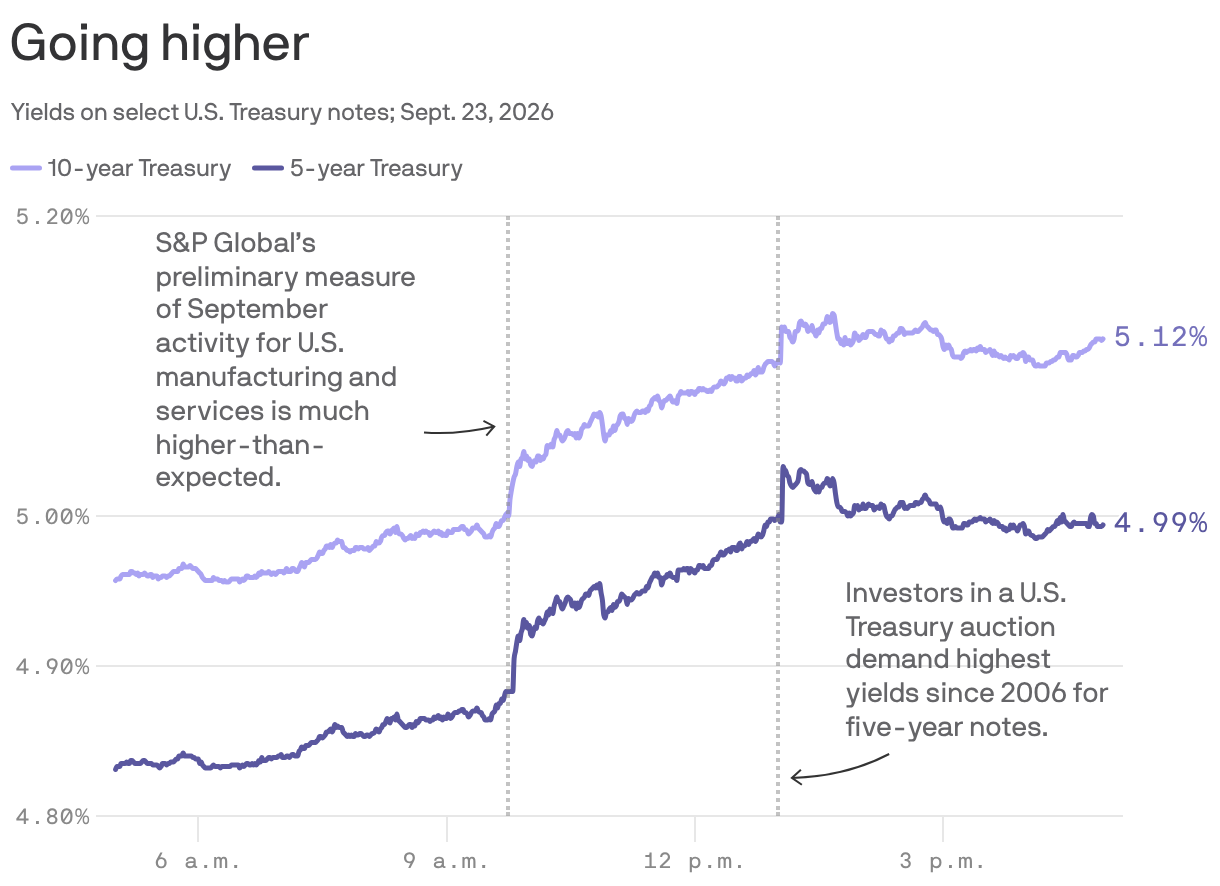
Treasury bond yields, especially for the 30-year and 10-year bonds, have risen sharply to levels not seen since 2004. This rise is driven by strong economic growth reports, high inflation, and increased borrowing by data center companies competing with the U.S. government for investor money.
Key Facts
The 30-year Treasury yield reached 5.44%, the highest since 2004.
The 10-year Treasury yield climbed to 5.13%, with a large jump of 0.15 percentage points recently.
Strong economic data in September showed growth in manufacturing and services but also rising prices.
Higher inflation makes bonds less attractive because it reduces the real value of interest payments.
Increased borrowing by tech companies for data centers is pushing up interest rates by competing with Treasury bonds.
Investors expect the Federal Reserve to raise interest rates further to control inflation.
The U.S. administration is considering a diesel export ban to help domestic prices.
Experts warn that a diesel export ban might raise prices for other fuel products due to refinery operations.
Read the Original
Want the full story? Tap a source to open the original
article.
AO World has bought the camera retailer Jessops from Peter Jones. AO plans to grow Jessops and expand its range of products using its own resources and online skills.
Key Facts
AO World acquired Jessops, including its seven UK stores, for an undisclosed amount.
AO paid for the purchase using its own cash reserves.
The deal fits AO’s plan to offer more types of electronics beyond its usual products like TVs and phones.
Jessops owns Camera Jungle, a business that buys and sells used digital cameras and accessories.
AO also owns musicMagpie, which deals in used smartphones and entertainment media.
Jessops had sales of £19.8 million last year but made a pre-tax loss of £1 million.
The Jessops brand started in 1935 and has faced financial problems several times in recent years.
Peter Jones bought Jessops in 2013, running it mainly online and closing many stores before AO's purchase.
Read the Original
Want the full story? Tap a source to open the original
article.