El Niño, a natural climate cycle causing warmer ocean waters in the Pacific, is expected to strengthen this winter and affect U.S. weather. This may lead to lower heating costs in some regions and changes in energy use due to wetter or drier conditions.
Key Facts
El Niño is a climate pattern that occurs every 2 to 7 years and changes ocean temperatures and weather.
The Climate Prediction Center expects El Niño to strengthen in the Northern Hemisphere this winter.
Typical U.S. winter effects include warmer weather in northern states, wetter conditions in the south, and drier weather in the Midwest.
Warmer winters can reduce heating costs for many Americans.
Increased rainfall can lower the chance of long heat waves in some regions, reducing summer energy demand.
The Northwest and upper Midwest might have drier, hotter summers, increasing cooling costs.
There is a 63% chance of a very strong El Niño between November and January, which could have major impacts.
Strong El Niños in the past have caused droughts and higher summer temperatures, leading to higher energy use in following years.
Read the Original
Want the full story? Tap a source to open the original
article.
In 2024, Klarna replaced many customer service staff with an AI chatbot but later rehired gig workers to handle more complex customer requests. This shows how AI is changing jobs by automating some tasks and causing companies to hire more part-time or contract workers instead of full-time employees.
Key Facts
Klarna cut hundreds of customer service jobs in 2024 and used AI chatbots to save money.
After customers complained, Klarna rehired human workers through a flexible, gig-style system.
Gig work means flexible, short-term jobs without typical employee benefits like paid leave or health insurance.
AI can handle basic tasks, but humans are still needed for complex work, often hired as contractors.
Labor experts agree AI will replace parts of many jobs, not all jobs completely.
Companies use AI to reduce costs by hiring fewer full-time employees and more gig workers.
This trend affects many industries and types of jobs, including office and white-collar work.
Gig work offers some independence but generally provides fewer worker protections and benefits.
Read the Original
Want the full story? Tap a source to open the original
article.
The official trailer for the upcoming movie "Spider-Man: Brand New Day" was released, showing Tom Holland as Spider-Man and other familiar characters. Fans are guessing that actress Sadie Sink might be playing a mysterious character who could be Jean Grey, a well-known superhero from the X-Men comics.
Key Facts
The "Spider-Man: Brand New Day" trailer was officially released online recently.
Tom Holland stars as Peter Parker/Spider-Man in the movie.
Other returning actors include Zendaya as MJ, Jacob Batalon as Ned, and Mark Ruffalo as Bruce Banner/The Hulk.
Sadie Sink, known from "Stranger Things," appears as a dark, hooded figure in the trailer, but her exact role is unclear.
Some fans think Sadie Sink’s character might be Jean Grey, a superhero with psychic powers from the X-Men.
If true, this could introduce the X-Men characters into the Marvel Cinematic Universe.
"Spider-Man: Brand New Day" is scheduled to be released in theaters on July 31.
Read the Original
Want the full story? Tap a source to open the original
article.
Apple CEO Tim Cook said the company will raise product prices because memory chip costs have risen a lot. He said the situation is unsustainable due to higher demand for memory chips and supply problems and did not specify when or which products will be affected.
Key Facts
Apple plans to increase prices because memory chips have become more expensive.
Tim Cook called the price rises "unavoidable" and said the situation is "unsustainable."
Memory chips are key parts of devices like smartphones and have grown costly due to AI demand.
The price of RAM, a common computer memory, has more than doubled since October 2025.
Supply issues, including the war in Iran affecting helium (used to make chips), have increased chip costs.
Apple has not said which products will see price hikes or when they will happen.
The iPhone 17 has sold well, and Apple’s device sales grew 17% in early 2026 compared to last year.
Tim Cook will step down as CEO in September, with John Ternus set to replace him.
Read the Original
Want the full story? Tap a source to open the original
article.
Jim VandeHei explains how he uses artificial intelligence (AI) to help with writing. He shares his rules and methods to make AI improve his thinking and writing style without losing originality or quality.
Key Facts
Writing with AI can seem dull or robotic if used without care.
VandeHei sets clear rules for AI to follow his style and challenge his ideas.
He feeds AI examples of his past work to guide its writing.
He uses AI tools like Claude and ChatGPT with detailed instructions called skills or projects.
He interacts often with AI to improve its output and make it match his style.
VandeHei tests AI writing for his Axios newsletter aimed at business leaders.
He also uses AI agents to find and write about relevant research automatically.
Transparency about AI use is important and Axios shares how they use it in journalism.
Read the Original
Want the full story? Tap a source to open the original
article.
Researchers from a UK AI security company found a way to make ChatGPT generate disturbing sexual and violent images by slightly changing a prompt. OpenAI, the maker of ChatGPT, said it has added safeguards to stop this but the researchers showed that small changes can still produce such content.
Key Facts
ChatGPT can be tricked into creating sexualized and violent images by altering prompts.
British AI security startup Mindgard discovered this vulnerability.
OpenAI responded by adding more protections to prevent these types of outputs.
Despite safeguards, researchers found variations of the prompt that still produce troubling images.
Mindgard’s founder, Peter Garraghan, said the AI generated bad images without specific instructions.
Some images included graphic violence and sexual content involving AI-generated adults.
Mindgard's work focuses on "red-teaming," meaning trying to find ways AI can fail so companies can fix it.
OpenAI continues to monitor and improve safety measures against such misuse.
Read the Original
Want the full story? Tap a source to open the original
article.
Delivery robots that carry groceries and food are becoming common in many cities worldwide. While the companies say the robots are safe and reduce traffic, some people and local governments are unhappy and have banned them in certain areas due to safety and space concerns.
Key Facts
Delivery robots use cameras, sensors, and GPS to move around sidewalks and streets.
These robots operate in cities in the US, UK, Japan, South Korea, and Germany.
Some cities like San Francisco and Toronto have restricted or banned robot use on sidewalks.
Chicago banned delivery robots in two small areas and is considering wider suspensions.
Concerns include people needing to move off sidewalks, collisions, injuries, and blocking emergency vehicles.
In Glendale, California, officials want clear rules before allowing robots on sidewalks.
Councils want regulations about where robots can operate, insurance, and safety standards.
Many people, including John Roberts in Chicago, have started campaigns and petitions against delivery robots.
Read the Original
Want the full story? Tap a source to open the original
article.
A new poll by the Pew Research Center shows that Generation Z (people roughly aged 18-29) is the most worried about how artificial intelligence (AI) might negatively affect society and their personal lives in the next 20 years. Despite these concerns, Gen Z also uses AI tools like chatbots more than any other age group.
Key Facts
48% of Gen Z believe AI will have a negative impact on society, and 37% think it will negatively affect their own lives.
Only 14% of Gen Z believe AI will have a positive impact on society.
66% of Gen Z have used chatbots like ChatGPT, which is higher than any other age group.
People aged 30-49 use chatbots more often daily than Gen Z, with 23% versus 21%.
Older adults (65+) use chatbots the least, with only 23% having ever used one and 4% daily use.
Many college students and young adults are skeptical about AI’s future, sometimes showing frustration during speeches about AI.
Concerns among Gen Z include job market disruption, environmental impacts, and AI’s reliability.
The survey was done in February 2026, involving over 5,000 participants.
Read the Original
Want the full story? Tap a source to open the original
article.
"Control Resonant" is a new video game made by Remedy, featuring a character named Dylan who has special powers like super speed and the ability to use metal as weapons. The game includes unusual enemies and complex combat, promising about 50 to 60 hours of gameplay. It will be released on September 24 for PS5, Xbox Series X|S, and PC.
Key Facts
"Control Resonant" is developed by Remedy and is described as their biggest game yet.
The main character is Dylan Faden, who has superhuman abilities and can fight enemies using melee and powers.
The game features strange and surreal enemies, including a giant disembodied head and possessed vehicles.
Players can move creatively, such as sticking to walls and ceilings and performing triple jumps.
The combat system encourages players to actively pursue enemies instead of waiting for attacks.
There is a large talent tree that lets players customize abilities, weapons, and build synergies.
One memorable scene involves a surreal, repeating apartment setting with a unique visual design.
The game launches on September 24 for PlayStation 5, Xbox Series X|S, and PC.
Read the Original
Want the full story? Tap a source to open the original
article.
The FDA has approved a second kind of fly larvae for use in maggot therapy, which helps clean wounds by eating dead tissue. Singapore-based Cuprina Holdings now has permission to sell two types of these fly larvae for medical use in the U.S., potentially expanding the maggot therapy market.
Key Facts
The FDA cleared Lucilia cuprina (Australian sheep blowfly) larvae for maggot wound therapy.
Cuprina Holdings already has FDA clearance for Lucilia sericata (green bottle fly) larvae, the first species approved in 2004.
Maggot therapy, also called maggot debridement therapy (MDT), uses sterilized fly larvae to clean wounds by consuming dead tissue.
Cuprina is the only company authorized to sell two different fly larvae species for MDT in the U.S.
L. sericata is commonly used in Western countries, while L. cuprina is more recognized in Australia, Africa, Asia, and parts of the Americas.
Maggot therapy is safe and can be effective, but there is limited strong scientific evidence from large studies.
The therapy is usually a last resort when surgery or other treatments can’t be used.
The newly cleared larvae only eat dead tissue and are not parasitic like some other fly larvae that damage living animals.
Read the Original
Want the full story? Tap a source to open the original
article.
Anthropic stopped letting people use its new AI models, Mythos 5 and Fable 5, because the U.S. government limited who can access them. This means only certain users approved by the government can now use these AI tools.
Key Facts
Anthropic released two new AI models called Mythos 5 and Fable 5.
The U.S. government issued a directive restricting access to these models.
As a result, Anthropic pulled access to the AI models for general users.
The restrictions mean only selected people or groups can use the models.
The move is related to government concerns about AI safety or control.
David Katzmaier, editor-in-chief of CNET, discussed this event on CBS News.
The initial models were available broadly before the government stepped in.
Read the Original
Want the full story? Tap a source to open the original
article.
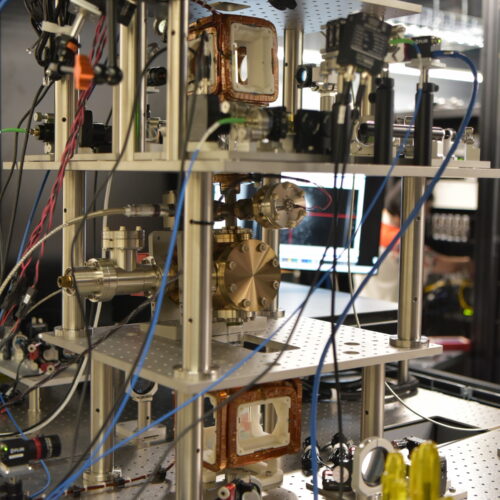
Amazon and the startup QuEra announced plans to deliver a quantum computer with error correction by 2028. This device, called Libra, will use a million quantum operations to handle scientific problems beyond current quantum and classical computers. The technology uses neutral atoms trapped by lasers, aiming to link many qubits for more reliable calculations.
Key Facts
Useful, error-corrected quantum computers were expected in 5 to 10 years, but Amazon and QuEra aim for 2028 (about 2 years from now).
Libra will run hundreds of logical qubits, which are linked small groups of hardware qubits that detect and fix errors.
Logical qubits require many hardware qubits; thousands are needed to solve practical problems in chemistry, physics, or breaking encryption.
QuEra uses neutral atom quantum computing, trapping atoms in a grid using lasers, storing information in atomic spins.
This technology can create many qubits (over 3,000 shown by research partners) but faces challenges like heating and slow atomic movement.
Amazon’s Braket cloud service currently provides access to several quantum computing technologies, with Libra to be added.
QuEra collaborates with Harvard and MIT, sharing research and technology for long-term development.
Error correction is crucial for useful quantum computing, and the path from current demos to a high-quality system is still being worked on.
Read the Original
Want the full story? Tap a source to open the original
article.
Scientists at Monash University found that a copper-based drug called Cu(ATSM) reduces toxic proteins linked to Alzheimer’s disease and improves memory in lab studies. The drug appears to help the brain clear waste by restoring the function of a protective barrier and its waste-removal pumps.
Key Facts
Cu(ATSM) lowered levels of amyloid-beta, a harmful protein linked to Alzheimer’s, by 42% in lab tests.
The drug improved long-term spatial memory by nearly 44% in the same studies.
It works by increasing the number and activity of P-glycoprotein pumps that remove waste from the brain.
These pumps are part of the blood-brain barrier, which becomes less effective in Alzheimer’s patients.
Cu(ATSM) has already been tested for safety in other brain diseases like Parkinson’s and ALS.
The treatment improved the function of brain blood vessels, helping clear toxic proteins.
Researchers believe fixing this waste-clearance system could slow or reverse Alzheimer’s damage.
Scientists are still studying exactly how the brain removes these proteins once the barrier is repaired.
Read the Original
Want the full story? Tap a source to open the original
article.
Nvidia CEO Jensen Huang says society needs to adapt as artificial intelligence (AI) becomes more common. He encourages everyone to start using AI and help create new social rules around the technology.
Key Facts
Jensen Huang is the CEO of Nvidia, a company that makes computer chips and software for AI.
Huang spoke in an interview on Tuesday with The Associated Press.
He believes society must develop new social norms to handle AI properly.
Huang recommends that all people try using AI to understand and work with it.
Nvidia is a leading company in AI technology and computing hardware.
AI refers to computer systems that can perform tasks normally requiring human intelligence.
Read the Original
Want the full story? Tap a source to open the original
article.
A large security breach affected nearly 74,000 Fortinet firewall devices in 194 countries, exposing network login details online. Attackers used these details to access internal systems of major companies and organizations, including some sensitive defense contractors.
Key Facts
About half of all publicly accessible Fortinet firewall devices were compromised.
The breach exposed usernames and passwords in plain text.
Attackers accessed central systems like Microsoft Active Directory and Radius servers inside organizations.
Victims included companies such as Oracle, Chevron, Lenovo, Federal Express, and a NATO defense contractor.
The attackers used advanced techniques, including a large GPU cluster, to crack encrypted passwords.
Some breached organizations lost sensitive data, including classified defense documents.
Security experts advise all Fortinet users to check their networks for signs of intrusion immediately.
The breach was discovered by independent security researchers who investigated the attackers’ infrastructure.
Read the Original
Want the full story? Tap a source to open the original
article.
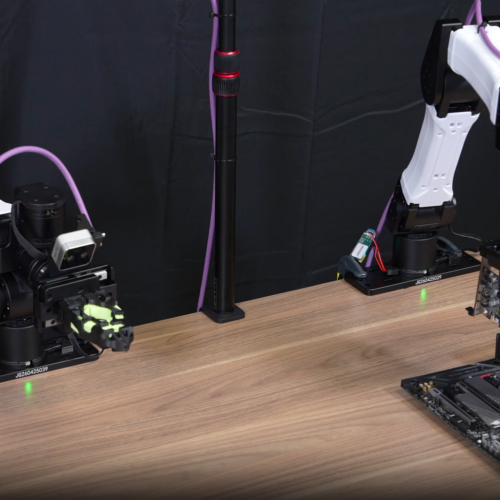
Researchers developed a new software framework called ENPIRE that allows AI coding agents to independently train robots to perform complex tasks. Testing showed these AI agents could teach robots to do jobs like cutting zip ties and inserting GPUs with high success rates, sometimes better and faster than human-guided methods.
Key Facts
ENPIRE is a software system that helps AI agents control robot training by managing tasks like resetting robots, checking results, and improving training strategies.
The framework was created by NVIDIA’s GEAR lab with help from Carnegie Mellon University and UC Berkeley.
AI agents tested include OpenAI’s Codex with GPT-5.5, Anthropic’s Claude Code with Opus 4.7, and Moonshot AI’s Kimi Code with Kimi K2.6.
These AI agents independently developed and tested different ways to train robots, keeping the best improvements.
Tasks mastered include moving T-shaped blocks, organizing pins, cutting zip ties, and inserting GPUs into motherboards.
Teams of eight AI agents trained robots faster and more successfully than smaller teams or single agents.
The AI groups achieved nearly 100% success in some tasks faster than human-guided methods.
Limitations include robots being idle while AI agents are busy debugging or waiting for processing time.
Read the Original
Want the full story? Tap a source to open the original
article.
Jeff Bezos said that artificial intelligence (AI) will cause a shortage of workers instead of taking jobs away from people. He spoke about this during a technology conference in Paris, where he and other leaders discussed how AI could work with space company Blue Origin's projects.
Key Facts
Jeff Bezos, founder of Amazon, made the statement on AI and labor.
He believes AI will lead to a lack of workers, not job loss.
The comment was made at the VivaTech conference in Paris.
Former astronaut Mike Massimino asked about using Bezos’ AI startup, Prometheus.
They discussed applying AI technology to Blue Origin’s engineering work.
Blue Origin is a space exploration company founded by Bezos.
The talk focused on how AI can help human work instead of replace it.
Read the Original
Want the full story? Tap a source to open the original
article.
The Blank Slate is a new, simple electric pickup truck designed to be affordable by cutting some usual features like electric windows. A recent leak showed its starting price might be $24,950, higher than the initially targeted $20,000 after a tax credit was removed.
Key Facts
The Blank Slate is an electric pickup truck by Slate Auto with a basic design.
It aims to lower prices by removing some common features, making even electric windows optional.
The truck offers about 150 miles (241 km) of range on a single charge.
A price leak showed a starting cost of $24,950 for the standard model.
This price is higher than the original $20,000 goal due to the end of a $7,500 tax credit for electric vehicles.
The rear electric motor’s power dropped slightly from 201 hp to 181 hp.
The truck’s towing capacity increased to 2,000 pounds (907 kg).
Official pricing and full details will be shared on June 24.
Read the Original
Want the full story? Tap a source to open the original
article.
Anthropic removed its new AI models, Claude Fable 5 and Mythos 5, after the U.S. government banned foreign users from accessing them due to national security concerns. Experts warn that many AI companies will soon have similar powerful models that can be used for both security and harmful purposes.
Key Facts
Anthropic took Claude Fable 5 and Mythos 5 offline following a U.S. government order restricting foreign use.
Mythos 5 can find computer security weaknesses and also discover ways to exploit them.
Claude Fable 5 was publicly available but blocked from answering some biology and cybersecurity questions.
The U.S. government fears that restrictions on Claude Fable 5 can be bypassed to access Mythos 5’s full abilities.
Other AI companies and open-source groups are likely developing similar or more advanced models.
Experts say restricting one company’s model won’t stop the spread of these AI capabilities worldwide.
OpenAI also released a cybersecurity-focused AI model and has a growing focus on cybersecurity.
Cybersecurity leaders told the White House that the government’s export controls may not address the broader technology trend.
Read the Original
Want the full story? Tap a source to open the original
article.
Young Palestinian women in Gaza are learning how to use artificial intelligence (AI) to make short films about their experiences during the war. They face difficulties because of frequent power outages and weak internet connections.
Key Facts
The women are in Gaza, an area affected by war.
They use AI tools to create short movies.
The films tell personal stories about life during the conflict.
Power cuts often disrupt their learning and work.
Internet access in Gaza is unstable and slow.
This training helps the women share their experiences in new ways.
Read the Original
Want the full story? Tap a source to open the original
article.