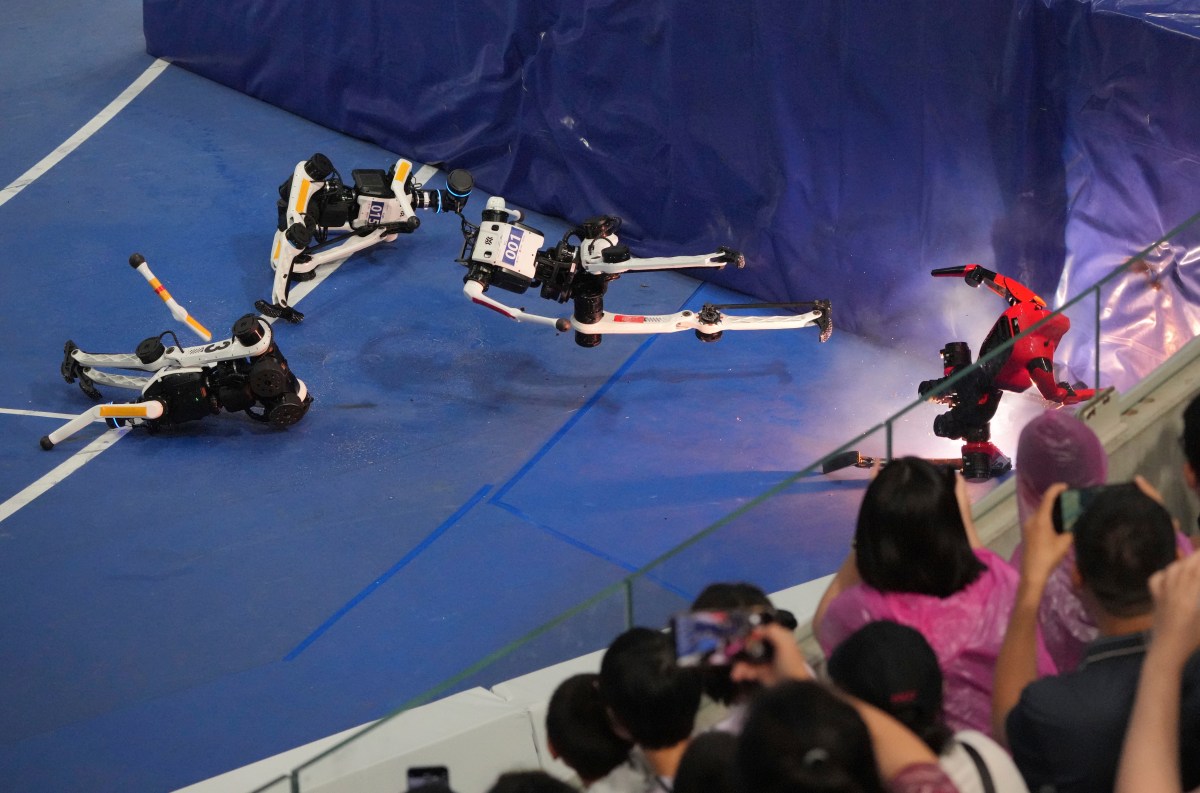
China held the World Humanoid Robot Games in Beijing, showcasing its progress in humanoid robot technology through various events like running, boxing, and obstacle courses. The event demonstrated both the advanced capabilities and current limitations of Chinese robots, while promoting the country’s leadership in robotics ahead of a U.S.-China summit.
Key Facts
The Games lasted five days and included over 2,000 humanoid robots from more than 660 mostly Chinese tech companies.
Robots competed in events such as 100m sprint, boxing, breakdancing, and obstacle courses.
Some robots showed advanced skills, but many also failed spectacularly, causing sparks and falls.
The event was used by China to promote its robotics industry globally and demonstrate its engineering progress.
China produces about 90% of the world’s humanoid robots, with 12,800 made last year.
The Games took place weeks before Chinese President Xi Jinping’s planned summit with U.S. President Donald Trump.
President Trump recently banned imports of Chinese humanoid robots and robot dogs over security concerns.
China’s government supports robotics growth to address labor shortages, military goals, and surveillance needs, as outlined in its latest five-year plan.
Read the Original
Want the full story? Tap a source to open the original
article.
The US Department of Justice corrected earlier statements to clarify that several government agencies were targeted, but not all were hacked, by Chinese state-sponsored hackers. The hackers have tried to access networks of agencies like NASA, the Senate, and the Federal Reserve, with some successful breaches at specific labs and contractors.
Key Facts
The US Justice Department updated its statement to say agencies were targeted, not all were hacked.
Agencies named include NASA, the Senate, the Federal Reserve, Department of Energy, and others.
Some breaches happened in September 2024 at DOE National Laboratories, NIH, an HHS agency, and a security device maker.
NASA’s breach attempt was unsuccessful due to timely software fixes.
Hackers have targeted US federal networks since at least 2018.
A joint cybersecurity advisory reported successful data thefts from defense contractors, financial institutions, and universities in May 2024.
Unsuccessful hacking attempts also targeted the US Senate and a hospital in 2026.
The Chinese Embassy denied wrongdoing and said the US uses cybersecurity claims to discredit China.
Read the Original
Want the full story? Tap a source to open the original
article.
A judge ruled that the Trump administration acted illegally when it blacklisted an AI company named Anthropic. The administration had ordered federal agencies to stop using Anthropic’s AI and labeled the company a security risk after it refused to let its technology be used for military surveillance or weapons.
Key Facts
A judge blocked the Trump administration from blacklisting Anthropic.
President Donald Trump ordered federal agencies to stop using Anthropic’s AI assistant called Claude.
Defense Secretary Pete Hegseth said Anthropic was a risk to the supply chain.
Anthropic refused to let the military use its technology for mass surveillance or autonomous weapons.
The ruling questioned whether the government action was legal under the Constitution.
The issue involves AI technology and the government’s control over its use.
CBS News discussed legal aspects of this ruling.
Read the Original
Want the full story? Tap a source to open the original
article.
NASA will launch the Nancy Grace Roman Space Telescope around August 30, 2026. This telescope will study a billion galaxies to learn how the universe has changed over time. The telescope was originally built by a U.S. spy agency and later given to NASA for scientific use.
Key Facts
The Nancy Grace Roman Space Telescope will observe about one billion galaxies.
Its goal is to track the evolution of the universe over time.
The telescope was first created by the National Reconnaissance Office (a U.S. intelligence agency).
The National Reconnaissance Office transferred the telescope to NASA in 2012.
NASA spent more than ten years modifying the telescope for space science missions.
The planned launch date is as early as August 30, 2026.
The telescope draws on advanced detector technology developed through decades of research.
Its mission builds on insights gained from previous telescopes like the James Webb Space Telescope.
Read the Original
Want the full story? Tap a source to open the original
article.
Juul Labs received federal permission to sell a new version of its e-cigarette called Juul2, which includes an optional age-verification system to help prevent use by minors. The Food and Drug Administration (FDA) approved the device after reviewing studies showing some smokers could quit cigarettes by switching to Juul products.
Key Facts
Juul can now sell an updated e-cigarette device called Juul2 with an optional online age-verification app.
The age-verification app ensures only users 21 and older can unlock and use the device.
Juul stopped selling popular flavors like mango and mint in 2019 due to concerns about teen use.
The FDA says the new product may help adult smokers reduce harm by switching from traditional cigarettes.
Company studies reported 20% to 50% of smokers using Juul products quit smoking in six weeks.
The FDA weighs the benefits to adult smokers against risks of youth use before approving such products.
Juul is no longer the top-selling e-cigarette brand in the U.S.; Vuse currently leads the market.
Teen vaping has decreased overall, and most teens who vape now use unapproved disposable e-cigarettes from China.
Read the Original
Want the full story? Tap a source to open the original
article.
Many U.S. cities and counties are ending their contracts with Flock Safety, a company that provides surveillance cameras, because of concerns about privacy, data sharing, costs, and police misuse. In August 2026, 90 places canceled their contracts, a sharp rise compared to previous months, while Flock says it is still gaining new customers and making changes to address privacy issues.
Key Facts
An advocacy group called Secure Justice found that 214 U.S. cities and counties have dropped Flock Safety since 2021.
In August 2026 alone, 90 localities canceled their contracts, averaging about three per day.
Concerns for ending contracts include too much surveillance, unwanted data sharing, high expenses, and police misuse.
Flock Safety reduced how long it keeps data from 30 days to 7 days to improve privacy.
Flock’s terms now forbid customers from using cameras to stalk or harass people.
Senator Josh Hawley is investigating Flock Safety’s data collection and sharing practices.
Florida Governor Ron DeSantis criticized Flock cameras after police officers were arrested for misuse.
Experts warn that Flock’s AI surveillance, combined with license plate readers, increases widespread monitoring and privacy risks.
Read the Original
Want the full story? Tap a source to open the original
article.
A report from Common Sense Media found that nearly two-thirds of kids aged 9 to 12 use AI at least once a month. However, almost half of these children say their parents have never talked to them about staying safe when using AI.
Key Facts
About 66% of tweens use AI monthly.
47% of kids aged 9 to 12 said their parents never discussed AI safety with them.
The report highlights a gap in communication about safe AI use between parents and kids.
Tweens are children roughly between ages 9 and 12.
AI means computer programs that can perform tasks like talking or answering questions.
Talking about AI safety early can help kids use these tools more responsibly.
Parents may need more resources or guidance to discuss AI issues with their children.
Read the Original
Want the full story? Tap a source to open the original
article.
After the death of country singer Dolly Parton, scammers quickly started using her name and image to trick fans with fake donation requests and fake memorial merchandise. Cybersecurity firm Allure Security found dozens of these scams shortly after the news of her death.
Key Facts
Dolly Parton died at age 80 after a short battle with cancer.
Scammers used Parton’s name and pictures to create fake charity campaigns and sell fake memorial items.
Allure Security found 62 threats linked to Dolly Parton and her charities one day after her death.
Many scam accounts existed before her death but were repurposed to take advantage of fans’ grief.
Social media platforms involved include Facebook, Instagram, X (formerly Twitter), and YouTube.
Scammers use Parton’s reputation for generosity to make fake donation requests seem more believable.
Older fans may be more vulnerable to these scams because of their emotional connection to Dolly Parton.
Experts advise fans to watch out for suspicious messages or offers asking for money or personal details.
Read the Original
Want the full story? Tap a source to open the original
article.
SpaceX has successfully recovered its Starship rocket from the Indian Ocean about a month after its launch. The company is now transporting the rocket back to Texas, where it was built, to study data and continue its development.
Key Facts
Starship launched from SpaceX’s Starbase in Texas on July 24, 2026.
This was the 13th full test flight of Starship and the first one to survive the flight and stay intact.
The rocket was found near Christmas Island in the Indian Ocean.
SpaceX called this recovery their biggest salvage operation so far.
Transporting Starship back to Texas will take several months using a semisubmersible ship.
SpaceX plans to use Starship to send people and cargo to Mars and the Moon.
NASA plans to use Starship and Jeff Bezos’ Blue Moon lander to return astronauts to the Moon by 2028.
President Donald Trump recently visited NASA and praised space exploration efforts.
Read the Original
Want the full story? Tap a source to open the original
article.
Apple has raised the prices for its Apple TV and Apple One subscription services by up to 20 percent. The price changes affect monthly and annual plans, with current subscribers receiving a one-month notice before the new prices start.
Key Facts
Apple TV monthly subscription price increased by $2, now costing $15 per month.
Apple's annual Apple TV subscription price rose from $99 to $119.
Apple One individual monthly subscription increased from $20 to $22.
Apple One Family and Premier plans also had recent price increases.
Apple Music monthly price rose from $11 to $13 last month.
Apple's services made up 28.1% of its revenue in the last quarter, with lower costs compared to hardware sales.
Apple TV has never been profitable and was reported to lose over $1 billion annually as of 2025.
Apple TV has no ads and a smaller content library than competitors like Netflix and Disney+.
Read the Original
Want the full story? Tap a source to open the original
article.
A federal judge ruled that the Pentagon acted illegally by labeling AI company Anthropic as a supply chain risk and punishing it for criticizing the Department of Defense’s approach to AI. The government plans to challenge this ruling.
Key Facts
A judge decided in favor of Anthropic against the Pentagon’s actions.
The Pentagon called Anthropic a supply chain risk earlier this year.
The judge said the Pentagon’s punishment was illegal and without basis.
The conflict began after President Donald Trump and Defense Secretary Pete Hegseth raised national security concerns.
Anthropic’s CEO, Dario Amodei, spoke out about possible misuse of their AI technology.
Risks mentioned include mass surveillance and use in autonomous armed drones.
The government intends to appeal the court’s decision.
Read the Original
Want the full story? Tap a source to open the original
article.
A survey by Glassdoor found that younger workers, especially those in Generation Z, feel more negative about how artificial intelligence (AI) will affect their jobs compared to older employees. Older workers tend to see AI as a helpful tool, while younger workers worry that AI could replace entry-level jobs and make it harder for them to find work.
Key Facts
Only about one-third of Generation Z workers view AI’s impact on jobs positively.
Nearly half (47%) of Generation X workers have a positive outlook on AI in the workplace.
Younger workers fear that AI will reduce job opportunities, especially for entry-level roles.
Older employees often see AI as a tool that supports their work and requires their experience to manage errors made by AI.
Women, particularly young women, are more negative about AI than men; 21% of Gen Z women are positive about AI compared to 42% of Gen Z men.
Some workers worry their companies focus too much on AI and not enough on their main business.
AI-driven job growth is increasing the gender gap in tech, with women underrepresented in new AI jobs.
Read the Original
Want the full story? Tap a source to open the original
article.
About 200 social media accounts linked to a suspected Chinese bot network have tried to influence Americans to oppose AI data centers by spreading messages about energy costs and environmental issues. U.S. lawmakers are investigating foreign efforts to slow down American AI and data center growth, while many Americans also show real concerns about new data centers in their communities.
Key Facts
Around 200 suspicious accounts tied to China tried to influence U.S. public opinion against AI data centers on social media platform X.
These posts focused on AI’s energy use, electricity grid strain, higher utility bills, and accusations that data center operators profit unfairly.
X identified 200,000 accounts in total linked to influence activities but has not commented on possible enforcement actions.
Congressional Republicans are investigating foreign propaganda from China, Russia, and Iran targeting U.S. AI development and data center projects.
Opposition campaigns have reportedly delayed or blocked nearly $46 billion of data center investments in Virginia.
Public opposition to new data centers has risen, with 61% of Americans opposed as of August, up 12 points since early 2023.
Surveys show a political divide: over 60% of Democrats and about a third of Republicans view new data centers negatively, with MAGA Republicans more supportive.
OpenAI recently exposed Chinese-linked networks creating fake content to influence U.S. debates about AI and energy policies.
Read the Original
Want the full story? Tap a source to open the original
article.
NASA has launched the Nancy Grace Roman telescope, which has a camera that can see much wider areas than the Hubble Space Telescope. It will orbit about a million miles from Earth and is expected to discover tens of thousands of new planets outside our solar system.
Key Facts
The Nancy Grace Roman telescope has a wide-field camera that covers 200 times more space than Hubble’s camera.
It will orbit approximately one million miles away from Earth.
The telescope aims to find tens of thousands of unknown exoplanets, which are planets outside our solar system.
This telescope will help scientists study the universe in new ways.
It is named after Nancy Grace Roman, a pioneer in NASA’s space telescope science.
The new telescope is part of NASA’s ongoing efforts to explore space.
The wide view allows the telescope to capture vast sections of the sky at once.
The launch and operation are expected to improve our understanding of cosmic secrets and distant worlds.
Read the Original
Want the full story? Tap a source to open the original
article.
Meta is updating its AI smart glasses to prevent users from hiding the recording light that warns people when the glasses are filming. The new update will stop the camera if the light is covered during recording, aiming to protect bystanders’ privacy. Privacy officials in the European Union are investigating the glasses, and a lawsuit is underway in the US over privacy concerns.
Key Facts
Meta’s AI glasses have a recording light (LED) that signals when video is being captured.
Previously, users could cover the light after starting to record, avoiding detection.
Meta’s update now stops recording if the light is covered during filming.
Only a few users try to bypass this safety feature, according to Meta’s executive.
EU regulators are probing privacy problems with the glasses and may regulate or ban them.
Germany is considering banning the glasses following a legal complaint alleging privacy law violations.
The European Data Protection Board will report later this summer on privacy rules for these devices.
A class action lawsuit in the US claims Meta misled consumers about the privacy protections of the glasses.
Read the Original
Want the full story? Tap a source to open the original
article.
The new Grand Theft Auto VI (GTA VI) game trailer shows a character that some Chinese gamers say looks like Mao Zedong, the former leader of China. This has caused concern among Chinese players because their government often bans games with certain content, and GTA games are not officially allowed in China.
Key Facts
GTA VI trailer includes a brief scene with an Asian-looking man holding a shotgun.
Some Chinese gamers believe this character resembles Mao Zedong, China's former leader.
The game is set in a Florida-inspired city and features crime and action gameplay.
GTA VI is scheduled for release on November 19 and is expected to be very popular.
Rockstar Games, the developer, has never received official approval to release GTA games in China.
Chinese players use VPNs (virtual private networks) to play GTA games despite restrictions.
Discussions about the character appeared on Chinese social media app Bilibili and on Reddit.
Chinese players are cautious about the possible appearance of Mao because of strict government controls on video game content.
Read the Original
Want the full story? Tap a source to open the original
article.
Labour has rejected a proposal by Green Party leader Zack Polanski to pause building large AI datacentres in the UK due to their high energy and water use. The government opposes a moratorium, saying it would harm jobs and national security, while datacentres are seen as essential infrastructure supporting AI and defense.
Key Facts
Zack Polanski from the Green Party wants to stop building big AI datacentres because they use a lot of energy and water.
Labour and the government disagree, saying datacentres are vital for jobs and national security.
Datacentres in the UK currently use about 2.5% of the country's electricity, expected to increase four times by 2030.
Datacentres have been labeled critical national infrastructure by Labour, meaning they are important for the country.
The government says stopping datacentre projects would push investment and jobs to other countries.
Datacentres do not get priority for water or electricity during shortages, and their water use is less than 1% of commercial water use in England.
Some parts of the UK, like Scotland, are considering pausing datacentre construction because of local concerns about noise, heat, traffic, and environmental impact.
Critics worry that plans for datacentres with gas-powered generators could harm efforts to fight climate change.
Read the Original
Want the full story? Tap a source to open the original
article.
Companies using AI must be able to explain how AI decisions are made, especially when those decisions affect customers, such as approving loans or detecting fraud. FICO’s president, Nikhil Behl, says businesses need systems that connect the data inputs, AI model results, and the final decisions, allowing clear oversight of the entire process.
Key Facts
AI is increasingly used to make decisions in finance, insurance, and other business operations.
85% of business leaders say problems with technology, data, and processes limit AI’s value in their companies.
Only 6% of companies have fully implemented and measured AI improvement programs.
Genpact promotes “agentic operations,” where AI handles routine tasks while humans monitor and intervene when necessary.
FICO’s president states businesses need a “decision layer” that links AI outputs to real-world actions with clear governance.
“Observability” means tracking what data went into an AI model, what it produced, and how that result was used in decision-making.
Without proper documentation, AI decisions cannot be properly understood or defended.
AI decisions can be fully automatic or assist human decision-making, but visibility must be maintained either way.
Read the Original
Want the full story? Tap a source to open the original
article.
CD Projekt Red is releasing a new expansion called Songs of the Past for the game The Witcher 3: Wild Hunt, more than ten years after the original game came out. The expansion will arrive next year with a free remaster of the original game for past buyers, and it brings Geralt back for a new story.
Key Facts
The Witcher 3: Wild Hunt was first released over ten years ago.
The new expansion is called Songs of the Past and will come out next year.
Buyers of the original 2015 game get the remaster version for free.
The expansion is developed in partnership with Fool’s Theory, a studio made up of former CD Projekt Red staff.
The story focuses on Geralt returning from retirement at the request of his friend Dandelion.
The setting is Letten, a peaceful land with hidden dark secrets.
Gameplay includes updated combat, skill trees, and new chain weapons.
The expansion is not a prequel to The Witcher 4, which is expected in 2028.
Read the Original
Want the full story? Tap a source to open the original
article.
The World Humanoid Robot Games in Beijing featured over 2,000 robots competing in sports events like running and boxing, where some robots broke human records but also crashed and caught fire. The competition showed advances in robot movement and skills but revealed challenges in robot safety, especially with stopping quickly after moving fast.
Key Facts
The games took place from August 22 to 26 in Beijing with 2,056 robots competing.
Robots competed in events like sprinting, soccer, table tennis, gymnastics, martial arts, and real-world tasks like household chores and emergency rescue.
The robot that ran 100 meters did it in 9.39 seconds, faster than human world record holder Usain Bolt’s 9.58 seconds.
Another robot broke the high jump record by reaching 2.88 meters, beating the human record of 2.45 meters.
Many robots crashed because they could not stop well after running fast, leading to damage and some catching fire.
Robots have trouble stopping quickly because they need complex calculations to keep balance and cannot absorb the force of slowing down as well as humans.
This was the second year of the games, with participation more than doubling from 500 to over 2,000 robots.
Most teams (641 out of 666) came from China.
Read the Original
Want the full story? Tap a source to open the original
article.