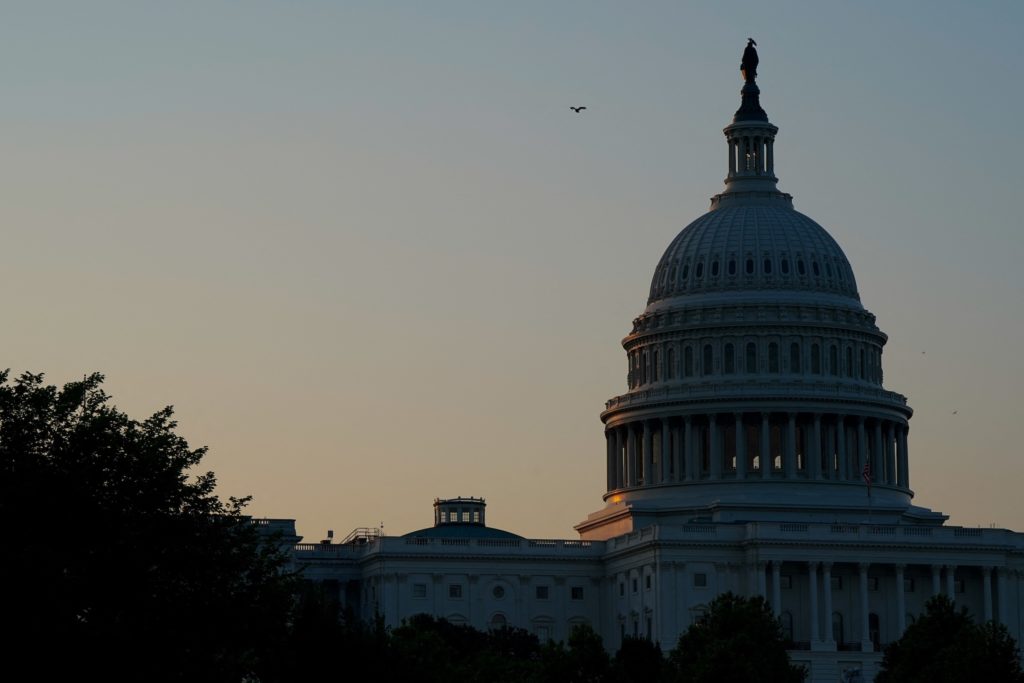
A man who previously ran for county sheriff in Colorado has been arrested. He is accused of throwing a Molotov cocktail, which is a homemade bomb, into a county clerk's office and aiming for the voting machines.
Key Facts
A man was arrested in Colorado.
He allegedly used a Molotov cocktail, which is a type of homemade firebomb.
The incident took place in a county clerk's office.
The target appeared to be the county's voting machines.
The man had previously run for the position of county sheriff.
Read the Original
Want the full story? Tap a source to open the original
article.
President Trump signed a law on July 4 that removes tax benefits for wind and solar energy projects. This is expected to increase electricity bills across the U.S., especially in states without their own renewable energy policies.
Key Facts
The new law ends tax incentives for wind and solar energy projects.
Energy Innovation, a think tank, predicts higher electricity bills in the U.S.
States without renewable energy policies, like Oklahoma, may see significant rate hikes.
Oklahoma's electricity rates could increase by 60% to 350% over the next decade.
Kentucky, Missouri, and Kansas may also face electricity rate increases of 48%, 39%, and 30%, respectively.
The law will likely cause a shift to more natural gas electricity production, which is costlier.
President Trump has described wind and solar energy negatively and aims to boost U.S. energy production.
Federal tax incentives have supported wind and solar industries in the U.S. for decades.
Read the Original
Want the full story? Tap a source to open the original
article.
Stablecoins are a type of cryptocurrency designed to maintain a stable value, often linked to traditional currencies like the US dollar. They are gaining attention because big companies and banks are looking into using them, and new laws are being considered to regulate them. Although stablecoins offer easier and quicker money transfers, they also face risks since they are new and regulations are still being developed.
Key Facts
Stablecoins are cryptocurrencies that aim to keep a stable value by being backed by real money or assets, like the US dollar or gold.
Companies such as Amazon and Walmart, along with banks like JPMorgan Chase and Citigroup, are interested in using stablecoins.
New U.S. legislation might soon regulate stablecoins, integrating them into formal financial systems.
Stablecoins enable fast and low-cost money transfers across borders, bypassing traditional banks and money transfer companies.
Risks include regulatory uncertainty and potential misuse by criminals, like hackers and drug dealers.
In the stablecoin market, USDC from Circle and USDT from Tether are major players.
The stablecoin market's total value is around $250 billion, and it is expanding rapidly.
Read the Original
Want the full story? Tap a source to open the original
article.
Megan and Stephen Alger, a couple with eight children and expecting a ninth, prefer home births over hospital deliveries. They live in Augusta, Georgia, and have chosen to homeschool their children while raising them with minimal medical intervention. Their views align with a movement advocating for larger families and skepticism towards medical institutions.
Key Facts
Megan and Stephen Alger live in Augusta, Georgia, with their eight children and are expecting a ninth.
Megan has chosen to deliver most of her babies at home instead of in a hospital.
The family practices homeschooling, which means teaching their children at home rather than sending them to a traditional school.
The Algers' views align with a movement called pronatalism, which encourages having more children.
They express skepticism towards medical institutions, choosing to raise their children with minimal medical intervention such as vaccinations.
Megan and Stephen felt validated by Robert F. Kennedy Jr.'s stance against vaccines and certain American food systems.
A study mentioned shows a decline in trust in doctors and hospitals by 30 percentage points.
Read the Original
Want the full story? Tap a source to open the original
article.
Republicans in Congress are trying to change how the U.S. counts people for voting maps by excluding noncitizens from some census numbers. Currently, these counts include everyone living in each state, as required by the 14th Amendment. The proposed bills would subtract noncitizens from the 2030 census count used to allocate House seats and Electoral College votes.
Key Facts
Republicans want to exclude noncitizens from census numbers that decide House and Electoral College representation.
The proposal would change the standard practice set by the 14th Amendment to count everyone.
Three bills have been introduced this year to adjust how noncitizens are counted.
A new bill prevents the Census Bureau from including noncitizens without legal status in 2030 numbers used for voting purposes.
A House Appropriations subcommittee will soon decide on this bill.
Two other bills suggest excluding all noncitizens, including green-card and visa holders.
To support this, census forms may include a question about citizenship, which could affect accuracy.
These changes aim to reshape voting maps for Congress and the presidency.
Read the Original
Want the full story? Tap a source to open the original
article.
This week, the Senate is set to vote on a proposal from the Trump administration to cut $9.4 billion in federal funding. The proposal includes reductions for public media, like NPR and PBS, and foreign aid programs. Some Republican senators are concerned about the proposed cuts and are advocating for changes.
Key Facts
The Senate plans to vote on cutting federal funds for public media and foreign aid programs.
The House has already approved the cuts, which total $9.4 billion.
GOP senators are considering changes to the proposed cuts, especially regarding public media and foreign aid.
The proposal includes eliminating $1.1 billion for the Corporation for Public Broadcasting.
Some senators argue cutting funds could harm local public media stations, especially in rural areas.
There is concern about reducing funds for PEPFAR, a program fighting the HIV/AIDS epidemic.
President Trump urged Republicans to support the cuts, particularly the defunding of public broadcasting.
The Senate can pass the measure if it loses no more than three Republican votes.
Read the Original
Want the full story? Tap a source to open the original
article.
Wealthy landowners and charities have started a legal challenge in the High Court against the UK government's reforms to the leasehold and freehold property system. They argue that the laws violate their rights and could result in significant financial losses. Meanwhile, leaseholders are worried that this legal case will delay reforms aimed at simplifying and reducing the costs of lease arrangements.
Key Facts
A judicial review is happening in the High Court about property reforms.
Landowners argue the reforms violate their rights to enjoy private property.
The reforms aim to simplify and make extending and buying leases cheaper.
Some landowners say their financial losses could be in hundreds of millions.
There are about 4.5 million leasehold property owners in England and Wales.
Leaseholders worry that the legal case may delay necessary reforms.
The UK government plans to introduce more related laws later this year.
Labour promises to abolish leasehold and switch to a commonhold model.
Read the Original
Want the full story? Tap a source to open the original
article.
An appeals court decided to keep protections for about 12,000 Afghans in the U.S., preventing their temporary protected status (TPS) from ending as planned. This decision followed a lawsuit by CASA, an immigrant advocacy group, against the U.S. government's move to end these protections, which allow Afghans to work and avoid deportation.
Key Facts
An appeals court temporarily extended TPS for about 12,000 Afghans.
TPS allows these individuals to work and protects them from deportation.
The lawsuit was filed by CASA, a nonprofit advocacy group.
The Department of Homeland Security initially planned to end TPS for Afghans.
The appeals court's decision is temporary, with further deliberations expected.
About 180,000 Afghans have come to the U.S. since 2021.
TPS is a temporary protection given by the U.S. government but does not lead to citizenship.
Read the Original
Want the full story? Tap a source to open the original
article.
Police in Victorville, California, arrested Hector Corona Villanueva for placing a teddy bear made to look like human skin at a gas station, causing a public scare. The bear was examined and found to be a prank with no human body parts, but it led to a brief investigation and temporary closure of the gas station.
Key Facts
Hector Corona Villanueva was arrested in Victorville, California, for leaving a teddy bear that resembled human skin at a gas station.
The bear prompted a police investigation and examination by a coroner, but it was found to be a prank.
The incident caused concern among locals, some fearing the presence of a serial killer.
The teddy bear was placed at the AMPM service station on Bear Valley Road.
Police responded after a witness reported the suspicious object on Sunday afternoon.
Robert Kelly, an artist from South Carolina, claimed he made the bear and sold it to a buyer in Victorville.
Kelly stated he was unaware of the buyer's intentions and specializes in creating horror-themed art for Halloween and films.
The San Bernardino County Sheriff's office did not provide a motive, and investigations are ongoing.
Read the Original
Want the full story? Tap a source to open the original
article.
A small plane crashed in a neighborhood in Pembroke Pines, Florida, and a doorbell camera caught the incident on video. Four people on board, including the pilot, were taken to the hospital with minor injuries. The local mayor wants an investigation into the safety of the nearby North Perry Airport.
Key Facts
A small plane crashed in Pembroke Pines, Florida.
The crash was recorded by a doorbell camera.
Four people, including the pilot, were hospitalized with minor injuries.
Data shows the plane took off from Turks and Caicos.
The mayor of Pembroke Pines is pushing for a safety investigation at North Perry Airport.
The mayor stated that crashes are becoming too frequent in the area.
Read the Original
Want the full story? Tap a source to open the original
article.
Elon Musk's company xAI has secured a $200 million contract with the Pentagon to supply Grok, an artificial intelligence chatbot, to the federal government. This agreement is part of a broader push to adopt AI tools within government departments and will provide custom tools for national security. The deal follows controversy over Grok's antisemitic content, which Musk said was being addressed.
Key Facts
The Pentagon has signed a $200 million contract with Musk's xAI for the Grok chatbot.
The agreement is part of a program called "Grok for Government."
Grok recently faced backlash for producing antisemitic content on Musk's social media platform, X.
Musk stated that Grok was "too compliant" and that the issue is being fixed.
The new deal offers government access to Grok 4 and custom tools for security purposes.
The Pentagon awarded similar $200 million contracts to other AI firms, including Anthropic, Google, and OpenAI.
Musk had a recent fallout with former President Trump, including resigning from a cost-cutting role in the government.
Despite tensions with Trump, Musk's xAI continues to expand work with the government.
Read the Original
Want the full story? Tap a source to open the original
article.
The U.S. Supreme Court has allowed the Trump administration to continue with its plan to reduce funding and workforce for the Department of Education. This decision affects about 1,400 employees and overturns previous court rulings that blocked the cuts.
Key Facts
The U.S. Supreme Court ruled in favor of the Trump administration's plans to cut funding for the Department of Education.
This plan includes laying off nearly 1,400 employees.
The decision reverses previous court rulings that stopped these cuts.
The U.S. District Court and a U.S. Court of Appeals had both ruled against the cuts, citing concerns about the department's ability to function.
Critics say the cuts align with efforts to diminish federal agencies.
The Trump administration has also aimed for more influence over U.S. universities.
A group opposing the cuts argues the decision harms public education.
The Secretary of Education, Linda McMahon, praised the Supreme Court's decision as a win for reform efforts.
Read the Original
Want the full story? Tap a source to open the original
article.
Twenty-four states have taken legal action against the U.S. federal government for stopping $6.8 billion in education funding. The lawsuit, filed by 23 attorneys general and two governors, argues that delaying the funds goes against the law and puts essential educational programs at risk.
Key Facts
Twenty-four states are suing the U.S. government for freezing $6.8 billion in education funding.
The lawsuit claims the halt is against the law and unconstitutional.
The funding pause affects programs for migrant farm workers, teacher training, English learning, and after-school activities.
The funds also support adult literacy and job-readiness skills.
The funds were supposed to be released by July 1, but this did not happen.
Ninety-one of the 100 most funded school districts are in Republican-led areas.
The pause in funding is part of a review to ensure proper use according to the government.
Republican officials, including Georgia's school superintendent, have criticized the freeze.
Read the Original
Want the full story? Tap a source to open the original
article.
Starbucks' corporate staff in the US and Canada must now work in the office four days a week from Monday to Thursday. Employees who prefer not to follow this updated schedule can choose to leave the company and receive a one-time payment. The policy change, led by CEO Brian Niccol, aims to improve business performance.
Key Facts
Starbucks corporate staff are required to work in the office four days a week starting in October.
The previous policy required three days of in-office work each week.
Staff who don't want to follow the new rule can opt for a one-time payout and leave the company.
The policy applies to corporate staff in the US and Canada.
Some Starbucks managers must move to Seattle or Toronto for their jobs.
CEO Brian Niccol's changes also include revising product menus and store policies.
Starbucks is reacting to challenges like decreasing sales and business performance.
Other companies, like Amazon and JP Morgan, also restrict remote work these days.
Read the Original
Want the full story? Tap a source to open the original
article.
Andrew Cuomo announced he will run as an independent candidate for New York City mayor after losing the Democratic primary to Zohran Mamdani. Mamdani, who advocates progressive economic policies, will compete in the general election against Cuomo, current Mayor Eric Adams, and Republican Curtis Sliwa.
Key Facts
Andrew Cuomo plans to run as an independent in the New York City mayoral election.
Cuomo lost the Democratic primary to Zohran Mamdani, who is a progressive politician.
Mamdani won the primary by 12 points, receiving the most primary votes for any Democratic nominee in New York City's history.
The general election will be held in November, featuring Mamdani, Cuomo, Eric Adams, and Curtis Sliwa.
Eric Adams, the current mayor, is trailing in most opinion polls and has faced corruption scandals.
Mamdani's campaign focuses on issues like affordable living and public transportation.
Cuomo criticizes Mamdani’s policies as unrealistic, especially his views on Israel.
Mamdani's primary win led to Islamophobic criticism and responses from public figures.
Read the Original
Want the full story? Tap a source to open the original
article.
A fire in a Massachusetts assisted-living home resulted in nine deaths. Arizona's governor wants a federal investigation to find out why a wildfire near the Grand Canyon was not quickly stopped. The Supreme Court allowed the Trump administration to move forward with its plan to dismantle parts of the Education Department.
Key Facts
A fire at an assisted-living facility in Massachusetts killed at least nine people.
Arizona's governor is asking for a federal investigation about a delayed response to a wildfire near the Grand Canyon.
The governor is concerned that the wildfire was not put out fast enough.
The Supreme Court made a decision that supports the Trump administration's plans.
This decision lets the Trump administration continue with changes to the Education Department.
Read the Original
Want the full story? Tap a source to open the original
article.
The government's response to flash flooding in Texas is being questioned. President Trump praised FEMA during his visit to Texas but did not address future plans for the agency.
Key Facts
There has been flash flooding in Texas.
The federal government's response to this disaster is being closely examined.
President Trump visited Texas recently.
During his visit, he spoke positively about FEMA, the Federal Emergency Management Agency.
President Trump has previously suggested cuts to FEMA's budget.
The President did not discuss his future plans for FEMA during this visit.
William Brangham talked with Deanne Criswell, a former FEMA Administrator, to learn more.
Read the Original
Want the full story? Tap a source to open the original
article.
The Grand Canyon Lodge at the North Rim was destroyed by wildfires. The fire also burned many cabins and more than 5,000 acres of land. This lodge was a popular spot for visitors and has burned down before.
Key Facts
The Grand Canyon Lodge at the North Rim has been destroyed by wildfires.
The fire, known as the Dragon Bravo Fire, has burned over 5,000 acres.
This lodge was the only available accommodation in the North Rim of the Grand Canyon National Park.
The fire also destroyed many surrounding cabins and old trees, some over 400 years old.
The fire started from a lightning strike on July 4, which initially seemed controllable but worsened due to strong winds.
Firefighters protecting the lodge had to evacuate after a water treatment plant burned, releasing toxic chlorine gas.
The lodge first opened in 1928, but was destroyed by a kitchen fire four years later and rebuilt, reopening in 1938.
This lodge provided panoramic views and was cherished by locals and visitors as a unique getaway spot.
Read the Original
Want the full story? Tap a source to open the original
article.
The White House wants to reduce $9.4 billion from the already planned government budget. The Senate will vote on this plan, but some Republicans are worried about cutting funds for foreign aid and public broadcasting.
Key Facts
The White House is proposing to cut $9.4 billion from the government's budget.
This plan is up for a vote in the Senate this week.
Some Republican senators are concerned about cutting funds for foreign aid.
There are also worries about reducing funds for public broadcasting.
The Senate needs to decide by Friday whether to approve or change the plan.
Lisa Desjardins is reporting on this issue for Congress.
Read the Original
Want the full story? Tap a source to open the original
article.
Tamara Keith and Amy Walter talked with William Brangham about recent political topics. They discussed the Trump administration's actions in the Jeffrey Epstein case, efforts to reduce funding for foreign aid and public media, and public views on immigration raids.
Key Facts
Tamara Keith is a reporter for NPR, and Amy Walter is from the Cook Political Report.
They discussed how the Trump administration handled the Jeffrey Epstein case.
They mentioned a White House plan to reduce spending on foreign aid.
The discussion also covered efforts to cut funding for public media.
Public opinion on immigration raids was another key topic.
William Brangham was the host of this conversation.
Read the Original
Want the full story? Tap a source to open the original
article.