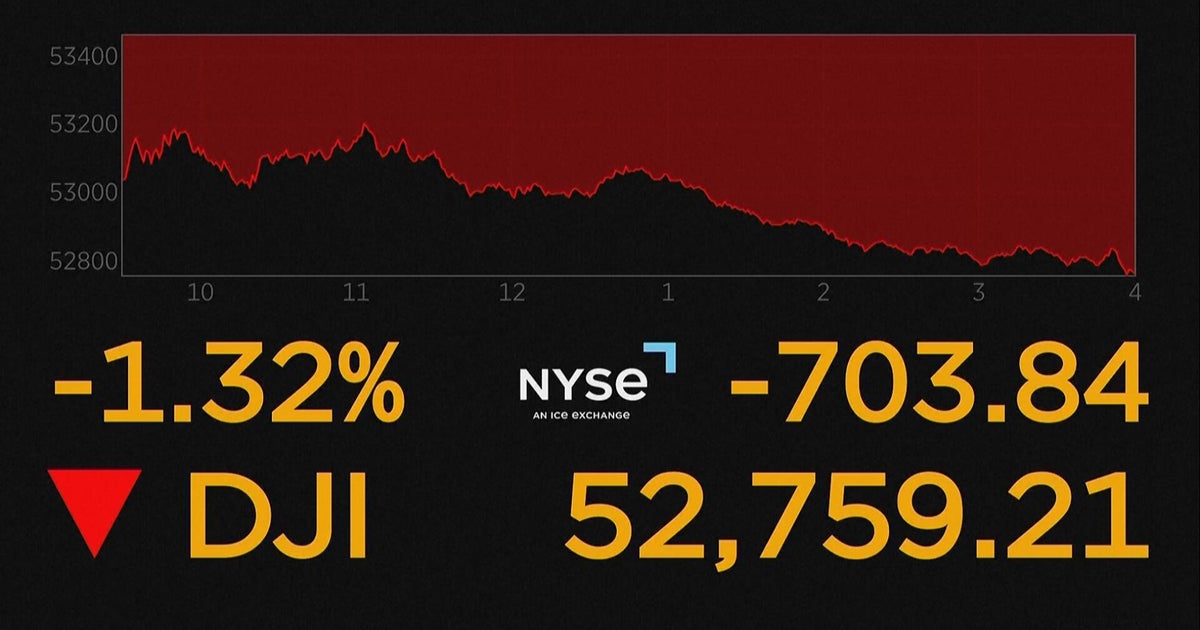
The Dow Jones Industrial Average dropped more than 700 points on Thursday. This fall happened because investors are worried about the rising national debt and unstable bond markets.
Key Facts
The Dow lost over 700 points in one day.
Investors are concerned about the increasing U.S. national debt.
Volatility means bond prices are changing quickly and unpredictably.
The bond market’s instability affects stock prices.
Jessica Inskip, a stock market expert, discussed these issues on CBS News.
Such large drops can reflect fear or uncertainty in the financial markets.
The national debt is the total money the U.S. government owes.
Read the Original
Want the full story? Tap a source to open the original
article.
Employers face another year of rising health care costs, with expenses expected to increase by 9.5% in 2027. This rise is due to higher demand for medical services, more chronic illnesses, and greater use of expensive drugs, making health coverage more costly for both companies and workers.
Key Facts
Employer health costs are projected to grow 9.5% in 2027, reaching over $19,000 per employee.
Workers will pay an average of $5,297 for health coverage in 2027, which is $388 more than in 2025.
Health care cost increases have more than doubled since 2022, rising from 3.7% to 8.8% in 2026.
Increased use of drugs like GLP-1s and more chronic diseases contribute to higher costs.
AI in medical billing and coding leads to more detailed records and can increase charges.
Employers typically cover about 82% of health plan costs.
Companies are considering changes to benefits and cost management to handle rising expenses.
Tightening cost controls, such as dropping high-cost providers, could upset some employees.
Read the Original
Want the full story? Tap a source to open the original
article.
Woody Johnson, owner of the New York Jets, has bought a small share of the Aston Martin Formula 1 racing team. He will join Aston Martin’s board as vice chairman and help with business growth, especially in the United States, but will not manage daily operations.
Key Facts
Woody Johnson owns the NFL team New York Jets and a part of the Premier League soccer club Crystal Palace.
He bought a minority stake in the British Formula 1 team Aston Martin.
Johnson will focus on expanding Aston Martin’s business, particularly in the U.S.
He becomes vice chairman on Aston Martin’s board of directors.
Johnson will not handle day-to-day management of the racing team.
Lawrence Stroll, Aston Martin’s executive chairman, will keep controlling the company.
Johnson was U.S. ambassador to the U.K. during President Donald Trump’s first term.
Johnson and Stroll both want to increase Formula 1’s fanbase in the United States.
Read the Original
Want the full story? Tap a source to open the original
article.
Australia has seen a big drop in property sales to foreign buyers after the government extended a ban on overseas people buying existing homes until June 2029. Despite this, foreign investments overall grew because most new investments were in commercial property, and new tax laws now require foreign residents to pay a 30% capital gains tax.
Key Facts
Approvals for foreign investment in Australian property fell by more than 22% to 5,284 in 2024/25.
The drop was mostly in residential real estate, linked to a ban on foreign buyers extended until June 2029.
The ban on foreign purchases will not fully take effect until April 2025, so the full impact is expected next year.
Foreign investment value in Australia rose by 32% to $256.4 billion, mostly from commercial property investments.
New laws require foreign residents to pay a 30% tax on profits from selling assets (capital gains).
An exception extends a 15% capital gains tax discount by 10 years for foreign investors in Australian renewable energy projects.
Treasurer Jim Chalmers said this tax break supports investment in the country’s shift to cleaner energy.
Read the Original
Want the full story? Tap a source to open the original
article.
Michael Selig, the chair of the Commodity Futures Trading Commission (CFTC), said the agency will quickly create rules for the cryptocurrency market if Congress does not pass new laws this year. He spoke to leaders in crypto and prediction markets, emphasizing the agency’s readiness to act.
Key Facts
Michael Selig is the head of the CFTC.
He made the statement at a meeting with crypto and prediction market leaders.
The CFTC will move quickly to regulate cryptocurrencies if Congress doesn’t pass laws soon.
The agency is prepared to start making rules immediately.
The goal is to provide clearer regulations for the growing crypto market.
Congress is currently working on legislation related to cryptocurrencies.
The CFTC oversees futures, options, and some digital asset markets.
Read the Original
Want the full story? Tap a source to open the original
article.
Coinbase CEO Brian Armstrong supports the CLARITY Act, a new bill that aims to regulate the cryptocurrency industry and protect consumers. The bill, backed by President Trump, would give government agencies clearer rules for overseeing digital assets and prevent problems like the FTX collapse.
Key Facts
The CLARITY Act is a bipartisan cryptocurrency bill supported by President Trump.
It would create clear rules and consumer protections for cryptocurrency users.
The bill gives the Securities and Exchange Commission and the Commodity Futures Trading Commission joint authority to regulate digital assets.
This legislation seeks to prevent collapses similar to FTX, which failed after misuse of customer funds.
President Trump met with tech leaders, including Coinbase CEO Brian Armstrong, to push for the bill’s approval.
Armstrong says the bill includes an ethics provision to prevent conflicts of interest.
Some critics, like Senator Elizabeth Warren, believe the ethics rules are not strong enough.
The bill is expected to be voted on in the Senate in September.
Read the Original
Want the full story? Tap a source to open the original
article.
Walmart’s sales growth slowed down as US consumers spent less, partly due to higher fuel prices and trade tensions with Iran. While in-store visits decreased, Walmart’s online sales increased significantly, leading the company to raise its sales growth forecast slightly.
Key Facts
Walmart’s US same-store sales rose 2.6% in the second quarter, below the 3.8% expected by analysts.
This 2.6% increase was Walmart’s slowest quarterly sales growth in six years.
Rising fuel prices, now averaging $4.10 per gallon, have caused consumers to cut back on spending.
Walmart expects $2 billion more in fuel-related costs than originally planned.
Sales fell in Walmart’s US pharmacy segment and some other areas.
Walmart reduced prices on 11,000 items to attract customers, using $2.9 billion received from tariff refunds.
Foot traffic in stores grew by 1.5%, less than the previous quarter’s 3%, but online sales jumped 24% in the US.
Overall retail sales in the US dropped 0.6% in July, the largest decrease since May 2025.
Read the Original
Want the full story? Tap a source to open the original
article.
Walmart’s sales grew at their slowest rate in over six years, partly because higher fuel prices are causing shoppers to spend less. The company plans to use about $3 billion from tariff refunds to lower prices and encourage customers to keep buying.
Key Facts
Walmart’s sales growth slowed to 2.6% between May and July, excluding fuel sales.
Rising fuel prices above $4 a gallon have made shoppers, especially lower-income households, spend less.
Walmart expects to receive nearly $3 billion in tariff refunds from duties paid after tariffs imposed last year were ruled unlawful.
The company is using this refund to support price cuts called "rollbacks" to attract customers.
Walmart has launched 11,000 price rollbacks across various product categories.
These price cuts are increasing sales of food and basic items like toys.
The tariff refund is a one-time benefit and may not happen again on this scale.
Walmart is also investing in automation, warehouses, and technology upgrades.
Read the Original
Want the full story? Tap a source to open the original
article.
Philadelphia is experiencing a renewed interest in cheesesteaks, with new shops offering higher-quality and more expensive versions of the classic sandwich. This trend, called a "cheesesteak renaissance," includes the use of a special cheese called Cooper Sharp and freshly baked bread, leading to praise and Michelin Guide recognition for some eateries.
Key Facts
Philadelphia is famous for its cheesesteaks, a popular local sandwich.
Pat’s King of Steaks is the original cheesesteak shop, open for nearly 100 years.
A new trend features cheesesteaks costing about $20, showing upgraded ingredients and preparation.
Cooper Sharp cheese, a meltable processed American cheese, helped start this cheesesteak revival.
Danny DiGiampietro of Angelo’s Pizzeria led this renaissance by baking fresh bread and using high-quality ribeye and Cooper Sharp cheese.
Angelo’s Pizzeria has received a Michelin Guide Bib Gourmand award for good quality at affordable prices.
Other notable cheesesteak spots include Del Rossi’s, known for seeded sourdough bread, and John’s Roast Pork, which has won culinary awards.
Customers can now choose from several cheese options, including Cheez Whiz, provolone, American, and Cooper Sharp.
Read the Original
Want the full story? Tap a source to open the original
article.
Mark Zuckerberg and his wife, Priscilla Chan, have purchased Strancally Castle, a large historic estate in Ireland, to use during visits to the country where Meta has an office. The estate covers 440 acres and was bought in a private sale for an estimated price between €20 million and €30 million.
Key Facts
Mark Zuckerberg is the CEO of Meta, the company formerly known as Facebook.
The couple bought Strancally Castle, a mansion with 440 acres in County Waterford, Ireland.
They plan to use the castle as a place to stay when visiting Ireland.
The castle was built in 1830 and is noted for its historic and high-quality stonework.
The sale price is estimated between €20 million and €30 million but was not officially disclosed.
The castle’s price is about 10% of the value of Zuckerberg’s large 387-foot yacht.
The previous owners, Michael Alen-Buckley and his wife Giancarla, had owned and restored the estate for 25 years.
Other tech entrepreneurs, like James Dyson and John Collison, have also bought historic estates in Ireland recently.
Read the Original
Want the full story? Tap a source to open the original
article.
Reform UK’s new economic adviser, Mitchell Palmer, has called for ending the pensions triple lock, a policy that increases state pensions yearly by the highest of inflation, earnings, or 2.5%. He also supports privatising the NHS and views migration as a way to reduce global poverty. Palmer’s economic views are more market-focused than some in Reform UK.
Key Facts
Mitchell Palmer was appointed as an economic aide by Robert Jenrick, Reform UK’s economic spokesperson.
Palmer argues the triple lock on pensions is costly and not sustainable as pensioners grow in number.
The triple lock guarantees pensions increase annually by the highest of earnings growth, inflation, or 2.5%.
Palmer supports privatising the NHS, citing poor performance and rationing of care under the current system.
He has promoted economic migration as a tool to alleviate global poverty.
Palmer’s views are sometimes more right-wing than Reform UK’s existing policies.
Reform UK plans to make major welfare cuts, potentially reducing benefits for disabled and terminally ill people.
There is some internal debate within Reform UK over tax cuts and welfare spending policies.
Read the Original
Want the full story? Tap a source to open the original
article.
Social media falsely claimed that the extreme heatwave in Italy threatens the production of Parmigiano Reggiano cheese and the banks that store the cheese wheels as loan collateral. In reality, the cheese is kept in cool storage warehouses that are operating well despite higher energy use, and the cheese production is not currently at risk.
Key Facts
Parmigiano Reggiano cheese is made in northern Italy under strict rules, including aging for at least 12 months.
Some banks accept cheese wheels as collateral for loans during aging, with Credito Emiliano S.p.A’s Magazini Generali delle Tagliate (MGT) being the largest storage.
MGT stores about 500,000 cheese wheels worth around 300 million euros ($350 million) in cooled facilities.
The extreme heat has increased energy use by 30% to keep the warehouses cool, but operations continue normally.
MGT has improved warehouse energy efficiency with new refrigeration, better insulation, and solar panels.
The Parmigiano Reggiano consortium says heatwaves can reduce milk yields by about 10%, but production is currently stable.
Cows are fed preserved and dried forage to help during droughts, and farms use fans and water sprays to keep cows comfortable.
Milk also comes from cooler hilly and mountain areas, helping to protect supply despite the heat.
Read the Original
Want the full story? Tap a source to open the original
article.
Many employers use advanced technology to watch and track their workers’ locations, activities, and communications, especially since the pandemic began. This monitoring raises privacy concerns, as some workers feel pressured and mistrusted, and data about employees is sometimes shared with outside companies without clear notice.
Key Facts
Employers track workers using digital tools that monitor locations, task completion, and even use cameras on work devices.
This technology increased during the coronavirus pandemic and continues widely in many industries.
Some monitoring programs share workers’ personal data with external data companies without clearly informing employees.
An example includes a pharmacist whose appointment lengths were tracked, leading to job stress and eventual termination after medical leave.
Experts say employees with less power often face the most intrusive forms of surveillance.
Digital data collected can be used to punish workers or try to predict their future behavior.
Some workers have tried to organize unions to address surveillance concerns.
Privacy experts encourage workers to understand how they are monitored and to advocate for themselves at work.
Read the Original
Want the full story? Tap a source to open the original
article.
A company called Prestige Consumer Healthcare is recalling about 40,000 bottles of Clear Eyes eye drops across the United States. The recall is because the eye drops might not be completely clean and could cause temporary health problems.
Key Facts
The recall involves 15mL bottles of Clear Eyes Maximum Itchy Eye Relief eye drops.
The product helps relieve eye itchiness, redness, and irritation.
The recall started on July 29 after concerns about the sterility, meaning possible contamination.
The U.S. Food and Drug Administration (FDA) classified the recall as Class II, indicating the issue could cause temporary or reversible harm.
The affected lot code is 2552A, and the expiration date is September 30, 2027.
Nearly 40,000 bottles are being recalled nationwide.
Prestige Consumer Healthcare, based in New York, initiated the recall.
FDA provides the recall number as D-0766-2026 for reference.
Read the Original
Want the full story? Tap a source to open the original
article.
The Federal Trade Commission (FTC) warns companies that using personal data to set different prices for shoppers could break the law if they do not clearly explain it. The FTC says people expect prices to be the same for everyone, whether in stores or online. Companies must disclose if they use customers’ data to decide prices or risk being disciplined.
Key Facts
The FTC released a policy statement cautioning companies about "personalized pricing" based on consumer data.
Personalized pricing means charging different prices based on a customer’s online habits or purchase history.
Consumers usually expect prices to be the same for all shoppers, both in stores and online.
The FTC cannot ban personalized pricing but can penalize companies that do not disclose how they use personal data for pricing.
Examples of possible violations include charging more because of household size, trip urgency, or medical emergencies.
Consumers can try to avoid personalized pricing by using tools like VPNs or private browsers.
Consumer Reports found Kroger collects detailed shopper data for profiling, and Instacart charges different prices for the same items.
The FTC wants companies to clearly say when prices are based on a customer’s estimated willingness to pay.
Read the Original
Want the full story? Tap a source to open the original
article.
Bernard Matthews Foods will close its factory in Derby by the end of 2026 due to ongoing financial losses. The company cited economic challenges like Brexit, Covid, and international conflicts as key reasons for the decision.
Key Facts
Bernard Matthews Foods confirmed it will shut its Derby processing factory on Shaftesbury Street South by 2026.
The closure comes after talks with employees and union representatives.
The company has faced significant financial losses in recent years.
Economic issues such as Brexit, the Covid pandemic, and conflicts in Ukraine and the Middle East affected the business and supply chain.
Bernard Matthews Foods previously announced a plant closure at its Norfolk headquarters two years ago.
The brand became famous in the 1960s for turkey farming and products like turkey Twizzlers.
Bernard Matthews, the founder, died in 2010 on the US Thanksgiving holiday.
The company still operates sites in Sunderland and Holton, Suffolk.
Read the Original
Want the full story? Tap a source to open the original
article.
U.S. mortgage rates dropped slightly for the second week in a row but are still higher than they were a year ago. Higher mortgage rates have made it harder for people to buy homes, contributing to slower home sales.
Key Facts
The average 30-year fixed mortgage rate decreased to 6.65% from 6.67% last week.
One year ago, the 30-year mortgage rate was 6.58%.
The 15-year fixed mortgage rate, often used for refinancing, fell slightly to 5.95% from 5.96%.
A year ago, the 15-year mortgage rate was 5.69%.
Mortgage rates usually move along with the 10-year Treasury yield, which is influenced by economic factors like inflation and Federal Reserve decisions.
The 10-year Treasury yield rose to 4.71% from 3.97% before the war between the U.S. and Iran started in late February.
Higher mortgage rates have slowed down U.S. home sales, which remain near a 30-year low.
The U.S. Treasury plans to buy back more government bonds to help reduce bond yields and mortgage costs.
Read the Original
Want the full story? Tap a source to open the original
article.
Specsavers paid £12 million in dividends to its parent company after its profits increased by over 25% to nearly £430 million in the year ending February. The company, which runs about 3,000 stores worldwide, saw sales grow 7% to £4.3 billion and resumed dividend payments after pausing them last year due to economic uncertainty and expansion.
Key Facts
Specsavers operates nearly 3,000 optometry, audiology, and ophthalmology stores in at least eight countries.
The company paid nearly £258 million to shop owners, up from £239 million the previous year.
Pre-tax profits rose to £429.7 million in the year ending February 2024.
Sales increased by 7% to £4.3 billion during the same period.
Dividends to the parent company controlled by founders Doug and Dame Mary Perkins resumed after being paused last year.
The company faced inflation pressures on wages, utilities, and supplier costs but tried not to increase prices for customers.
Specsavers is investing in its website to support customers who want to combine online and in-store shopping.
The Perkins family founded Specsavers in 1983 and their combined fortune is now estimated at £1.4 billion.
Read the Original
Want the full story? Tap a source to open the original
article.
David Mansdoerfer says slow approval processes at the FDA are holding back American progress in regenerative medicine. This delay may allow countries like China to get ahead in this important area.
Key Facts
The FDA is responsible for approving new medical treatments in the United States.
Regenerative medicine is a field focused on healing or replacing damaged tissues and organs.
Bureaucratic delays mean the FDA takes a long time to approve these new treatments.
Slow approvals can slow down innovation and investment in the U.S. biotech industry.
China is moving faster in this field and may become a global leader.
Mansdoerfer believes freeing biotech innovators from strict rules could help America compete better.
The issue highlights a balance between safety regulations and speed in medical advances.
Read the Original
Want the full story? Tap a source to open the original
article.