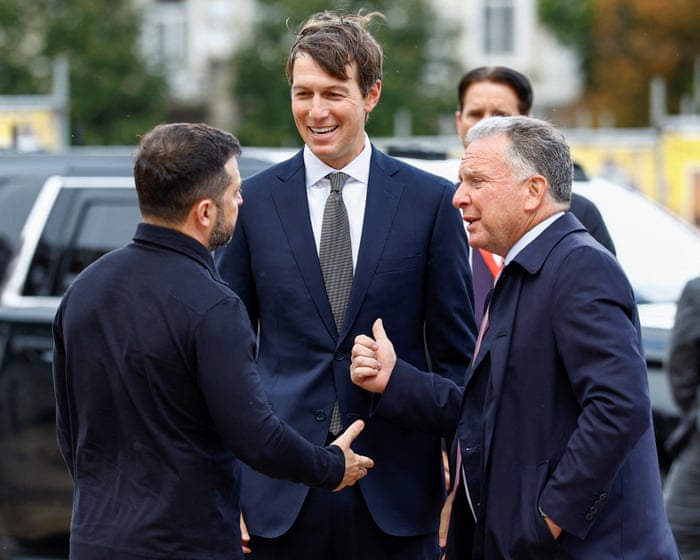
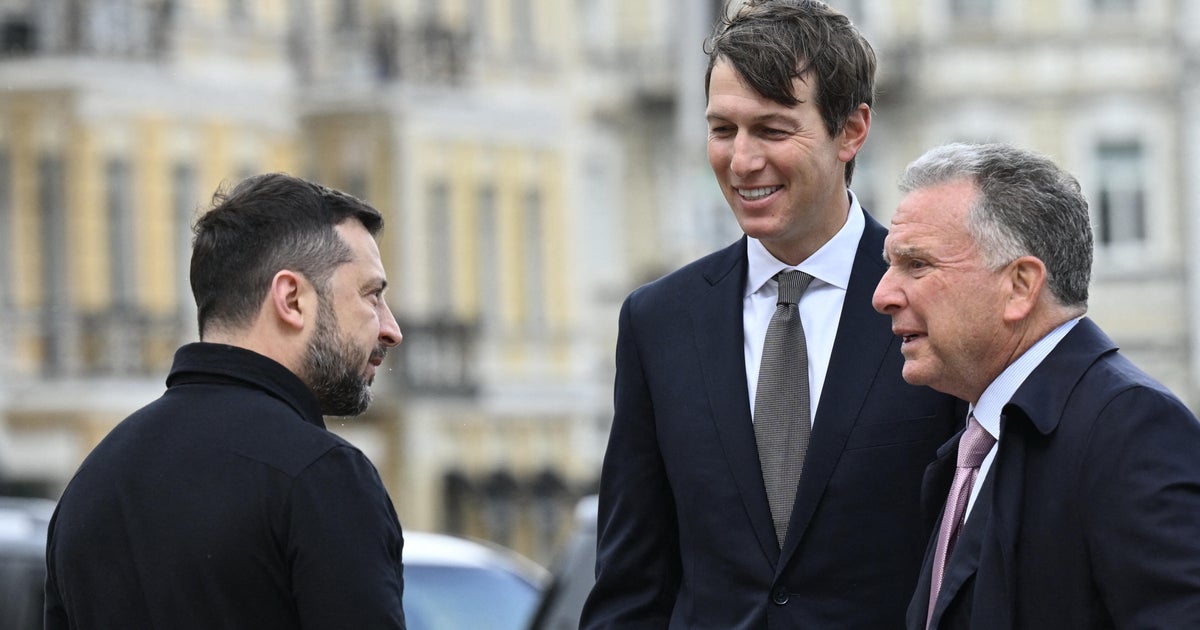
US negotiators Jared Kushner and Steve Witkoff visited Kyiv to continue talks on ending the war in Ukraine, meeting with President Volodymyr Zelenskyy after discussions in Moscow with President Vladimir Putin. The peace talks focus on a 20-point plan but face challenges, including disagreements over control of territory in eastern Ukraine.
Key Facts
Kushner and Witkoff arrived in Kyiv for talks following meetings in Moscow with President Putin.
President Zelenskyy welcomed the US envoys in Sophia Square, near a recent Russian drone attack site.
The war in Ukraine has lasted for over four years, with ongoing drone and missile strikes.
Talks involve a 20-point peace plan proposed by Washington and Kyiv, but key issues remain unresolved.
Moscow and Kyiv agreed on a temporary ceasefire to allow safe travel for negotiators.
British, French, and German security advisers were also in Kyiv before the US envoys’ arrival.
Ukraine faces challenges intercepting fast Russian drones and is concerned about winter impacts.
Ukrainian casualties continue, with recent attacks causing deaths and injuries across the country.
Read the Original
Want the full story? Tap a source to open the original
article.
Prime Minister Andy Burnham has spoken about the problems he sees in the country’s direction over the past 40 years. Ahead of a key speech by his new Chancellor John Healey on economic growth plans, the article compares the approaches of Burnham’s Labour government and the Conservative opposition, focusing on how different they really are.
Key Facts
Prime Minister Andy Burnham has criticized the country’s direction over the last 40 years.
John Healey, the new Chancellor, is preparing a speech about plans for economic growth.
The article questions whether Burnham’s government is truly different from past governments.
Conservative shadow Chancellor Andrew Griffith also wants to show a break from the political past.
The article compares the approaches of Labour and Conservative parties on government and economy.
Reform UK and Nigel Farage face tough questions about money issues.
The article discusses the challenges Reform UK faces and how they might recover.
The news program “Newscast” covers these topics in daily political analysis.
Read the Original
Want the full story? Tap a source to open the original
article.
At least 25 people, mostly teenagers, died in a bus crash on Fogo Island in Cape Verde. The accident happened on a mountain road and some people were also injured. Officials are investigating the cause, and the president of Cape Verde has called it a major tragedy.
Key Facts
The crash occurred on Saturday on the Campanas de Cima route on Fogo Island.
At least 25 people died, most of them teenagers.
Several others were injured in the accident.
Seven bodies were buried immediately because of their condition.
The cause of the crash is not yet known and is under investigation.
Cape Verde’s president, José Maria Pereira Neves, described the event as a great catastrophe.
The president and other officials planned to visit the island following the crash.
The accident involved a passenger bus traveling in a mountainous area.
Read the Original
Want the full story? Tap a source to open the original
article.
Iran said it hit an unmanned U.S. military boat in the Strait of Hormuz, increasing hostilities between the two countries. At the same time, Israeli airstrikes in southern Lebanon killed four people and destroyed a hospital, near areas of ongoing conflict involving Hezbollah.
Key Facts
Iran claims it struck a U.S. unmanned military boat near the Strait of Hormuz in a restricted area, but the U.S. military did not confirm this.
The incident follows U.S. strikes on Iranian oil tankers, which were in retaliation for Iran firing ballistic missiles at U.S. Navy ships.
Fighting between the U.S., Israel, and Iran has continued despite a ceasefire announced in June.
Israeli airstrikes in southern Lebanon killed four people and destroyed an empty hospital.
The strikes targeted areas near Hezbollah, an Iran-backed militant group, following a drone attack by Hezbollah on Israeli forces.
At least 20 people were wounded in the Israeli strikes, including children and women.
Fighting has lessened overall in Lebanon since the ceasefire but low-level conflicts persist.
The region remains unstable with ongoing military and economic tensions.
Read the Original
Want the full story? Tap a source to open the original
article.
The United Nations General Assembly voted to promote a new world map called the Equal Earth projection. This map shows countries and continents in their true size, correcting the distortions found in the older Mercator map that makes places near the poles look bigger and places near the equator look smaller.
Key Facts
The Mercator map, created in the 16th century, distorts the size of countries, making regions near the poles, like Greenland and Europe, look much bigger than they really are.
Africa is about 14 times larger than Greenland, but Mercator maps make them appear nearly the same size.
The UN vote was 164 in favor, 1 against (the United States), and a few abstentions from some European countries.
The resolution encourages schools, institutions, and tech companies to use the Equal Earth map instead of the Mercator map.
The Equal Earth projection shows the correct area sizes of countries and continents, though shapes may appear slightly bent.
The African Union and Togo led the effort to promote the map to better reflect the true size of African countries.
The resolution is nonbinding, meaning it only recommends the change without requiring it.
A meeting with UNESCO and tech companies, including Google, is planned to discuss how to put the change into practice.
Read the Original
Want the full story? Tap a source to open the original
article.
Palestinians held a funeral for 100 people whose bodies were found under rubble in Gaza City’s Zeitoun neighborhood. The victims died when Israeli forces struck homes about two and a half years ago, and thousands attended the procession.
Key Facts
The funeral procession was for 100 Palestinians from five families in Gaza City’s Zeitoun neighborhood.
The bodies were recovered from under destroyed homes.
The victims died after Israeli military strikes on residential buildings roughly two and a half years ago.
Families involved include Rahim, Balawi, Malaka, Qanbour, and Salmi.
Similar recent recoveries found over 100 bodies from other families and over 500 from another site called al-Taj Tower.
Gaza’s Health Ministry reports at least 73,651 Palestinians killed and 174,592 injured since October 2023.
The bodies were laid near the ruins with Palestinian flags on them.
Thousands of people, including relatives, attended the funeral procession.
Read the Original
Want the full story? Tap a source to open the original
article.
As the planet warms due to climate change, millions of people will need air conditioning (AC) to stay safe and healthy. The use of AC is expected to rise sharply, especially in hot, poorer countries, but this will increase energy use and carbon emissions unless new energy-saving methods are implemented.
Key Facts
If the Earth warms more than 3°C above past averages, many big cities will face long heatwaves each year.
Currently, about 90% of households in the US and Japan have AC, but only 5-9% in countries like India and Indonesia do.
The number of air conditioners worldwide in buildings is expected to grow from 2.5 billion today to 5.6 billion by 2050.
India’s AC units alone could increase from 48 million in 2020 to 1.1 billion by 2050.
Cooling demand might use up to 75% of current electricity in countries like India and Indonesia by 2050.
In 2022, cooling energy produced about 7% of global carbon emissions; this could rise to nearly 8 billion tons by 2050 without improvements.
Air conditioning reduces heat-related deaths and helps keep workers productive and students focused during hot weather.
Many people prefer to avoid AC due to environmental concerns, but access to cooling is critical to health and economic growth as temperatures rise.
Read the Original
Want the full story? Tap a source to open the original
article.
President Donald Trump's special envoy Steve Witkoff and his son-in-law Jared Kushner visited Ukraine after meeting with Russian President Vladimir Putin in Moscow. They discussed plans to end the war between Russia and Ukraine, with both sides agreeing to pause attacks during their trip.
Key Facts
Witkoff and Kushner traveled first to Moscow, where they met Putin for three hours to discuss peace plans.
They then arrived in Ukraine, marking their first visit since President Trump took office again in 2024.
Ukrainian President Volodymyr Zelensky asked for security guarantees and peace in a social media post before their arrival.
Russia and Ukraine agreed to stop attacks for three days to allow peaceful talks.
Putin sent warm regards to President Trump during the meeting with the envoys.
The talks included ideas for possible agreements between the U.S. and Russia.
The U.S. thanked Russia for releasing Robert Gilman, a U.S. Marine veteran who had been detained there since 2022.
The peace proposal discussed will be announced in the coming weeks by the White House.
Read the Original
Want the full story? Tap a source to open the original
article.
The United States and Iran have recently attacked each other’s oil tankers and military ships near the Strait of Hormuz, a key waterway for global oil transport. This conflict is part of ongoing tensions, with both sides trying to control the area and disrupt each other’s oil shipments.
Key Facts
The US struck three Iranian vessels, including oil tankers near Iran’s main oil export hub, Kharg Island.
Iran fired ballistic missiles at a US aircraft carrier and a destroyer in the same region, but no US crew were hurt.
The US claims the Iranian tankers were part of a secret network funding Iran’s military forces.
Iran uses a “shadow fleet” of tankers to bypass US sanctions and sell oil despite the blockade on its ports.
The Strait of Hormuz is a critical global route, carrying about 20% of the world’s oil before the conflict.
Iran warns ships not to use what it calls “unauthorized routes” in the waterway or risk being attacked.
The fighting between the US and Iran at sea is a sign of rising tensions in a conflict that has lasted for months.
This conflict has disrupted global energy supplies and threatens further economic issues worldwide.
Read the Original
Want the full story? Tap a source to open the original
article.
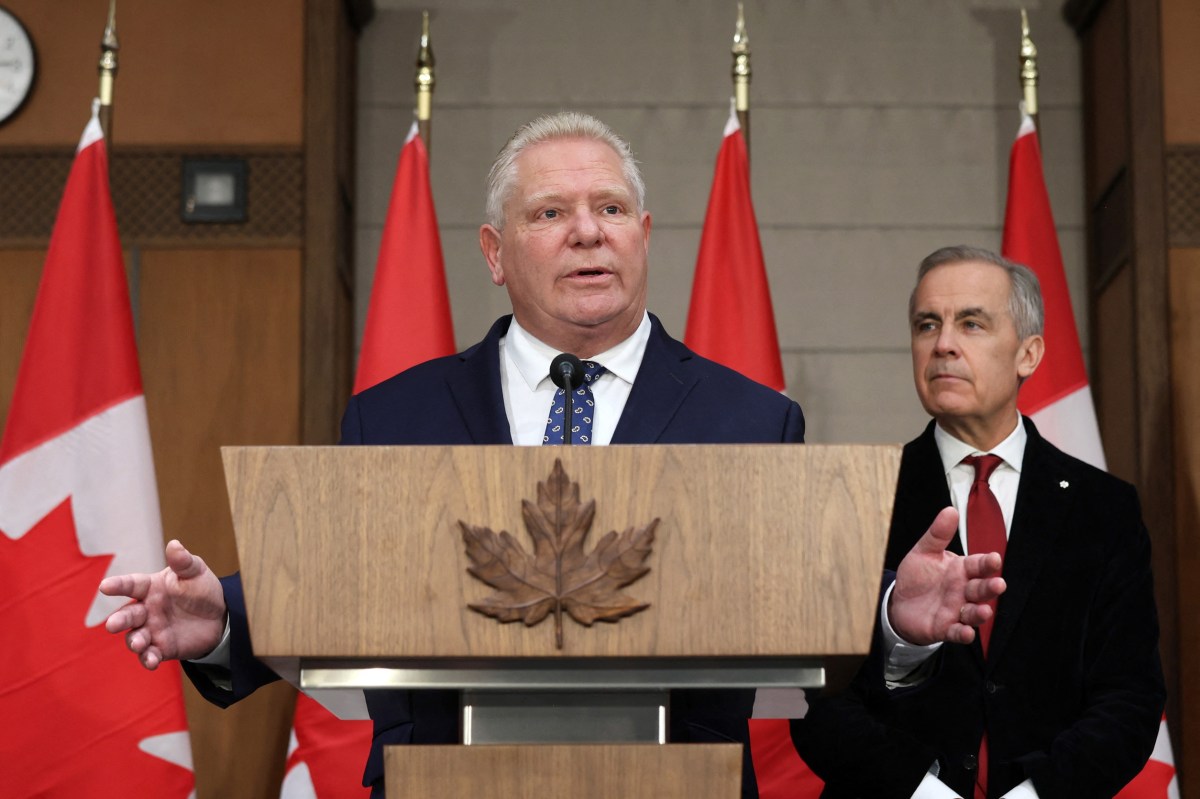
Canada’s largest newspaper, The Globe and Mail, supports Ontario’s plan to target U.S. voters over President Trump’s trade tariffs. The paper says Canada’s tariffs on American goods will raise prices but could pressure U.S. politicians to stop the trade conflict before the November elections.
Key Facts
The Globe and Mail is Canada’s biggest newspaper.
Ontario Premier Doug Ford supports targeting U.S. voters to oppose President Trump’s trade tariffs.
Canada has imposed retaliatory tariffs on U.S. goods in response to President Trump’s trade actions.
The newspaper says these tariffs have no strong economic benefit for Canada.
Both Canadian and American consumers will likely pay higher prices because of the tariffs.
The editorial encourages U.S. politicians and voters to understand the negative effects of the trade conflict.
It highlights the importance of calling for an end to the trade war before the midterm elections in November.
The goal is to create political pressure on Republicans who support President Trump’s tariffs.
Read the Original
Want the full story? Tap a source to open the original
article.
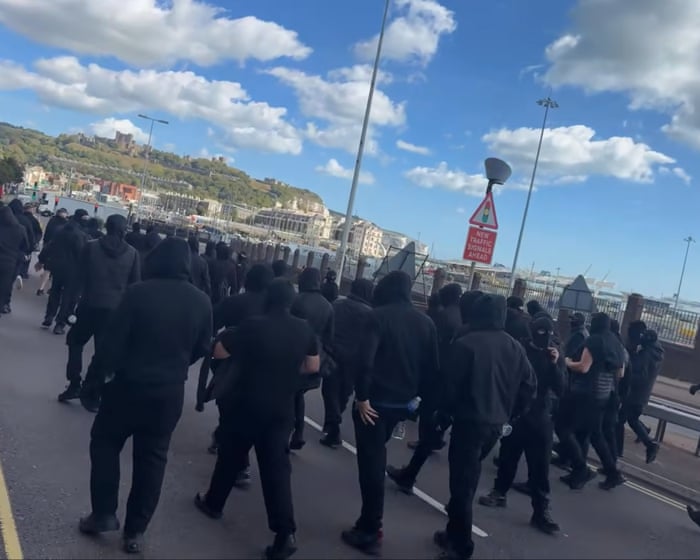
A group of black-clad protesters blocked roads near the Port of Dover, causing traffic delays and disruption on Saturday. A government minister and local MP criticized the protest for disrupting daily life, while police managed the situation without making arrests.
Key Facts
Dozens of protesters dressed in black and wearing masks blocked the A20 road near Dover.
Protesters chanted slogans like “stop the boats” and “England till I die.”
The protest was linked to Patriot Platform, an anti-immigration group with far-right connections.
Traffic was delayed by up to 45 minutes, with congestion stretching about four miles.
Kent police attended the protest, which ended by lunchtime with no arrests.
Business Secretary Jonathan Reynolds said peaceful protest is important but criticized the disruptive tactics and costumes.
Labour MP Mike Tapp raised concerns about police preparedness and called for more officers if similar protests occur again.
The Port of Dover is important for UK trade, handling about one-third of goods moving between the UK and the EU.
Read the Original
Want the full story? Tap a source to open the original
article.
Palestinians in northern Gaza held funerals for about 100 people, including 60 children, whose remains were found in rubble from destroyed buildings. Rescue teams have recovered these remains after weeks of digging, but many more bodies are still believed to be trapped under the ruins, with recovery efforts slowed by a lack of equipment.
Key Facts
Around 100 people’s remains, including 60 children, were recovered in Gaza’s Zeitoun neighborhood.
The remains were carried by families to a central cemetery for burial.
Many victims were from the Malaka family, which lost 55 members.
Recovery crews face delays due to limited heavy machinery and protective gear.
About 8,000 bodies are estimated to still be under rubble in Gaza.
Rescue teams rely on local families to help identify remains and document findings.
Some areas with bodies are under Israeli military control, making access difficult.
Gaza’s Health Ministry says over 73,000 Palestinians have died since the conflict began in October 2023.
Read the Original
Want the full story? Tap a source to open the original
article.
The Royal Navy's aircraft carrier HMS Queen Elizabeth has left Portsmouth to take part in a three-month training mission around the UK and northern Europe. This is the first time the ship will serve as NATO's command ship for the Allied Response Force, practicing how allied navies would work together during a crisis.
Key Facts
HMS Queen Elizabeth weighs 65,000 tonnes and was commissioned in 2017.
The ship left Portsmouth Naval Base at about 18:20 BST on a Saturday evening.
More than 800 sailors are on board for the training mission.
The deployment will last around three months and focus on intensive training exercises.
HMS Queen Elizabeth is now NATO’s command ship for the Allied Response Force, a role it received in July 2025.
The training will prepare the ship and crew to work effectively with allied naval forces in emergencies.
The carrier will soon replace its sister ship HMS Prince of Wales as the Royal Navy’s high-readiness aircraft carrier.
Families and friends waved goodbye to the ship, and the Navy supports personnel and their families during deployments.
Read the Original
Want the full story? Tap a source to open the original
article.
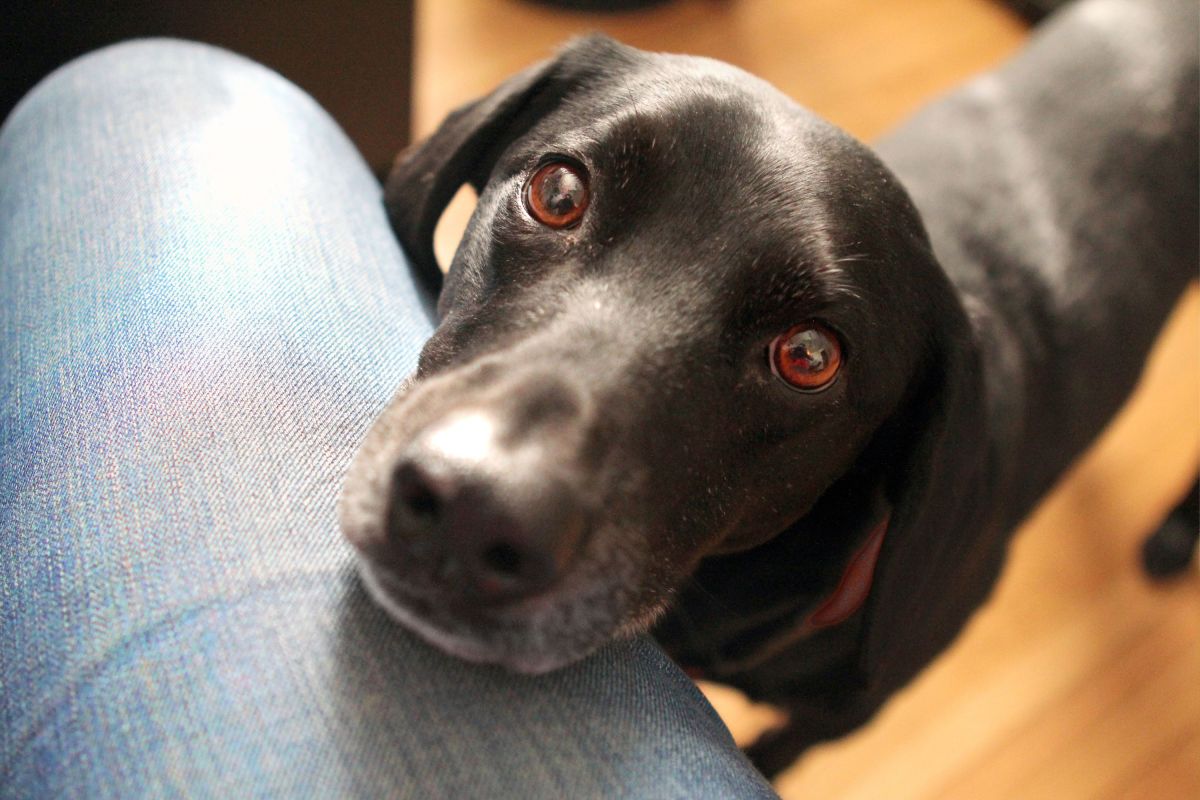
Dogs are very good at noticing changes in their owner's mood, even if the owner tries to hide it. Research shows dogs can sense stress through changes in breath, sweat, and behavior, which can affect how dogs act around their owners.
Key Facts
Dogs notice subtle changes in facial expressions, voice, scent, and body language.
Dogs may become clingy, restless, fearful, or hard to handle when they sense their owner's stress.
Veterinary surgeon Mathieu Glassman sees dogs behave differently when separated from stressed owners during exams.
A 2022 study found dogs can detect stress from human breath and sweat with about 94% accuracy.
Dogs’ physiological responses, like heart rate and hormone levels, can be linked to their owners' stress levels.
Dogs respond to physical and behavioral signals, not necessarily the owner's emotions themselves.
Changes in a dog's normal behavior may indicate it is reacting to owner stress but could also signal illness or other factors.
Owners should observe behavior changes in the context of overall health and timing with stressful events.
Read the Original
Want the full story? Tap a source to open the original
article.
Hundreds of masked protesters blocked roads and access to the Port of Dover for several hours, chanting against migrants arriving by boat. Local council leader Kevin Mills said the police were slow to respond, while a government minister said officers acted quickly and condemned the protest as intimidating.
Key Facts
The protest at the Port of Dover lasted from about 7:00 AM to 11:30 AM.
Hundreds of masked men chanted slogans such as "stop the boats."
The protest caused long traffic jams and blocked port access.
Dover District Council leader Kevin Mills said police were slow to keep roads open.
The police have not publicly identified who organized the protest.
Anti-hate group Hope Not Hate said a network called Patriot Platform arranged the event.
Government minister Jonathan Reynolds said the protest was not peaceful and criticized far-right figures supporting it.
The protest aimed to stop small boats carrying migrants to the UK.
Read the Original
Want the full story? Tap a source to open the original
article.
Israeli settlers have been placing many Israeli flags along roads in the occupied West Bank, especially near Jenin, as a way to show control over the land. This is part of a larger effort that includes setting up new settlements and changing the landscape, which affects Palestinians who live and travel there.
Key Facts
Israeli flags have been placed along major roads in the West Bank, including near Jenin and Nablus.
Palestinians feel these flags and new settler homes change the familiar landscape and highlight Israeli control.
The flag displays often happen alongside military actions that protect settlers.
Illegal Israeli settlements are being set up on Palestinian land with government support.
Since October 7, 2023, violence has increased, with over 1,100 Palestinians killed and many villages displaced.
The Israeli government reviewed plans for more settlement expansions in early 2026.
The settlements and flag displays create challenges for Palestinian movement and identity.
This expansion threatens the possibility of a future Palestinian state by dividing the West Bank.
Read the Original
Want the full story? Tap a source to open the original
article.
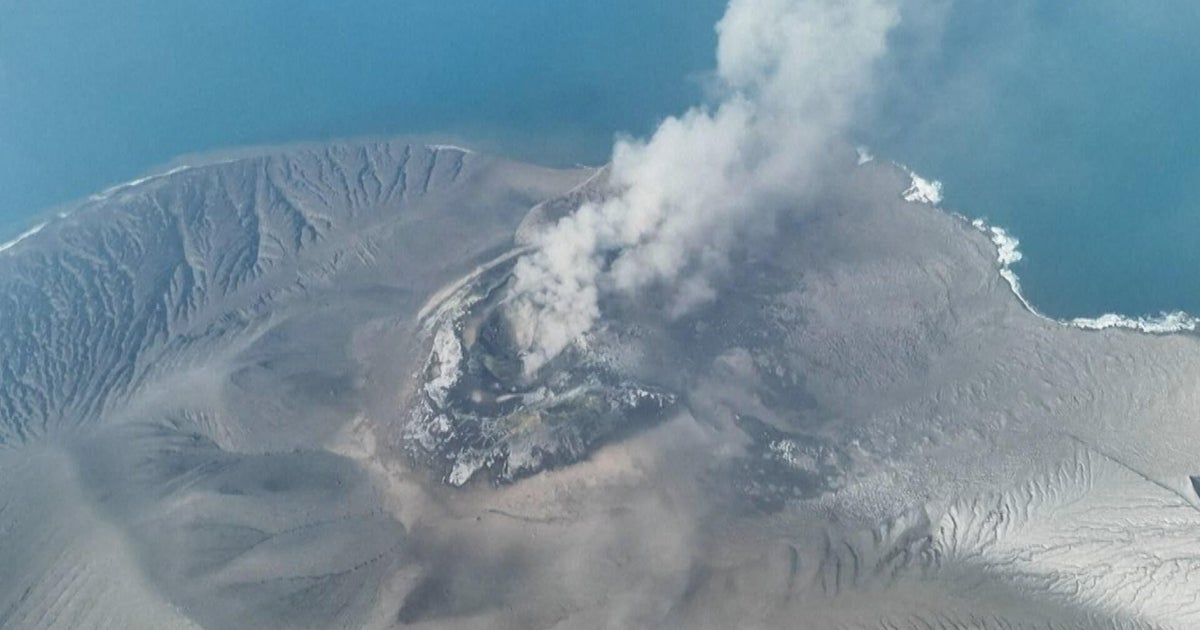
A volcano called Anak Krakatau in Indonesia erupted on Sunday, causing volcanic ash to spread over parts of the country. This made authorities close several airports and cancel many flights to keep people safe, but no injuries or evacuations were reported.
Key Facts
Anak Krakatau is a volcanic island located between Java and Sumatra islands in Indonesia.
The volcano erupted for about 30 seconds early Sunday morning after showing activity since Friday.
Volcanic ash spread over Jakarta and Lampung province, affecting air quality.
Airports in Jakarta and Lampung, including Soekarno-Hatta and Halim Perdanakusuma, were closed due to ash in the air.
More than 500 flights were canceled, impacting around 22,800 passengers at Jakarta's main airport alone.
Authorities advised people to stay at least 2 miles away from the volcano crater.
No casualties or evacuations were reported because nearby towns are more than 10 miles from the volcano.
Anak Krakatau is a "child" of the larger Krakatau volcano, which famously erupted in 1883 and caused a global climate effect.
The 2018 Anak Krakatau eruption caused a tsunami that killed over 400 people and significantly reduced the size of the island.
Read the Original
Want the full story? Tap a source to open the original
article.
Israeli air attacks on southern Lebanon killed at least four people and injured 20 despite a truce. Israel said the strikes targeted Hezbollah after the group launched drones toward Israeli forces, while Lebanon reported damage and casualties from the recent attacks.
Key Facts
Israeli air strikes hit several towns in southern Lebanon, including Nabatieh and Arab Salim.
At least four people were killed and 20 wounded in the attacks.
Israel said it attacked Hezbollah targets after drones were launched at its forces.
Lebanon’s Health Ministry and National News Agency reported damage to homes, historical buildings, and a municipal park.
Israeli forces operate inside a “security zone” about 10 km inside Lebanon.
The number of attacks decreased after US-Iran agreements in June, but strikes continue.
Israel plans to potentially pull back troops closer to its border, creating a new “Grey Line.”
Qatar is urging both sides to reduce tensions through diplomatic talks.
Read the Original
Want the full story? Tap a source to open the original
article.
Chris Nicks, the brother of Fleetwood Mac singer Stevie Nicks, died at age 72 after a private battle with cancer. He was involved in supporting Stevie’s music career and was remembered fondly by family and the Fleetwood Mac community.
Key Facts
Chris Nicks passed away on September 4 at the age of 72.
He battled cancer privately for about two and a half years.
Nicks was Stevie Nicks’ younger brother and worked behind the scenes in her solo tours.
He introduced Stevie before concerts and worked on merchandise for her tours.
Chris appeared in some of Stevie’s music videos and co-wrote a song on her 1985 album.
Mick Fleetwood and other family members paid tribute to him after his death.
Chris is survived by his daughter Nixi, son-in-law Alec, grandchildren, his former wife Lori, and sister Stevie Nicks.
He remained closely connected to Fleetwood Mac though never an official band member.
Read the Original
Want the full story? Tap a source to open the original
article.
Search teams in Nepal are working for the 12th day after severe floods hit the country. Despite difficult conditions, rescuers saved four survivors, but the floods damaged roads and other important infrastructure.
Key Facts
Floods in Nepal caused major destruction and loss of life.
Rescue operations have been ongoing for 12 days.
Four survivors have been rescued during the search efforts.
The flooding harmed roads and other infrastructure, making rescue work harder.
The situation remains challenging for rescuers due to weather and terrain.
A Chinese national was also rescued from a tunnel 10 days after a flash flood.
The floods have attracted international attention and support efforts.
Read the Original
Want the full story? Tap a source to open the original
article.