A common drug used to treat constipation, prucalopride, may help improve memory, attention, and thinking speed in people who have recovered from depression but still experience mental fog. A small study in the UK showed that people who took the drug performed better on cognitive tests than those who took a placebo.
Key Facts
Prucalopride is a drug normally used to treat chronic constipation.
The drug activates a serotonin receptor found in both the gut and brain.
Serotonin affects digestion and brain function, so researchers tested if the drug could improve thinking skills.
The study involved 50 adults who had recovered from depression at least six months earlier and were not on medication.
Participants took either 2mg of prucalopride or a placebo for 7 to 10 days.
Those who took prucalopride showed faster and more accurate performance on memory, attention, processing speed, and planning tests.
Researchers say the results are promising but preliminary, requiring larger studies for confirmation.
The study did not test people currently experiencing depression or on antidepressants.
Read the Original
Want the full story? Tap a source to open the original
article.
Ars Technica is hiring a full-time senior technology reporter who enjoys working hands-on with hardware and software. The job focuses on writing about operating systems, devices, and technology like CPUs, storage, and open-source solutions, and it allows remote work with occasional travel.
Key Facts
The position is for an experienced writer with a strong technology background.
Topics include desktop and mobile operating systems such as Windows, macOS, Linux, iOS, and Android.
Coverage also includes devices like desktops, laptops, and mobile phones.
The role involves writing about hardware parts like CPUs and GPUs and storage technologies such as NAS and solid-state drives.
Open-source software and self-hosting technologies are important subjects for this job.
It is a full-time position with benefits, requiring eligibility to work in the United States.
The job is mainly remote, with 4 to 5 trips per year and an annual in-person meeting.
The position aims to be filled by August 2024.
Read the Original
Want the full story? Tap a source to open the original
article.
Search engines like Google are now using artificial intelligence (AI) to provide answers directly within search results, changing how people find information online. This shift means companies need to use both traditional search engine optimization (SEO) and a newer approach called generative engine optimization (GEO) to improve their online visibility.
Key Facts
For 20 years, ranking high on Google’s search results was the main way to get website traffic.
Increasingly, search results include AI-generated answers from systems like Google AI and ChatGPT.
Generative engine optimization (GEO) is a way to create content that AI systems can find, trust, and cite.
GEO works alongside SEO, using similar principles like authority, clear structure, and answering real questions.
AI favors content that gives clear, direct answers early in the text and sounds natural and knowledgeable.
Writing only for traditional SEO (focused on keywords) is less effective because AI values clarity and credibility.
Companies successful in this new environment provide evidence-backed content and maintain a presence across multiple trusted sources.
A Chicago-based marketing agency, Simple SEO Group, uses a combined SEO and AI strategy to help brands appear both in traditional search results and AI-generated answers.
Read the Original
Want the full story? Tap a source to open the original
article.
Amazon Web Services (AWS) accidentally sent customers huge billing amounts, some as high as $1.5 trillion, due to a technical glitch. The problem caused alarm worldwide, affecting users from charities to students, before AWS identified the issue and began fixing it.
Key Facts
AWS billing system showed bills much higher than normal, reaching up to $1.5 trillion.
Customers usually pay small amounts, often less than a few dollars a month.
The glitch started around 3:38 am UK time on a Friday.
AWS investigated for about 1.5 hours and found an error in the pricing calculation system.
The company paused the billing estimation system and said it would take hours to fully fix.
People around the world expressed shock and concern on social media.
AWS apologized for the confusion caused by the incorrect bills.
The incident showed how many rely heavily on AWS for data and cloud services.
Read the Original
Want the full story? Tap a source to open the original
article.
Scientists at Pennsylvania State University discovered a tiny structure inside brain cells called the membrane-associated periodic skeleton (MPS). This structure controls what brain cells absorb and may play a key role in Alzheimer's disease by influencing the buildup of harmful proteins.
Key Facts
The MPS is a lattice-like structure made of protein rings found just beneath the surface of neurons.
It regulates endocytosis, the process by which brain cells take in nutrients and molecules from their surroundings.
Using advanced microscopy, researchers showed that damaging the MPS causes neurons to absorb material too quickly.
Faster absorption weakens the MPS further, creating a cycle of damage and increased uptake.
In neurons engineered to produce more amyloid precursor protein (APP), MPS damage sped up the intake of APP, which is linked to Alzheimer's disease.
Breakdown of the MPS leads to more toxic amyloid-beta 42 buildup, causing neuron death.
The MPS deteriorates with age and disease, which may worsen neurodegeneration.
Researchers believe stabilizing the MPS could help slow diseases like Alzheimer's.
Read the Original
Want the full story? Tap a source to open the original
article.
Apple became the world’s most valuable company again, surpassing Nvidia after a shift in investor interest related to artificial intelligence (AI). Nvidia, which was the first to reach a $5 trillion market value, fell slightly, while Apple’s value steadied at $4.88 trillion.
Key Facts
Apple’s market value reached $4.88 trillion, overtaking Nvidia’s $4.86 trillion.
Nvidia was the first company to hit a $5 trillion value in October but saw its shares drop by 3.5%.
Investors are now looking beyond Nvidia as the main AI beneficiary and are showing more interest in Apple.
Apple recently upgraded its AI assistant, Siri, aiming to compete better in the AI field.
Tim Cook will step down as Apple’s CEO in September, handing over to John Ternus.
Nvidia remains a key player in AI technology with its graphics processors powering many AI applications.
The semiconductor industry has seen growth beyond Nvidia and Apple, including companies like Micron and SK Hynix.
The chip market experienced a decline in July as investors questioned the long-term growth of AI-related stocks.
Read the Original
Want the full story? Tap a source to open the original
article.
A quiz created by an identity verification company shows that people find it very hard to tell real images and videos from those made by artificial intelligence (AI). Even experts struggle to spot the difference because AI has become very good at creating realistic visuals.
Key Facts
A quiz tested a consumer investigator’s ability to tell real images from AI-made ones, with only 3 out of 12 correct answers.
The average accuracy for Americans in identifying AI-generated deepfakes is about 50%, like flipping a coin.
AI technology has improved, removing obvious errors like distorted fingers or unnatural eyes that once helped spot fakes.
People can look for subtle signs such as mismatched earrings, unusual textures, or strange movement in videos to identify deepfakes.
After learning what to watch for, the investigator improved her score to 8 out of 12.
Even AI experts cannot identify all fake images correctly without special detection tools.
Experts advise using AI detection software or verification apps instead of trusting only visual inspection.
The main message is that “seeing is no longer believing” when it comes to images and videos.
Read the Original
Want the full story? Tap a source to open the original
article.
Scientists have discovered an experimental drug called KCL-286 that may help treat Alzheimer's disease by repairing brain cell DNA and reducing inflammation. Tests in mice show promise, and the drug has passed early human safety trials, but more funding is needed to start testing it in Alzheimer's patients.
Key Facts
KCL-286 is an oral drug developed by King's College London researchers.
It helps fix DNA damage in brain cells and lowers inflammation linked to Alzheimer's.
The drug activates a protein (RARβ) that starts DNA repair processes.
KCL-286 also increases BRCA1 protein levels, important for repairing DNA.
The drug improved brain immune and support cells in a mouse Alzheimer's model.
It has finished Phase I safety trials in healthy humans.
A small trial in Alzheimer's patients could begin soon if funding is found.
Current treatments mostly target amyloid proteins, but KCL-286 uses a different approach by helping brain cells fix themselves.
Read the Original
Want the full story? Tap a source to open the original
article.
The world's first free-combat tournament for full-sized humanoid robots began in Shenzhen, China. During the event, a robot named "Matador" lost its head but kept fighting before eventually collapsing. The competition uses EngineAI's T800 robots and aims to promote robotics innovation and global teamwork.
Key Facts
The tournament is called the Ultimate Robot Knock-out Legend (URKL).
It started in Shenzhen, China, with 32 teams from around the world participating.
Robots use the EngineAI T800 model, about 173 cm tall with 29 movable joints.
The T800 robot can perform complex fighting moves like punches and kicks.
One robot, "Matador," lost its head during a fight but continued moving before falling.
The winning team receives a gold championship belt worth $1.44 million (10 million yuan).
The tournament runs in stages from July to December 2026.
EngineAI’s goal is to encourage technological progress, teamwork across countries, and professional robotic contests.
Read the Original
Want the full story? Tap a source to open the original
article.
Meta has developed smart glasses with cameras and AI features that raise privacy and safety concerns. Celebrities like Kylie Jenner are promoting these glasses, but many worry about misuse, such as secret recording and facial recognition without consent.
Key Facts
Meta’s smart glasses include cameras visible on the frames and an LED light that is supposed to alert others when recording.
Some users have reported harassment and unauthorized recording, especially targeting women.
Meta states their glasses have tamper detection to prevent hiding the recording light, but some victims did not notice any light.
There are social media tutorials on how to bypass the glasses’ recording light warning.
Meta has added a face-recognition feature called “NameTag” that identifies people using AI and biometric data.
Experts worry this technology could be used by stalkers or governments for intrusive surveillance.
Despite concerns, celebrities like Kylie Jenner are endorsing the glasses to promote the product.
Read the Original
Want the full story? Tap a source to open the original
article.
Artificial intelligence (AI) is being used in schools faster than rules and guidelines are being made to control it. Experts warn that schools need clear policies and protections to help AI improve learning safely and to address how AI affects children's behavior and emotions.
Key Facts
Less than 10% of schools and universities have official rules on using AI tools, despite rapid growth in its use.
UNESCO says the main challenge is how to govern AI in education, not whether AI should be used.
Current rules don’t cover new risks like student data privacy and how AI affects children's feelings and decision-making.
AI systems can interact like humans, remembering conversations and showing empathy, which influences children beyond traditional teaching tools.
Schools are collecting large amounts of personal and behavioral data from students, often without strong safety measures.
Education experts stress that safety and ethics must be included from the start when designing AI tools for learning.
AI speeds up existing pressures in education, like grading and lesson planning, without solving deeper problems.
Experts argue that AI literacy should include understanding how AI forms relationships and affects emotions, not just technical skills.
Read the Original
Want the full story? Tap a source to open the original
article.
Convochat is a new social media platform that combines sports, pop culture, and lifestyle content in one place. It uses AI technology to create a space where fans can discuss sports, celebrities, and trends together, reflecting how these topics are now closely connected.
Key Facts
The global sports industry is valued at $2.3 trillion.
Sports events often feature celebrities, which increases social media engagement.
Convochat was created by Marc Ettrick, a former football player and sports agent.
Ettrick observed that sports and entertainment are merging into one cultural conversation.
The platform offers both blog-style discussions and short videos for user interaction.
Convochat includes content on restaurants, travel, nightlife, and fashion related to sports and celebrity lifestyles.
Users join Convochat to follow breaking news, trending stories, and community reactions.
The platform encourages user participation and calls its style “infotainment,” blending information with entertainment in a fast social media format.
Read the Original
Want the full story? Tap a source to open the original
article.
Lucid Motors released the 2026 Gravity Touring, an electric SUV starting at about $82,000 in the US. This model offers 560 horsepower, a driving range of around 337 miles, and supports fast charging at Tesla Superchargers using plug-and-charge technology.
Key Facts
The 2026 Gravity Touring starts at about $82,000, with the test model priced at $107,200 after adding options.
It uses a 16-module, 89-kWh battery pack, providing an EPA-estimated range of 337 miles.
The SUV produces 560 horsepower from two electric motors (one in front and one in the rear).
The Grand Touring version offers more power (828 hp) and a longer range (407 miles) with a 123 kWh battery.
The Gravity SUV supports charging at Tesla Superchargers through the NACS port and plug-and-charge technology, enabling easy and fast charging.
Charging from 15% to 95% takes about 31 minutes on compatible fast chargers.
The vehicle includes an optional advanced driver assistance system called Dream Drive 2.0 Pro with features like hands-free driving assist and automatic lane changes.
Additional features can include luxury seating, a 22-speaker audio system, rear-wheel steering, and air suspension for better handling.
Read the Original
Want the full story? Tap a source to open the original
article.
India's Skyroot Aerospace will launch its Vikram-1 rocket for the first time on July 18, aiming to reach low-Earth orbit with small satellites. Meanwhile, Japan's space agency successfully tested a reusable rocket that took off, moved horizontally, and landed safely. Additionally, new private space launch facilities are being developed in Australia, and China recovered a reusable rocket booster.
Key Facts
Vikram-1 is India's first commercial rocket designed to carry up to 350 kg to a 450 km orbit at 60 degrees inclination.
The launch date for Vikram-1 is set for July 18 at 11:30 am local time in India.
The rocket will carry technology demonstration payloads from several companies and artwork pieces.
Japan’s space agency JAXA tested a reusable rocket called RV-X that reached 11 meters in height, moved 16 meters horizontally, and landed after 40 seconds.
JAXA plans to use the test data to develop a reusable rocket in collaboration with French and German research groups.
Spinifex Space, a new Australian company, was formed to provide launch sites, licenses, and test facilities for suborbital rockets but does not build rockets itself.
China’s state-owned rocket developer recovered a reusable orbital-class booster from its Long March rocket family.
SpaceX experienced an engine failure at launch ignition with its Starship vehicle in Texas, delaying its flight attempt.
Read the Original
Want the full story? Tap a source to open the original
article.
A new study from MIT shows that a ketogenic diet, which is high in fat and low in carbohydrates, may increase the risk of tumors in the small intestine in mice prone to intestinal cancer. The research found that the high fat content, not the ketones produced by the diet, activated a pathway that fueled tumor growth.
Key Facts
The ketogenic diet reduces carbs and forces the body to burn fat for energy, producing ketone bodies.
It was first used to treat epilepsy and is now popular for weight loss and blood sugar control.
The study used mice genetically likely to develop intestinal cancer to test the diet’s effects.
Mice on the ketogenic diet developed more small-intestine tumors than those on regular or high-fat, high-calorie diets.
The tumor growth was linked to the fats in the diet activating a cell pathway called PPAR-delta.
This pathway affects intestinal stem cells, which renew the gut lining but can also start tumors if mutated.
The results were seen in mice and may not directly apply to healthy humans.
Researchers say more studies are needed to understand how ketogenic diets affect cancer risk in people.
Read the Original
Want the full story? Tap a source to open the original
article.
A Chinese AI model called Kimi K3 has matched and even surpassed some leading American AI models while costing less. This challenges the idea that the U.S. is far ahead in advanced AI and may change the global AI competition.
Key Facts
Kimi K3 is a new AI model developed by Beijing-based Moonshot AI.
It performed better than top U.S. AI models like Anthropic's Fable 5 and OpenAI's GPT-5.6 in coding tests.
Kimi costs about 40% less than comparable U.S. AI models.
Moonshot plans to release Kimi as an open-weight model on July 27, letting users customize and run it themselves.
Earlier estimates said China was 6 to 12 months behind the U.S. in AI development, but Kimi shows the gap is closing fast.
Chinese AI labs may be using large amounts of American AI data to train their models.
China has obtained some restricted Nvidia chips through smuggling, despite U.S. efforts to limit access.
U.S. AI companies are developing newer models like GPT 6 and Claude Opus 5 to regain lead.
The U.S. government faces tough decisions balancing AI safety regulation and maintaining global competitiveness.
Read the Original
Want the full story? Tap a source to open the original
article.
A new study from the University of Virginia found that an unhealthy gut can cause bile acids to build up, which may help breast cancer spread in the body. Researchers hope this discovery will lead to new ways to prevent breast cancer from spreading and improve patient survival.
Key Facts
The study focused on hormone receptor-positive (HR+) breast cancer, the most common type that spreads to other parts of the body.
When the gut microbiome is unbalanced, bile acid levels become uncontrolled, affecting metabolism and the immune system.
An unhealthy gut environment helps breast cancer tumors spread more easily.
There are about 225,000 new HR+ breast cancer cases yearly in American women.
The researchers suggest that medications called bile acid sequestrants, already approved for metabolic diseases, might reduce cancer spread.
Higher bile acid levels and insulin resistance were linked to lower survival rates in HR+ breast cancer patients.
Some patients taking bile acid-suppressing drugs lived longer, but more research is needed to confirm the benefits.
The team is studying if these drugs can prevent cancer spread and exploring immune system effects related to bile acids.
Read the Original
Want the full story? Tap a source to open the original
article.
Many fans traveled long distances to watch Christopher Nolan’s new film, The Odyssey, at the BFI Imax cinema in London. The movie is the first to be shot entirely on the highest-quality Imax 1570 film format, using large, specialized cameras.
Key Facts
The Odyssey is based on Homer’s epic poem about Odysseus’s journey.
Fans came from places like Atlanta, Switzerland, and Ireland to see the film in London.
The film was shot entirely with Imax 1570 cameras, the highest-resolution format available.
The large cameras each weigh 180kg, and special soundproofing was developed to record dialogue.
The movie has a budget of about $250 million (£186 million).
It is expected to earn $80 million to $100 million in North America during its opening weekend.
Early reviews are very positive, with a 96-99% rating on Rotten Tomatoes.
Fans express admiration for Nolan’s filmmaking and have high expectations for The Odyssey.
Read the Original
Want the full story? Tap a source to open the original
article.
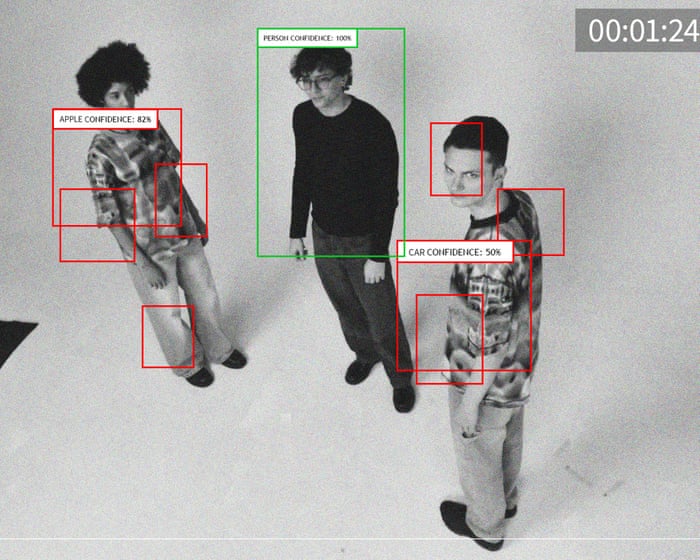
Clothing designers are creating garments with special patterns that aim to confuse facial recognition systems used in public spaces. These "adversarial clothing" designs use shapes and colors to make it harder for computer algorithms to identify people, raising awareness about privacy and surveillance concerns.
Key Facts
Facial recognition technology is increasingly used in public areas across Britain.
“Adversarial clothing” uses patterns that try to trick facial recognition software.
Advances in computing have made it easier to produce such garments for everyday consumers.
The effectiveness of these patterns depends on the type of surveillance system and the settings.
Experts warn that no design can fully guarantee protection from facial recognition.
Some garments incorporate features like infrared LEDs to confuse night-vision cameras.
There are concerns that facial recognition often misidentifies Black and Asian people more than white people.
Public worry about surveillance is growing, with nearly 60% fearing it may lead to a “surveillance society.”
Read the Original
Want the full story? Tap a source to open the original
article.
Scientists have discovered how a toxin made by a common gut bacterium called Bacteroides fragilis attaches to a protein on colon cells, causing damage that can lead to colorectal cancer. This breakthrough helps explain how some gut bacteria may directly contribute to the development of colon tumors and offers a new way to potentially block the toxin’s harmful effects.
Key Facts
Bacteroides fragilis is a common bacterium found in about 20% of healthy people’s guts.
Only certain strains of this bacterium produce a toxin called BFT linked to colorectal cancer.
The toxin binds to a protein on colon cells called claudin-4 to start damaging the gut lining.
Damage from BFT triggers inflammation, which may lead to tumor growth in the colon.
Researchers used a gene-editing method (CRISPR) to find claudin-4 as the toxin’s attachment point.
Blocking claudin-4 prevented the toxin from harming colon cells in lab tests.
Scientists created a molecular "decoy" that mimics claudin-4 to intercept the toxin and stop damage in animal studies.
Maintaining a healthy diet and lifestyle can help support colon health and reduce cancer risk.
Read the Original
Want the full story? Tap a source to open the original
article.